Have you ever noticed how the sun isn’t just a ball of light in the sky but also a source of inspiration for language? Idioms about the sun are everywhere—from casual conversations to literature, from workplace emails to songs.
But what exactly is an idiom? In simple terms, it’s a phrase whose meaning isn’t obvious from the words themselves. For example, if someone says, “She’s my sunshine,” they don’t literally mean you can see the sun in her hair—they mean she brings happiness and warmth into their life.
Learning idioms about the sun can make your English richer, more colorful, and more native-like. Imagine telling a friend: *“After a tough week, I finally saw the sun break through the clouds”—*doesn’t that sound more expressive than just saying “I’m happy now”? In this article, we’ll explore 20+ sunny idioms, their meanings, how native speakers use them, and ways to sprinkle them naturally into your daily English.
Fun Fact 🌞
Did you know that many sun idioms originated from ancient literature and poetry? Writers often used the sun to symbolize hope, happiness, and power, which is why phrases like “make hay while the sun shines” have lasted hundreds of years.
Sun Idioms Grouped by Emotion & Context
1. Positive Feelings & Happiness
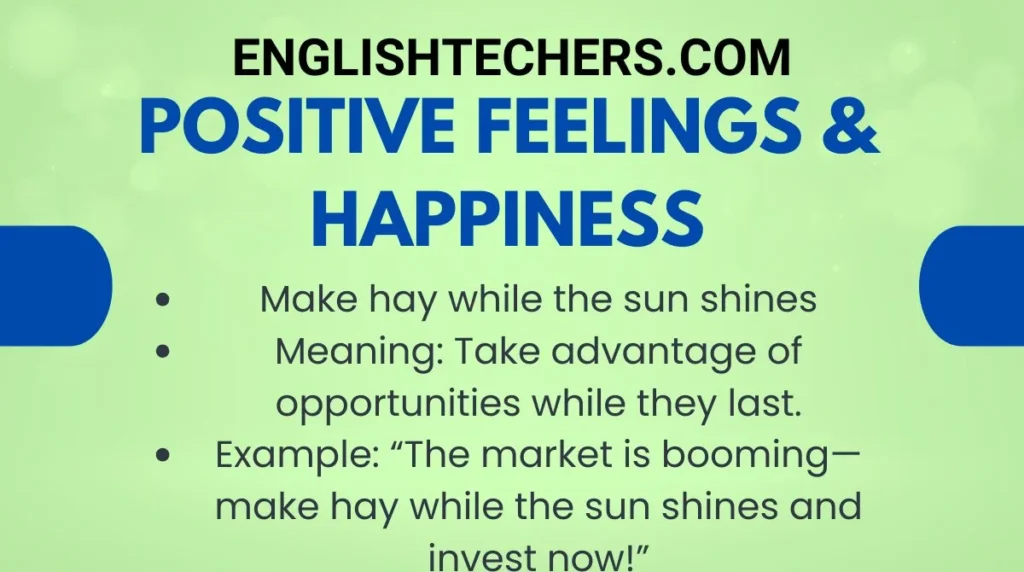
1. Make hay while the sun shines
Meaning: Take advantage of opportunities while they last.
Example: “The market is booming—make hay while the sun shines and invest now!”
2. A ray of sunshine
Dialogue:
- Sarah: “I’m feeling down today.”
- Mike: “Don’t worry, your puppy is a ray of sunshine!”
3. Everything under the sun
Usage: Refers to all kinds of things.
Example: “She has read books about everything under the sun—from astronomy to cooking.”
Mini Cultural Note: In English literature, the sun often represents positivity and clarity. Writers use sun imagery to lighten moods and signal hope.
2. Daily Life / Everyday Usage
4. Soak up the sun
Meaning: Enjoy sunlight, relax.
Example: “After exams, I just want to go to the beach and soak up the sun.”
5. Sun-kissed
Dialogue:
- Emma: “Your skin looks amazing!”
- Lucy: “Thanks! I’ve been sun-kissed at the coast.”
Note: Often used to describe a healthy glow.
6. Rise and shine
Mini Exercise: Fill in the blank:
“Come on, sleepyhead, ________!”
Answer: Rise and shine!
3. Workplace & Professional Contexts
| Idiom | Meaning | Example |
|---|---|---|
| Catch some rays | Take a short break outside | “Let’s catch some rays during lunch break.” |
| Make the sun work for you | Use resources efficiently | “Plan your schedule wisely and make the sun work for you.” |
| Sunset on | End or close something | “It’s time to sunset on this project and start the next.” |
Usage Warning: Avoid literal translation from other languages. For instance, “catch sun” is incorrect in English. Always use native idioms.
4. Heartfelt & Emotional Expressions
7. You are my sunshine
Story: Little Timmy always felt sad after school. One day, his sister said, “Don’t worry, you are my sunshine,” and Timmy smiled all the way home.
8. Under the sun
Usage: Often emphasizes universality.
Example: “She’s experienced everything under the sun in her travels.”
9. Sun will shine again
Dialogue:
- John: “I failed my driving test.”
- Lisa: “Don’t worry, the sun will shine again!”
5. Funny & Creative Twists
10. Sunny side up
Meaning: Optimistic attitude.
Example: “Even after the rainy week, Mark stayed sunny side up.”
11. Sunshine and rainbows
Usage: Often humorous when exaggerated.
Dialogue:
- Kate: “How’s life?”
- Sam: “Oh, just full of sunshine and rainbows—except my car broke down!”
12. Sunstroke of genius
Meaning: A sudden brilliant idea.
Example: “He had a sunstroke of genius and fixed the issue instantly.”
6. Idioms in Literature
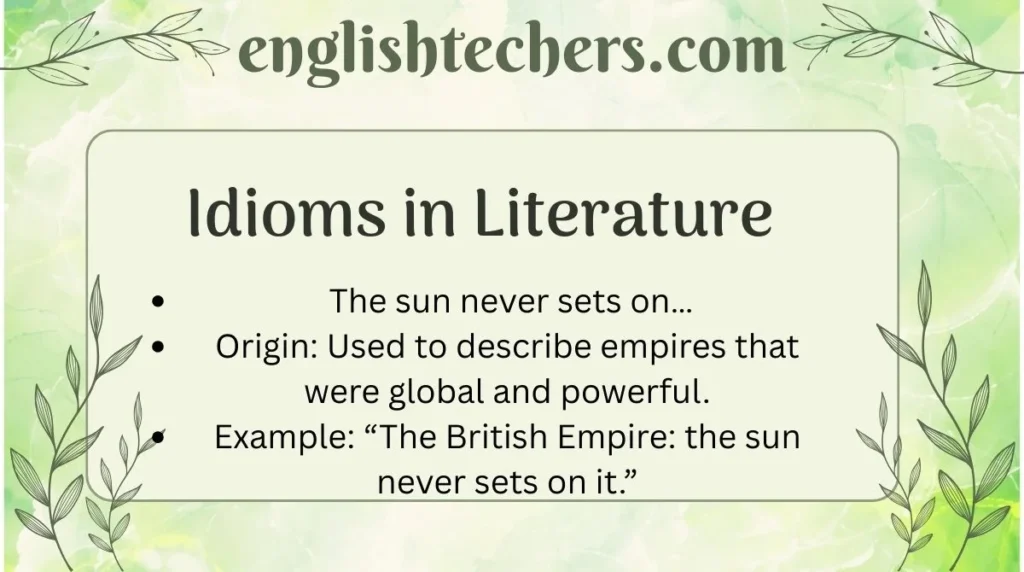
13. The sun never sets on…
Origin: Used to describe empires that were global and powerful.
Example: “The British Empire: the sun never sets on it.”
14. Chasing the sun
Meaning: Pursuing happiness or dreams.
Literature Note: Used in poetry to describe adventurous journeys.
15. Sun-drenched
Usage: Often in novels and descriptive writing.
Example: “The sun-drenched hills of Tuscany were breathtaking.”
7. Exercises / Practice for Learners
Fill in the blanks with the correct idiom:
- “It’s a beautiful day! Let’s ________ at the park.” (soak up the sun)
- “Don’t waste your chance—________!” (make hay while the sun shines)
- “Even after bad news, I stay ________.” (sunny side up)
8. Emotional Scale Table: Mild → Intense
| Intensity | Idiom | Usage Example |
|---|---|---|
| Mild | Ray of sunshine | “She’s a ray of sunshine.” |
| Moderate | Sunny side up | “He remains sunny side up.” |
| Strong | The sun will shine again | “Don’t worry; the sun will shine again.” |
| Extreme | Everything under the sun | “She’s tried everything under the sun.” |
9. How to Use Sun Idioms in Daily Life
- Speaking: Compliment someone: “You are my sunshine!”
- Writing: Emails or letters: “Let’s make hay while the sun shines.”
- Professional: Lighten moods in meetings: “Time to catch some rays during lunch.”
Common Mistakes Learners Make:
- Literal translation (e.g., “catch sun” instead of “catch some rays”)
- Overusing one idiom in a conversation
- Misplacing idioms in formal writing
- Ignoring context—some idioms are casual
- Confusing intensity—sun will shine again is stronger than ray of sunshine
FAQ
1: Are sun idioms the same in all English-speaking countries?
A1: Most are common in the USA and UK, but some phrases may vary culturally.
2: Can I use them in formal writing?
A2: Idioms like make hay while the sun shines are acceptable in semi-formal contexts, but avoid overly casual ones like sunshine and rainbows.
3: How can idioms help in IELTS?
A3: They add color to your speaking and writing, showing advanced vocabulary and natural expression.
4: Are sun idioms used in literature only?
A4: No, they appear in literature, daily conversations, songs, and professional settings.
5: Is it okay to mix multiple idioms in one sentence?
A5: Yes, but don’t overdo it—too many idioms can confuse the listener.
Conclusion
The sun isn’t just in the sky—it’s in our language! By learning and using these 20+ idioms, you can make your English brighter, more expressive, and truly native-like. From casual chats to professional emails, there’s a sunny idiom for every occasion. Start small—use one idiom a day, notice the smiles or raised eyebrows, and gradually sprinkle them naturally into conversations.
Remember, the best way to learn idioms is to practice, enjoy, and let your language shine. So, go ahead—be someone’s ray of sunshine today!

Thomas Reed is an experienced English teacher helping students learn with simple, clear lessons.
He focuses on improving speaking, grammar, and confidence through easy daily practice.