

Ever noticed how languages have a way of making even the simplest tasks sound dramatic, funny, or poetic? Take cleaning, for example.
Beyond sweeping and dusting, English speakers have come up with a treasure trove of idioms for cleaning, each packed with meaning and often a sprinkle of humor.
Whether you’re scrubbing your kitchen or “cleaning up your act,” idioms make your speech colorful, memorable, and natural.
Imagine this: Sarah, a new office worker, was overwhelmed by messy paperwork. Her colleague chuckled, “Don’t worry, just sweep it under the rug for now.” At first, Sarah pictured literally sliding papers under a rug, but soon she realized it meant avoiding the problem temporarily.
Moments like this show why idioms aren’t just fun—they’re keys to understanding real-life English culture.
By learning idioms related to cleaning, learners not only boost vocabulary but also sound more fluent and relatable in conversations. So grab your metaphorical mop, and let’s dive in!
🎉 Fun Fact / Trivia
Did you know that many cleaning idioms have origins in the 16th and 17th centuries? Phrases like “wash your hands of something” come from religious and moral contexts, where physically washing hands symbolized letting go of responsibility. English has been turning everyday chores into colorful expressions for centuries!
15+ Idioms for Cleaning: Contexts & Stories
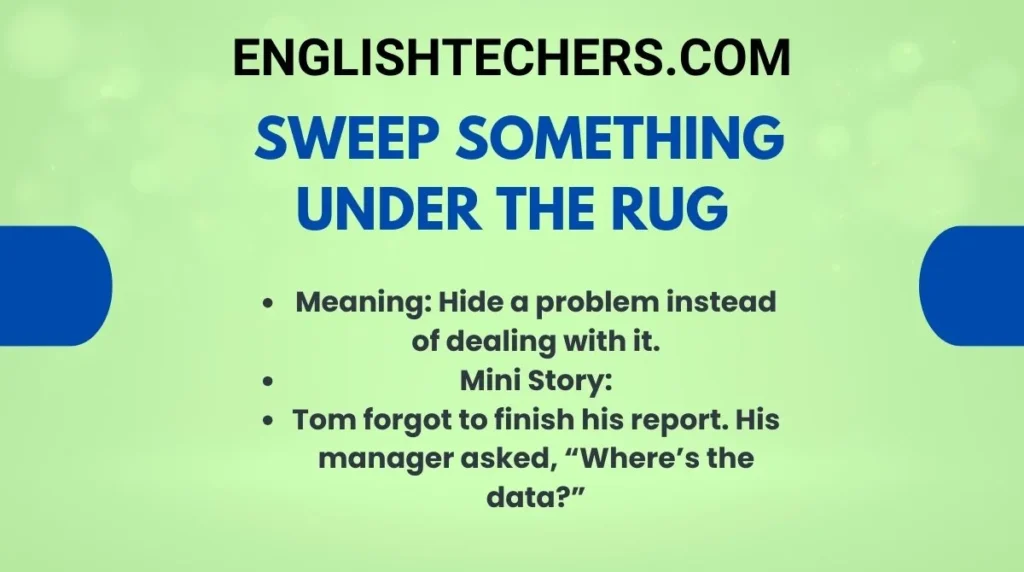
1. Sweep something under the rug
Meaning: Hide a problem instead of dealing with it.
Mini Story:
Tom forgot to finish his report. His manager asked, “Where’s the data?” Tom muttered, “Maybe I can sweep it under the rug until tomorrow.”
Cultural Note: Commonly used in workplaces and politics.
2. Clean slate
Meaning: Starting over without previous mistakes affecting you.
Dialogue Example:
- Jane: “I messed up last project.”
- Mark: “Don’t worry, it’s a clean slate. Let’s start fresh.”
3. Spring cleaning
Meaning: Thorough cleaning, often seasonal; can also mean organizing life.
Mild Humor: “I don’t just spring clean my room—I also delete old emails, dump old friends… kidding!”
4. Polish up
Meaning: Improve something (skills, appearance, work).
Example: She decided to polish up her presentation before the big meeting.
5. Mop up
Meaning: Deal with the aftermath of a problem.
Story: After the messy merger, HR had to mop up complaints from confused employees.
6. Dust off
Meaning: Bring something unused back into action.
Mini Exercise: Fill in: “It’s time to ______ your old guitar and play again.”
Answer: dust off
7. Wash your hands of something
Meaning: Stop being involved; refuse responsibility.
Dialogue:
- Mike: “Are you helping with the prank?”
- Lily: “Nope, I wash my hands of this one.”
8. Spick and span
Meaning: Spotlessly clean.
Funny Twist: “His kitchen is so spick and span, you could eat off the ceiling.”
9. Squeaky clean
Meaning: Very pure, honest, or flawless.
Workplace Note: Often used to describe a person with a perfect reputation.
10. Neaten up
Meaning: Make tidy.
Table of Intensity:
| Level | Idiom | Example |
|---|---|---|
| Mild | Neaten up | “Please neaten up your desk.” |
| Medium | Spick & span | “The hotel room was spick & span.” |
| Strong | Sweep under the rug | “They swept the scandal under the rug.” |
11. Scrub up well
Meaning: Dress up or clean up nicely.
Cultural Note: British English often uses this when talking about appearances before events.
12. Broom closet secret
Meaning: A small, hidden secret or minor scandal.
Mini Story: The office had a broom closet secret: leftover snacks from the CEO’s desk!
13. Tidy up loose ends
Meaning: Finish small unfinished tasks.
Exercise: Complete: “Before leaving, don’t forget to tidy up ____.”
Answer: loose ends
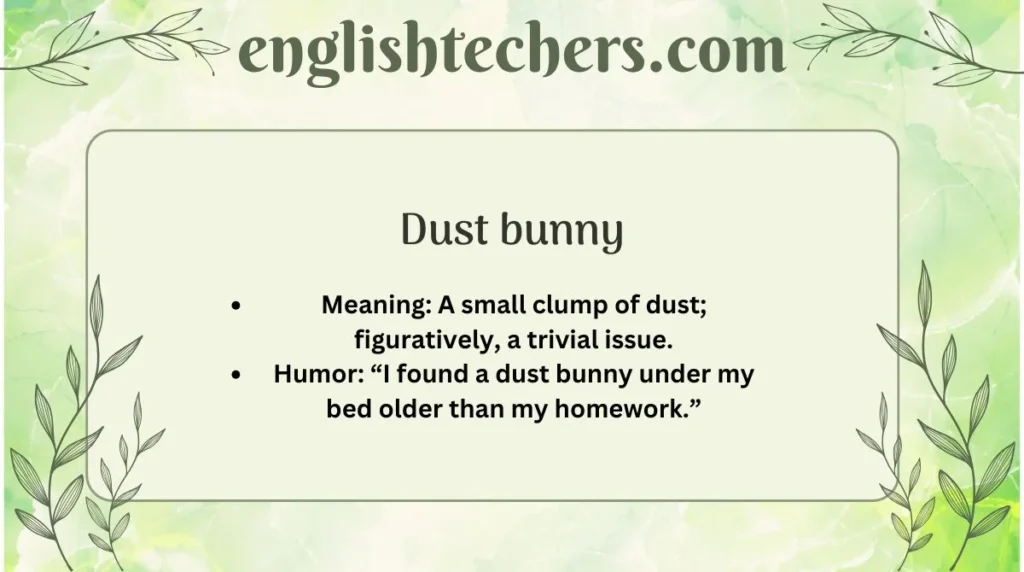
14. Dust bunny
Meaning: A small clump of dust; figuratively, a trivial issue.
Humor: “I found a dust bunny under my bed older than my homework.”
15. Mop the floor with
Meaning: Defeat someone decisively.
Dialogue:
- Coach: “Tonight, we mop the floor with the rivals!”
- Player: “Yes, coach!”
16. Clean up one’s act
Meaning: Improve behavior.
Workplace Tip: Often used in professional or academic settings.
🧠 Idioms by Emotional Context
| Emotion / Situation | Idioms | Usage Example |
|---|---|---|
| Mild Frustration | Neaten up, Dust off | “I need to dust off my old skills.” |
| Stress / Pressure | Mop up, Sweep under the rug | “HR had to mop up after the software crash.” |
| Motivation | Clean slate, Polish up | “It’s a clean slate, go for it!” |
| Humor / Fun | Dust bunny, Broom closet secret | “Found a dust bunny in my fridge!” |
📚 Idioms in Literature & Real Life
- Literature: Dickens often used “wash one’s hands” to explore morality.
- Real Life: Native speakers say, “Let’s tidy up loose ends before the meeting” daily in offices.
💼 Professional / Workplace Idioms
- Clean up one’s act – improve performance.
- Polish up – refine skills or presentation.
- Mop up – resolve lingering issues after projects.
😂 Funny & Creative Idioms
- Dust bunny rebellion – humorously exaggerated mess.
- Sweep it under the unicorn rug – playful twist for social media.
✍️ How to Use Cleaning Idioms in Daily Life
- Speaking: Add idioms in casual chats to sound natural.
- “Let’s sweep this under the rug for now.”
- Writing: Use idioms to make essays or emails lively.
- Professional: Polished idioms like “tidy up loose ends” show fluency.
⚠️ Common Mistakes Learners Make
- Literal translation: Saying “I sweep it under the rug” in non-idiomatic sense.
- Wrong context: Using “dust bunny” for serious problems.
- Overuse: Too many idioms in one paragraph can confuse.
- Formality mismatch: “Broom closet secret” in a formal email sounds odd.
FAQ
1. Are cleaning idioms formal or informal?
Mostly informal, but some like “tidy up loose ends” are workplace-appropriate.
2. Can I use them in writing?
Yes, especially in creative writing, storytelling, or casual essays.
3. Are these idioms universal in English-speaking countries?
Most are understood across US, UK, and Australia, but slangy ones like broom closet secret may vary.
4. Can cleaning idioms appear in IELTS speaking?
Absolutely! They add color and show fluency.
5. How can I practice idioms daily?
- Replace literal words with idioms in your diary.
- Make short dialogues using 2–3 idioms each day.
Conclusion
Idioms for cleaning aren’t just about tidying your home—they help you tidy up your English, make conversations colorful, and even add humor to daily life.
From dust bunnies to clean slates, these expressions give learners the tools to sound like native speakers and navigate social, professional, and literary contexts effortlessly.
So next time you’re mopping, scrubbing, or polishing, remember: your language can shine just as brightly. Start sprinkling these idioms into your speech today and sweep your audience off their feet!

Thomas Reed is an experienced English teacher helping students learn with simple, clear lessons.
He focuses on improving speaking, grammar, and confidence through easy daily practice.