
Idioms are the colorful threads that make any language vibrant and expressive. They let us convey feelings, thoughts, or reactions in ways that plain words often cannot.
Among these, idioms for acceptance are particularly powerful—they help us express agreement, resignation, or coming to terms with life’s twists and turns.
Imagine this: Sarah just missed her flight, and her weekend getaway is ruined. Instead of sulking, she shrugs and says, “Well, c’est la vie!”—a French idiom meaning “that’s life.” Instantly, her frustration softens, and she’s ready to make the best of the situation.
This is the beauty of idioms: they encapsulate complex emotions in a single phrase, making your speech more natural, relatable, and sometimes even humorous.
Whether you’re chatting with friends, writing emails, or reading English literature, knowing idioms for acceptance helps you sound like a native and handle daily situations with emotional finesse.
Fun Fact / Trivia
Did you know? Many idioms for acceptance come from historical events, literature, or everyday life experiences centuries ago. For example, “bite the bullet” comes from soldiers literally biting bullets during surgery to endure pain—now it’s a common idiom for accepting unpleasant situations.
Idioms for Acceptance in Daily Life
Here are 17+ idioms grouped by context and intensity.
1. Mild Upset / Everyday Acceptance
| Idiom | Meaning | Example |
|---|---|---|
| C’est la vie | That’s life | “I forgot my umbrella and got wet—c’est la vie.” |
| So be it | Accept it as it is | “They decided to change the meeting time. So be it.” |
| It is what it is | Cannot be changed | “Our project got delayed—well, it is what it is.” |
Tip: These are perfect for casual conversations when life doesn’t go as planned.
2. Dialogue / Micro-Story Example

Emma: “I studied so hard for the test, but I failed.”
Jake: “Ouch… that sucks.”
Emma: “Yeah, but I guess I’ll just roll with the punches and try again.”
Here, roll with the punches expresses acceptance while implying resilience—common in spoken English.
3. Mild Frustration / Stress
- Take it on the chin – Accept criticism or a setback without complaint.
Example: “He lost the client, but he took it on the chin and started the next pitch confidently.” - Go with the flow – Adapt without resisting.
Mini Tip: Often used in casual, friendly contexts.
Cultural Note: British English speakers frequently use “take it on the chin”, while Americans prefer “roll with it”.
4. Heartbreak / Emotional Acceptance
- Bite the bullet – Accept a difficult or unpleasant situation.
Example: “She decided to bite the bullet and apologize, even though it was awkward.” - Grin and bear it – Endure something unpleasant with patience.
Example: “I don’t like long meetings, but I’ll just grin and bear it.”
Usage Warning: These idioms suggest patience; avoid using them for trivial situations—it can sound sarcastic.
5. Professional / Workplace Acceptance
- Face the music – Accept responsibility for mistakes.
Example: “The report was late, so we had to face the music at the team meeting.” - Play ball – Agree to cooperate.
Example: “Our manager asked us to help with the new system—we decided to play ball.”
Exercise: Write a sentence using face the music about a work scenario you’ve experienced.
6. Literature & Creative Usage
- Let nature take its course – Accept events as they naturally unfold.
Example: Found in novels: “She decided to let nature take its course, waiting patiently for the truth to emerge.” - Go down with flying colors – Sometimes used ironically, meaning accept failure gracefully.
Mini Tip: Literary idioms are often metaphorical and add elegance to your writing.
7. Funny / Lighthearted Acceptance
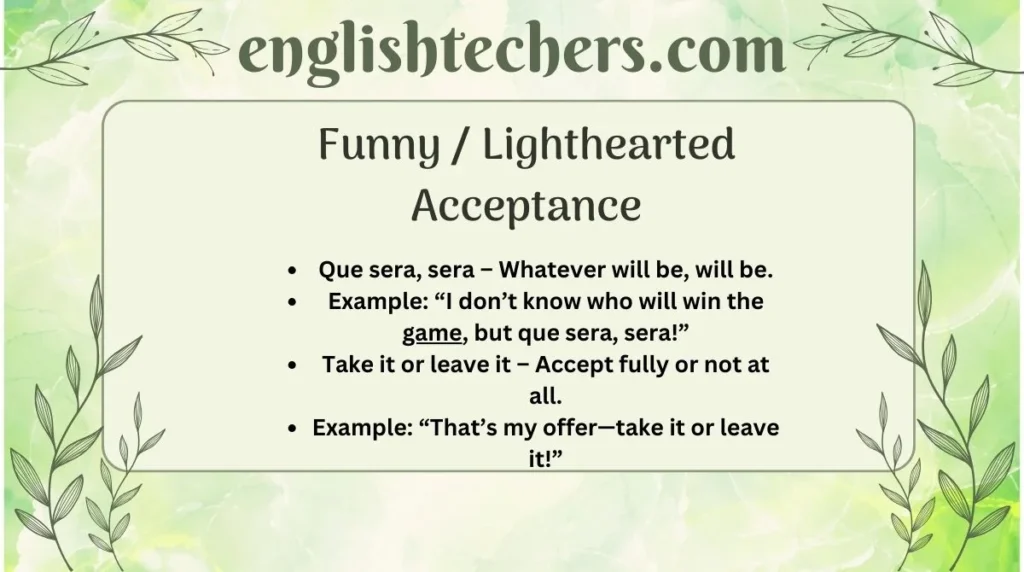
- Que sera, sera – Whatever will be, will be.
Example: “I don’t know who will win the game, but que sera, sera!” - Take it or leave it – Accept fully or not at all.
Example: “That’s my offer—take it or leave it!”
Fun Twist: Using foreign-origin idioms like French or Spanish phrases makes casual English sound playful and cosmopolitan.
8. Exercises / Practice Sentences
Fill in the blanks with the correct idiom:
- I lost my keys again… oh well, _________.
- The manager blamed me for the mistake, but I had to _________ and accept it.
- Our weekend plans were canceled, but we decided to _________ and enjoy a quiet stay-at-home day.
- You can’t change the past, so sometimes you just have to _________.
- The teacher scolded me for the late assignment, so I just _________ and promised to do better next time.
9. Emotional Intensity Table
| Intensity | Idioms |
|---|---|
| Mild | It is what it is, So be it, Go with the flow |
| Moderate | Take it on the chin, Roll with the punches, Grin and bear it |
| High | Bite the bullet, Face the music, Let nature take its course |
This table helps learners choose idioms based on emotional tone—essential for sounding natural.
10. How to Use Idioms in Daily Life
- Speaking: Use idioms in conversations to show emotional intelligence.
- Writing: Sprinkle idioms in emails, stories, or social media posts for color.
- Professional: Stick to mild/moderate intensity idioms to remain polite and formal.
Common Mistakes Learners Make:
- Using idioms too literally.
- Applying informal idioms in formal emails.
- Mixing idioms from different cultures incorrectly.
- Overusing idioms, which can confuse readers.
- Mispronouncing foreign-origin idioms like c’est la vie or que sera, sera.
FAQ
1: Can idioms for acceptance be used in IELTS speaking?
Yes! Using idioms naturally demonstrates advanced vocabulary and fluency, boosting your score.
2: Are acceptance idioms universal?
Not always—some idioms like bite the bullet may be unknown outside English-speaking cultures.
3: What’s the difference between formal and informal usage?
Mild idioms like it is what it is work in both, while slang idioms like roll with it are informal.
4: How do I remember idioms better?
Practice them in mini-stories, dialogues, or daily journaling to reinforce context and emotion.
5: Can idioms replace polite phrases in professional settings?
Sometimes—but use cautiously. Idioms like face the music are safer than humorous ones like que sera, sera.
Conclusion
Idioms for acceptance are more than just fancy phrases—they’re tools to express resilience, patience, and humor in daily life.
From shrugging off minor inconveniences to facing serious challenges, these idioms help you communicate naturally and empathetically.
Start by learning a few, practice them in conversations, and gradually you’ll notice your English sounding more fluent, colorful, and emotionally aware.
So next time life throws a curveball, choose an idiom and embrace it—because sometimes, words are the easiest way to accept what comes your way!

Thomas Reed is an experienced English teacher helping students learn with simple, clear lessons.
He focuses on improving speaking, grammar, and confidence through easy daily practice.