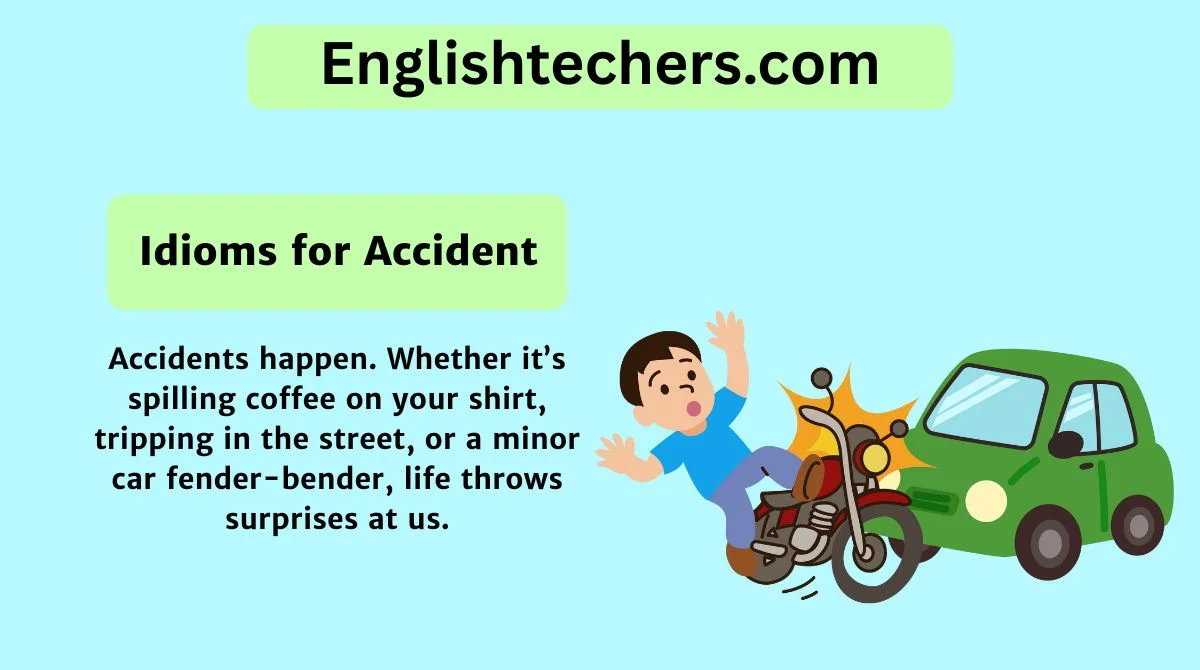
Accidents happen. Whether it’s spilling coffee on your shirt, tripping in the street, or a minor car fender-bender, life throws surprises at us.
But did you know English speakers often describe accidents not just literally, but with idioms—expressions that bring color, humor, or emotion to everyday mishaps? Idioms make your language more natural, lively, and even fun.
Imagine this: Emma was rushing to a meeting when she tripped over her own bag, papers flying everywhere.
Instead of saying, “I had an accident,” a native speaker might chuckle and say, “I really dropped the ball this morning.” Suddenly, the story feels relatable and expressive.
Learning idioms for accidents helps language learners sound like natives, understand movies, books, and even casual chats.
Plus, it’s easier to remember vocabulary when it’s tied to a story, emotion, or humor. Ready to dive into some colorful accident idioms? Let’s go!
🎉 Fun Fact / Trivia
Did you know the idiom “to drop the ball” originally comes from sports? In games like baseball or American football, dropping the ball meant making a mistake or missing an opportunity. Today, we use it for accidents, errors, or minor mishaps in daily life or work.
Idioms Grouped by Emotion & Context
1. Mild Upset / Small Mishaps
a) Drop the ball
- Meaning: Make a mistake or fail in a minor accident.
- Example: “I really dropped the ball when I forgot Sarah’s birthday.”
b) Slip up
- Dialogue:
Tom: Did you send the email to the client?
Anna: Oops… I slipped up and sent it to the wrong address!
c) Fall flat
- Meaning: A plan or action doesn’t go as expected.
- Example: “My attempt to cook a fancy dinner fell flat—the pasta was burnt!”
2. Frustrated / Stressful Accidents
a) Hit a snag
- Mini story:
James was organizing a birthday party, but he hit a snag when the cake delivery got delayed. Sometimes accidents are just unexpected obstacles!
b) Go pear-shaped (UK)
- Meaning: Things go wrong unexpectedly.
- Example: “The camping trip really went pear-shaped when it rained all weekend.”
- Cultural Note: This is common in British English, often humorous.
c) Go off the rails
- Usage Warning: Avoid using this for literal train accidents unless joking! It means plans spiraled out of control.
- Example: “The meeting went off the rails after the projector stopped working.”
3. Heartbroken / Emotional Accidents
a) Break down
- Meaning: Emotional or mechanical failure.
- Example: “She broke down in tears when she lost her wallet.”
b) Crash and burn
- Mini Cultural Note: Often used in both literature and films to describe dramatic failure.
- Example: “His first presentation crashed and burned, but he learned a lot.”
c) Bite the dust
- Dialogue:
Alex: How’s the old car?
Lisa: Unfortunately, it finally bit the dust on the highway.
4. Workplace / Professional Accidents
a) Drop the ball (again, but in office context)
- “I really dropped the ball on the Johnson project—forgot the deadline!”
b) Backfire
- Meaning: A plan or strategy fails unexpectedly.
- Example: “Our marketing idea backfired when the audience misunderstood it.”
c) Go south
- Table format for quick reference:
| Idiom | Meaning | Example | Intensity |
|---|---|---|---|
| Go south | Things worsen | “Sales numbers went south after the launch.” | Medium |
| Blow up | Sudden problem | “The debate blew up during the presentation.” | High |
| Fall through | Plan fails | “The contract fell through at the last minute.” | Mild |
5. Funny / Creative Idioms
a) Throw a wrench in the works
- Meaning: Cause a problem in a plan.
- Example: “The weather threw a wrench in the works for our outdoor party.”
b) Kick the bucket (humorous in accidents context)
- Literal: die, but sometimes jokingly used for minor failures:
- “My phone kicked the bucket after the water spill.”
c) Go control
- Usage: To get frustrated or chaotic after a small accident.
- Example: “He went banana swhen the printer jammed right before the meeting.”
6. Idioms Used by Native Speakers in Real Life
- Pull a fast one – to trick someone; sometimes accidental mistakes count:
“I accidentally pulled a fast one when submitting the wrong report.” - Hit the deck – fall down or take cover:
“During the surprise drill, we all hit the deck.” - Scrape through – survive a close call:
“I scraped through the presentation without embarrassing myself.”
7. Idioms in Literature
- Go up in smoke – used for plans destroyed:
“All her hopes for the summer adventure went up in smoke when the storm hit.” - On thin ice – risky situation:
“He was on thin ice after spilling coffee on his boss’s report.” - Take a tumble – fall, literal or figurative:
“The hero took a tumble but got up stronger.”
8. Exercises for Learners
Fill in the blanks with the correct idiom:
- I completely ________ when I forgot my lines in the play.
- The surprise inspection really ________ for the lazy team.
- He was already nervous, but the microphone failing made him ________.
Answers: 1) dropped the ball, 2) hit a snag, 3) go control
9. Emotional Scale Table: Accidents & Idioms
| Intensity | Idioms | Example |
|---|---|---|
| Mild | Slip up, fall flat | “I slipped up with my homework.” |
| Medium | Hit a snag, backfire | “The plan hit a snag when the car broke down.” |
| High | Crash and burn, go south | “The party crashed and burned due to rain.” |
10. How to Use Idioms in Daily Life
- Speaking: Adds humor and relatability. “I dropped the ball again today!”
- Writing: Shows nuance in emails, blogs, or essays.
- Professional: Subtle idioms like “hit a snag” or “go south” work in business communication.
11. Common Mistakes Learners Make
- Using idioms literally – “I dropped the ball” ≠ literally dropping a ball.
- Mixing contexts – “Crash and burn” for minor slips can be exaggerated.
- Overusing idioms – one per sentence can sound unnatural.
- Confusing UK vs US idioms – “Go pear-shaped” is mostly British.
- Misplacing intensity – “kick the bucket” should be humorous or literal carefully.
FAQ
1: Can I use accident idioms in formal writing?
A: Mostly casual writing; subtle ones like “hit a snag” are acceptable professionally.
2: Are these idioms universal in English-speaking countries?
A: Some are UK-specific, like go pear-shaped, but most are understood globally.
3: How can I remember idioms easily?
A: Tie them to stories, emotions, or visuals for better retention.
4: Can idioms replace literal expressions?
A: Sometimes, but clarity matters. Don’t confuse the listener.
5: Do idioms appear in IELTS or language exams?
A: Yes! Using a few idioms naturally can improve writing and speaking scores.
Conclusion
Idioms for accidents make your English colorful, expressive, and fun. From small slip-ups like dropping the ball to dramatic failures like crash and burn, these expressions let you communicate emotions and mishaps naturally.
Using idioms in conversations, writing, and even professional settings will make you sound like a native speaker while adding humor and relatability.
Practice with stories, dialogues, and exercises, and watch your language skills soar beyond literal phrases. Next time something unexpected happens, don’t just describe it—idiomatize it!

Thomas Reed is an experienced English teacher helping students learn with simple, clear lessons.
He focuses on improving speaking, grammar, and confidence through easy daily practice.