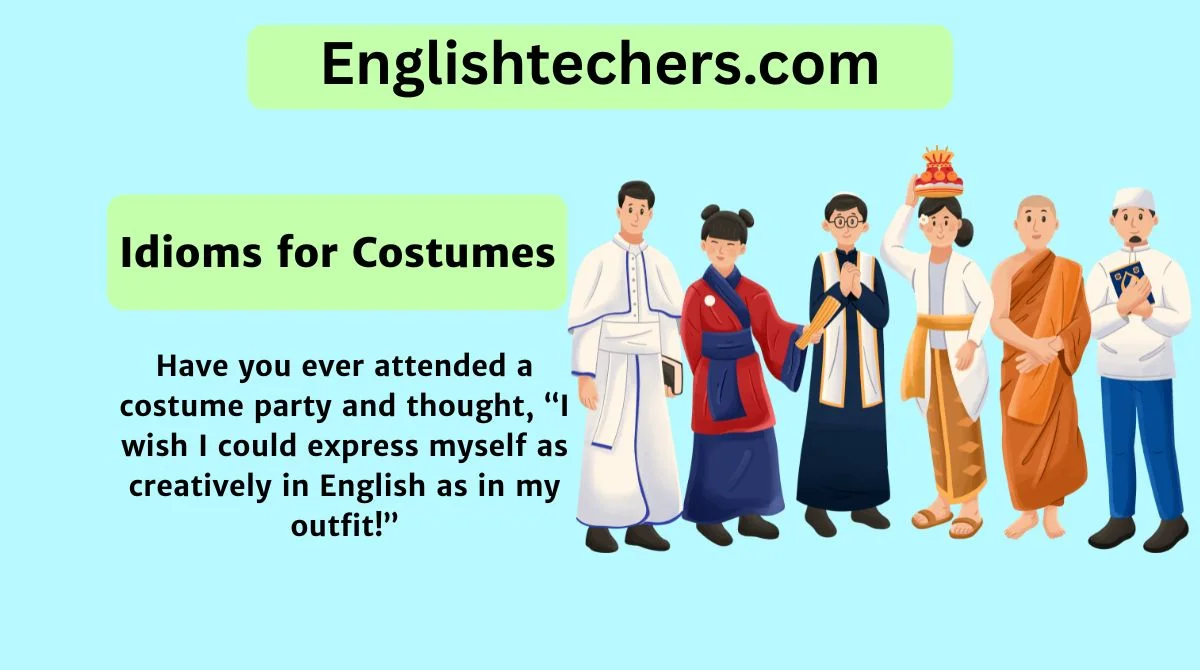
Have you ever attended a costume party and thought, “I wish I could express myself as creatively in English as in my outfit!” Well, idioms are the secret wardrobe of language—they allow you to dress up your speech with color, humor, and personality.
Just like choosing the perfect costume, picking the right idiom can make your conversation unforgettable.
Idioms are phrases whose meanings cannot be understood from the individual words alone. They often carry cultural nuance, emotion, or humor, making them a vital part of sounding like a native speaker.
For learners, idioms related to costumes, dressing up, or disguises are especially fun—they help you describe appearances, personalities, or even deception in playful ways.
Imagine this: Lisa wore a sparkly superhero costume to her office party. Her colleague whispered, “She’s really wearing her heart on her sleeve tonight!” That simple idiom not only described her costume but hinted at her open, cheerful personality.
Moments like these show how idioms make language vivid and expressive.
🎉 Fun Fact / Trivia
Did you know the idiom “wearing many hats” originated from the literal hats worn by professionals in different roles? A single person could be a judge, a teacher, and a soldier—all in one day! Today, this idiom is commonly used in workplaces, not just costume parties.
Costume-Related Idioms
Here’s a creative mix of idioms, grouped by context and emotion, with examples, mini-stories, and practical tips.
1. Wear Your Heart on Your Sleeve ❤️ (Emotional / Expressive)
Meaning: To openly show your emotions.
Example Story:
At the Halloween party, Mia wore a ghost costume and laughed so freely that her friends said, “She’s really wearing her heart on her sleeve tonight!”
Tip: Use this idiom to describe both literal costume choices and emotional openness.
2. Wear Many Hats 🎩 (Professional / Contextual)
Meaning: To handle multiple roles or responsibilities.
Dialogue:
- “I can’t believe you organized the party, handled the budget, and still wore a clown costume!”
- “Yep, I wear many hats!”
Note: Perfect for workplaces or describing someone multitasking.
3. Put on a Brave Face 😐 (Coping / Emotional)
Mini-Cultural Note: This idiom comes from the idea of putting on a mask to hide fear or sadness.
Example: During the costume parade, Tom tripped but smiled through it. “He put on a brave face even after falling,” said his friend.
4. Face Like Thunder 🌩️ (Frustration / Anger)
| Idiom | Emotion | Example |
|---|---|---|
| Face like thunder | Anger | Sarah’s vampire costume didn’t fit, and she had a face like thunder all evening. |
| Blow your top | Anger | Mark blew his top when someone ruined his costume. |
Usage Tip: Great for storytelling or playful exaggeration.
5. Under the Mask 🎭 (Literature / Hidden Identity)
Meaning: To hide your true intentions or feelings.
Example Story: The mysterious guest at the masquerade had a charming smile, but under the mask, she was planning a surprise.
Tip: Works in literature or creative writing, not just real-life parties.
6. Costume-Drama Idioms in Daily Life
- “Decked out” – To be dressed up nicely or elaborately.
- She was decked out in a sparkling fairy costume.
- “Sunday best” – Wearing your finest clothes.
- Even for Halloween, he wore his Sunday best.
- “Put on airs” – Pretending to be more important than you are.
- She put on airs in her princess gown.
Quick Exercise: Write 3 sentences using “decked out” and “put on airs” with your own costume ideas.
7. Funny Idioms / Creative Twists
Idioms Can Be Punny:
- “Dressed to kill” – Looking very stylish or attractive.
- She was dressed to kill as a vampire; everyone noticed.
- “Fit like a glove” – Perfect fit (can be literal or figurative).
- His werewolf costume fit like a glove!
- “All dressed up and nowhere to go” – Effort without opportunity.
- They bought matching superhero outfits, but the party was canceled!
8. Idioms in Professional / Workplace Settings
- “Step into someone’s shoes” – To take over someone’s role.
- Dressing as the CEO, John joked, “Time to step into her shoes!”
- “Pull a rabbit out of the hat” – Achieve something surprising.
- During the team costume contest, Maya pulled a rabbit out of the hat with her clever design.
9. Exercises / Practice Sentences
Fill in the blanks with an idiom:
- Even though he lost his mask in the wind, he _______ and smiled at the crowd.
- Julia wore a sparkly gown, clearly _______.
- The new manager had to _______ after the old boss retired.
Answer Key: 1. put on a brave face 2. dressed to kill 3. step into someone’s shoes
10. Emotional Scale Table (Mild → Intense)
| Emotion | Mild | Moderate | Intense |
|---|---|---|---|
| Frustration | annoyed | fed up | blow your top |
| Happiness | pleased | delighted | over the moon |
| Surprise | curious | intrigued | pull a rabbit out of the hat |
Tip: Grouping idioms this way helps learners choose the right intensity in conversations.
11. How to Use Idioms in Daily Life
- Professional: Use workplace idioms carefully—some are casual, some are formal.
- Speaking: Sprinkle idioms naturally in conversation to sound lively.
- Writing: Add idioms in emails, stories, or social media posts for flair.
Common Mistakes Learners Make:
- Using idioms too literally.
- Mixing idioms that conflict in meaning.
- Overloading a sentence with multiple idioms.
- Ignoring cultural context.
- Mispronouncing or misspelling idioms.
FAQ
Q1: Can idioms be used in formal writing?
A1: Some idioms, like wear many hats, are fine in professional emails; avoid overly casual ones.
Q2: Are costume idioms understood worldwide?
A2: Not always—cultural references (like masquerades) may confuse non-Western audiences.
Q3: Can idioms improve IELTS scores?
A3: Yes! Using idioms naturally in speaking and writing can boost your band, but don’t overuse them.
Q4: How do I remember idioms easily?
A4: Group them by theme, emotion, or intensity. Practice with dialogues or mini-stories.
Q5: Can idioms be adapted for humor?
A5: Absolutely! Creative twists like all dressed up and nowhere to go make conversations fun.
Conclusion
Idioms are like costumes for your words—they let you express emotions, show personality, and make your language unforgettable.
From wearing your heart on your sleeve to pulling a rabbit out of the hat, each idiom adds flair and cultural depth.
Practice, play, and sprinkle these idioms into your conversations or writing. Your English will feel more alive, natural, and memorable—just like the perfect Halloween outfit! Go ahead, pick an idiom, and wear it proudly today.

Thomas Reed is an experienced English teacher helping students learn with simple, clear lessons.
He focuses on improving speaking, grammar, and confidence through easy daily practice.