
Goodbyes are never easy—but saying them with flair can turn an ordinary farewell into something memorable.
English speakers often rely on idioms to add color and emotion to their parting words. But what exactly is an idiom? In simple terms, an idiom is a phrase whose meaning isn’t obvious from the individual words.
For example, “hit the road” doesn’t mean literally striking a road—it means to leave or start a journey.
Imagine this: Sarah was leaving her hometown to study abroad. Instead of a plain “goodbye,” her friends waved and said, “Don’t be a stranger!” That tiny idiom carried warmth, urging her to stay in touch.
Using idioms for goodbye lets you express emotions ranging from excitement and hope to sadness and humor.
For English learners, mastering these idioms not only enriches vocabulary but also makes conversations sound more natural and native-like.
🎲 Fun Fact: Did You Know?
The word “goodbye” itself is a contraction of “God be with ye” from the 16th century. Over time, English speakers invented hundreds of creative alternatives, many of which are now idioms. Some express longing, some humor, and others a sense of adventure!
1. Everyday Casual Goodbyes
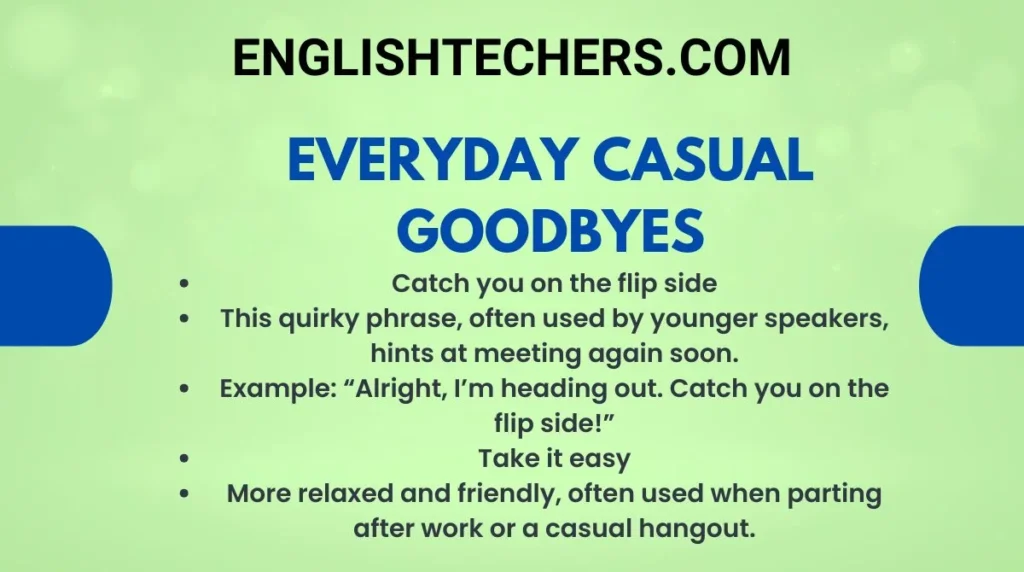
Some farewells are light and casual, perfect for friends and daily life:
- See you later / See you around
Dialogue:
Anna: “I’m off to the café. See you later!”
Ben: “Sure, don’t get lost!” - Catch you on the flip side
This quirky phrase, often used by younger speakers, hints at meeting again soon.
Example: “Alright, I’m heading out. Catch you on the flip side!” - Take it easy
More relaxed and friendly, often used when parting after work or a casual hangout.
2. Slightly Emotional Farewells
Some idioms carry a soft emotional touch, perfect for when parting stirs feelings:
- Don’t be a stranger
A gentle reminder to stay in touch, often used with friends moving away. - Part ways
Usually used in slightly formal contexts, or in stories/literature:
Mini story: Jane and Mark decided to part ways after college. Though sad, they wished each other well. - Until we meet again
Romantic or poetic, often seen in letters, songs, or literature.
3. Farewells Under Stress or Frustration
Sometimes goodbyes happen under tension or conflict. Idioms reflect that:
| Idiom | Emotion | Example |
|---|---|---|
| Hit the road | Mild frustration | “You’ve been late all week—time to hit the road!” |
| Take a hike | Anger / annoyance | “If you’re going to complain, just take a hike!” |
| See you never | Strong frustration | Often sarcastic; “After what you did, see you never!” |
Usage warning: Idioms like take a hike or see you never are informal and can sound rude if used in professional settings.
4. Heartfelt & Emotional Idioms
Some farewells tug at the heartstrings:
- Bidding adieu
French-inspired, often literary or poetic.
Example: “She waved, bidding adieu to her childhood home.” - Say your goodbyes
A gentle reminder, usually in emotional or dramatic contexts. - Parting shot
Can be literal or figurative; sometimes a final witty remark.
Dialogue:
“Here’s my parting shot: You owe me coffee next time!” - Go separate ways
Often used when friends, couples, or coworkers end a relationship or journey.
5. Funny & Creative Farewells
Humor keeps goodbyes light-hearted:
- See you in the funny papers
Retro slang, playful, and old-school funny. - I’m off like a herd of turtles
Silly twist for comic effect when leaving. - Drop me a line
Friendly and casual, asking the person to stay in touch.
Mini Exercise: Replace “goodbye” in these sentences with a funny idiom:
- I’m heading home now, ______.
- Don’t forget to ______ when you arrive!
6. Workplace & Professional Farewells
Goodbyes at work require professionalism mixed with warmth:
- Move on to greener pastures
Often used when someone resigns or leaves a job. - Time to call it a day
Used to signal the end of work or a project. - Farewell / Bon voyage
Slightly formal; used in emails, cards, or retirement parties.
Mini cultural note: In the UK, “cheerio” is a friendly yet informal goodbye, sometimes used in professional contexts if relationships are close.
7. Idioms in Literature & Pop Culture
- Parting is such sweet sorrow – Shakespeare, Romeo and Juliet
- So long, and thanks for all the fish – Douglas Adams, The Hitchhiker’s Guide to the Galaxy
These idioms show how literature and humor influence everyday English farewells.
8. Emotional Scale Table
| Intensity | Idiom Example |
|---|---|
| Mild | See you later, Take it easy |
| Moderate | Don’t be a stranger, Until we meet again |
| Strong | Hit the road, See you never |
| Heartbreaking | Parting is such sweet sorrow, Bidding adieu |
9. How to Use Idioms in Daily Life
- Speaking: Add idioms naturally to conversations. Example: “Time to hit the road, see you later!”
- Writing: Emails, letters, and texts sound friendlier with idioms.
- Professional: Use cautiously; prefer polite forms like farewell, until next time, or best wishes.
10. Common Mistakes Learners Make
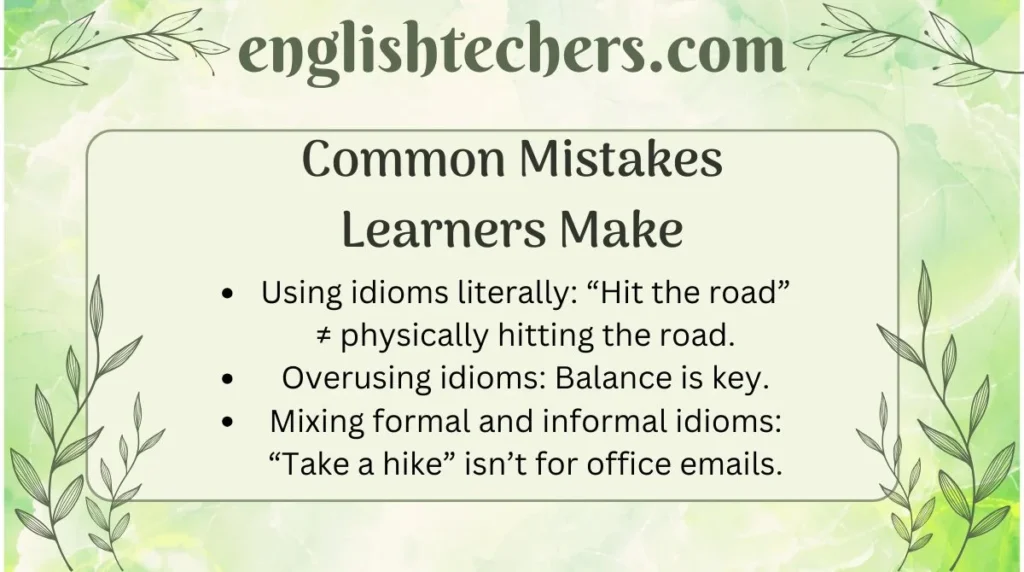
- Using idioms literally: “Hit the road” ≠ physically hitting the road.
- Overusing idioms: Balance is key.
- Mixing formal and informal idioms: “Take a hike” isn’t for office emails.
- Ignoring context: Sarcastic idioms can hurt feelings.
- Mispronunciation: Some idioms like adieu may confuse listeners.
📝 Practice Sentences
Fill in the blanks with an idiom from this article:
- I’m leaving now, ______.
- Don’t forget to ______ when you move!
- It’s been great working with you; time to ______.
- Saying goodbye was hard, truly ______.
FAQ
1: Can idioms for goodbye be used in formal writing?
Some, like farewell or until we meet again, are fine. Informal ones like catch you later are not.
2: Do other cultures have similar idioms?
Yes! French says à bientôt (see you soon), and Japanese uses sayonara (goodbye, often formal).
3: Are Shakespearean idioms still useful today?
Absolutely! They’re poetic and can impress in writing or special occasions.
4: How can idioms help in IELTS speaking?
Using idioms naturally can boost your fluency and lexical resource scores.
5: Can I mix humorous and emotional idioms?
Yes, but make sure the tone fits the context to avoid confusion.
Conclusion
Mastering 24+ idioms for goodbye allows you to express emotions, charm friends, and sound like a native speaker. From casual see you later to dramatic parting is such sweet sorrow, there’s an idiom for every mood and context.
Practice using them in conversations, writing, and even professional emails. Soon, saying goodbye won’t just be a routine—it’ll be a way to leave a lasting impression.
Start sprinkling these idioms into your English today and watch your conversations come alive!

Thomas Reed is an experienced English teacher helping students learn with simple, clear lessons.
He focuses on improving speaking, grammar, and confidence through easy daily practice.