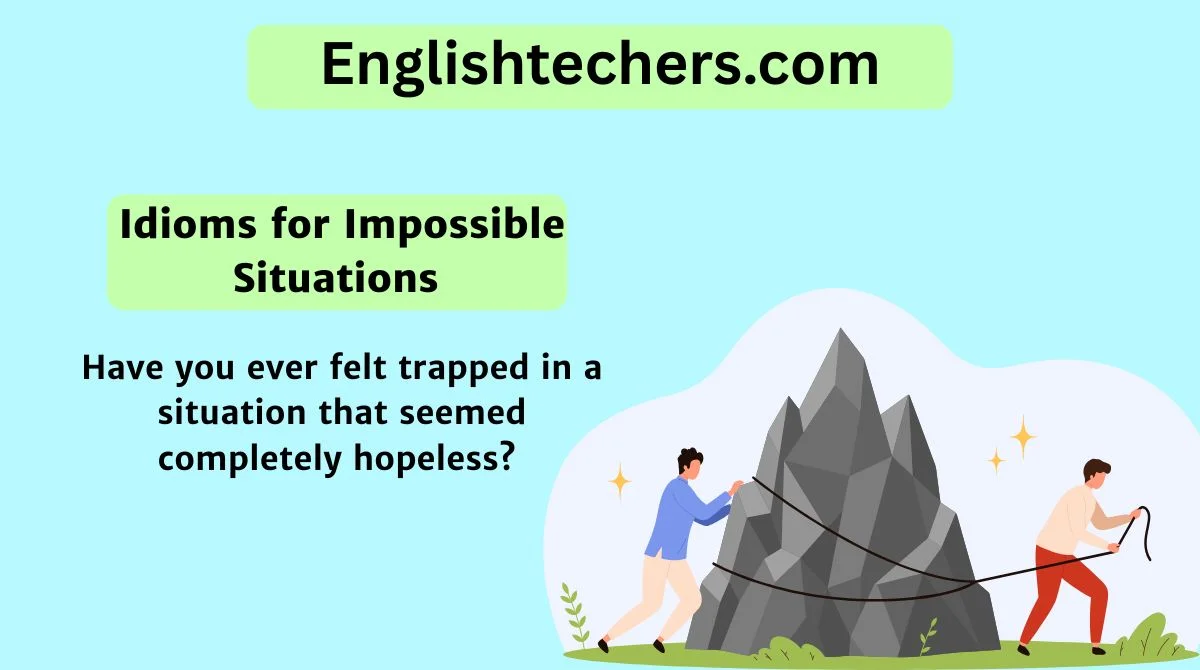
Have you ever felt trapped in a situation that seemed completely hopeless? Maybe you tried fixing a leaky roof during a storm or asking for a refund after a sold-out event.
These moments often leave us frustrated, stressed, or even laughing at our own misfortune. That’s where idioms for impossible situations come in—they help us describe these moments vividly and with a touch of personality.
Idioms are phrases that carry a meaning different from the literal interpretation of the words. For learners, they are like secret keys to sounding natural in English.
Imagine telling a friend, “That’s like trying to nail jelly to a wall!” instead of just saying, “It’s impossible.” Suddenly, your sentence feels alive, humorous, and memorable.
Here’s a short story: Sarah was preparing a surprise party for her colleague, but every plan she made seemed doomed.
The cake melted, the balloons popped, and the music system refused to work. Feeling defeated, she sighed, “Well, this is like herding cats!”—perfectly capturing the chaos of her day.
This article will explore 24+ idioms for impossible situations, show you how to use them naturally, and even provide exercises to practice them.
Fun Fact: Idioms Are Cultural Windows
Did you know many idioms for impossible situations originated from historical events, farming, or old trades? For example, “beating a dead horse” comes from horse-riding culture, literally meaning futile effort.
Learning idioms isn’t just about language—it’s a peek into history and culture!
Mildly Frustrating Situations
| Idiom | Meaning | Example |
|---|---|---|
| Barking up the wrong tree | Pursuing a mistaken course | “If you think I broke the vase, you’re barking up the wrong tree.” |
| Beating a dead horse | Wasting effort | “We’ve discussed this issue enough—let’s not beat a dead horse.” |
| Flogging a dead horse | Similar to above | “Trying to convince him is just flogging a dead horse.” |
Mini cultural note: Both “beating” and “flogging a dead horse” are common in British English, but Americans often just say “wasting your time.”
Stressed and Overwhelmed
- Hitting a brick wall – When you face a complete obstacle.
Dialogue:- Alex: “I’ve tried every solution for the project glitch.”
- Mia: “Sounds like you’re hitting a brick wall!”
- Up the creek without a paddle – Totally stuck.
Example: “I forgot my passport at home. Now I’m up the creek without a paddle.” - Like trying to juggle knives – Dangerous and impossible.
Example: “Managing three deadlines at once feels like juggling knives.”
Usage warning: Don’t use “up the creek” in formal writing; it’s informal and conversational.
Heartbreaking / Emotional Impossible Situations
- Chasing rainbows – Pursuing something unattainable.
Example: “He’s chasing rainbows if he thinks he can buy a mansion on his current salary.” - Pie in the sky – Unrealistic hope.
Example: “Her business plan is full of pie in the sky ideas.” - Building castles in the air – Fantasizing about impossible outcomes.
Dialogue:- Emma: “I want to open a café on the moon.”
- Liam: “Sounds like you’re building castles in the air!”
Frustrated / Angry Contexts
- Herding cats – Trying to control the uncontrollable.
Example: “Organizing this volunteer group is like herding cats.” - Nail jelly to a wall – Attempting the impossible.
Example: “Getting him to follow a schedule is like nailing jelly to a wall.” - Catching lightning in a bottle – Achieving something nearly impossible.
Example: “Landing that client was like catching lightning in a bottle.”
Mini exercise for learners: Try replacing “impossible” in a sentence with one of the above idioms. Example: “It’s impossible to finish this in one hour.” → “It’s like trying to nail jelly to a wall to finish this in one hour.”
Workplace / Professional Idioms
- Running on fumes – Continuing despite exhaustion.
Example: “After working 14 hours, the team was running on fumes.” - Mission impossible – Popularized by movies, meaning a task is extremely difficult.
Example: “Meeting the deadline with half the team sick felt like Mission Impossible.” - Moving mountains – Doing something extremely difficult.
Example: “She moved mountains to get the new software implemented.”
Note for learners: “Moving mountains” works in formal and informal contexts.
Funny / Creative Idioms
- Like squeezing water from a stone – Trying something hopeless.
- Pushing water uphill with a rake – A humorous twist on futile effort.
- Like teaching a goldfish to climb trees – Silly but expressive.
Dialogue example:
- Sam: “Can you get him to agree to our terms?”
- Jo: “Might as well teach a goldfish to climb trees!”
Idioms in Literature
Authors often use idioms for impossible situations to add flair:
- Charles Dickens wrote, “It was like trying to catch the wind.”
- Mark Twain used, “Like trying to row a boat with a spaghetti paddle.”
Literature gives idioms emotional depth—perfect for storytelling or essays.
Idioms Used by Native Speakers in Real Life
- Casual conversation: “I’m up the creek without a paddle after losing my keys.”
- Texting/friends: “That plan is pie in the sky.”
- Workplace: “We’re hitting a brick wall with this project.”
Emotional Intensity Table
| Intensity | Idioms | Example |
|---|---|---|
| Mild upset | Barking up the wrong tree, Beating a dead horse | “You’re barking up the wrong tree with that idea.” |
| Stressed | Hitting a brick wall, Up the creek without a paddle | “I’m up the creek without a paddle at work today.” |
| Frustrated | Herding cats, Nail jelly to a wall | “Trying to coordinate the team is like herding cats.” |
| Heartbroken | Chasing rainbows, Castles in the air | “He’s chasing rainbows if he thinks she’ll reply.” |
| Intense / Rare success | Catching lightning in a bottle, Moving mountains | “Landing that deal was like catching lightning in a bottle.” |
How to Use Idioms in Daily Life
- Speaking: Use in conversation to express feelings naturally.
- Writing: Sprinkle idioms in emails, stories, or blogs for color.
- Professional: Use workplace idioms sparingly; avoid overly humorous ones in formal reports.
Common Mistakes Learners Make
- Using idioms too literally (“I herded cats” instead of “It was like herding cats”).
- Overloading sentences with idioms.
- Using informal idioms in formal writing.
- Mispronouncing or misplacing words in multi-word idioms.
- Confusing similar idioms (“pie in the sky” vs “chasing rainbows”).
Exercises for Learners
Fill in the blanks:
- Trying to convince him is like __________. (Hint: impossible)
- We’re __________ without our project manager. (Hint: stuck)
- His dream of winning the lottery is __________. (Hint: unrealistic hope)
Create dialogues: Take two idioms and write a 2-line conversation using them naturally.
FAQ
1. Can idioms for impossible situations be used in formal writing?
Mostly no. Stick to neutral alternatives like “extremely difficult” for essays or reports.
2. Are idioms universal across English-speaking countries?
Some idioms differ. For example, “flogging a dead horse” is British; Americans often say “wasting your time.”
3. Can beginners use these idioms?
Yes! Start with simple ones like “barking up the wrong tree” or “pie in the sky.”
4. Are idioms good for IELTS or language exams?
Absolutely. Using idioms naturally can boost your speaking and writing scores. Just don’t overuse them.
5. How to remember idioms effectively?
Connect them with images, short stories, or real-life situations—context helps memory.
Conclusion
Idioms for impossible situations give your English personality, humor, and cultural flair. From expressing mild frustration to extreme impossibility, these phrases make communication vivid and natural.
Try them in conversation, writing, or storytelling, and watch how your English comes alive. Start small—swap one simple “impossible” with an idiom today, and see the difference.
Remember, learning idioms is like adding color to a black-and-white sketch: suddenly, your language feels real, relatable, and memorable.

Thomas Reed is an experienced English teacher helping students learn with simple, clear lessons.
He focuses on improving speaking, grammar, and confidence through easy daily practice.