
Leaving someone or somewhere isn’t just about walking out the door—it can carry emotions from relief to heartbreak, humor to frustration.
And English idioms capture all of this beautifully. But for learners, idioms often feel tricky. How do you know which to use? Can you sprinkle them naturally into conversation?
Imagine this: Anna is at a noisy office party. She’s tired, stressed, and just wants to go home. Instead of simply saying, “I’m leaving,” she laughs and tells her coworkers, “I’m going to make myself scarce.” Suddenly, leaving sounds playful, casual, and distinctly native.
Idioms like this give your English personality, helping you express emotion and tone that plain language often can’t.
In this guide, we’ll explore 24+ idioms for leaving, grouped by context and intensity, with examples, mini-stories, exercises, and cultural tips to help you sound natural.
Whether for daily conversation, literature, or professional settings, you’ll find plenty of ways to say goodbye with flair.
🎲 Fun Fact About Leaving Idioms
Did you know? Many idioms for leaving come from old customs or historical phrases. For instance, “beat a hasty retreat” originated from military language, describing soldiers withdrawing quickly from battle.
Today, it’s a playful way to talk about leaving any situation fast. English idioms often carry centuries of history—so every phrase tells a story!
🟢 Mild / Casual Leaving (Friendly & Everyday)
Sometimes leaving is casual, playful, or low-stress. These idioms are perfect for chatting with friends or colleagues.
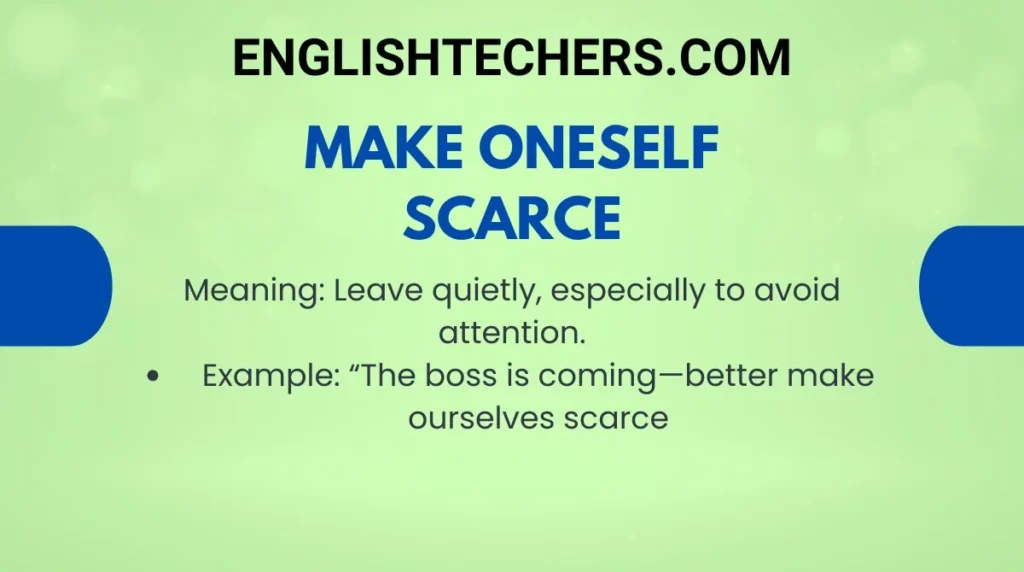
1. Make oneself scarce
Meaning: Leave quietly, especially to avoid attention.
Example: “The boss is coming—better make ourselves scarce!”
2. Head out
Dialogue Example:
John: “Are you staying longer?”
Sally: “Nah, I’ll head out. It’s been a long day.”
3. Take off
Usage: Very casual, commonly used in spoken English.
Example: “I think I’ll take off before the traffic gets worse.”
4. Slip away
Mini Story: Emma wanted to avoid the farewell speech. She slipped away unnoticed, glad for the quiet exit.
5. Call it a day
Table of Emotion:
| Idiom | Emotion | Context |
|---|---|---|
| Call it a day | Relief, tiredness | Workplace, casual |
| Take off | Casual, light | Everyday, friends |
| Slip away | Quiet, secretive | Social gatherings |
🟠 Stressful or Urgent Leaving
Some departures are driven by tension, stress, or urgency.
6. Beat a hasty retreat
Example: After seeing the huge line at the coffee shop, Mark beat a hasty retreat.
7. Cut and run
Usage Warning: Informal, can sound negative (implies leaving responsibilities behind).
Example: “The project was messy, so he just cut and ran.”
8. Duck out
Dialogue:
Anna: “Where’s Dave?”
Tom: “He ducked out early—probably tired of the meeting.”

9. Make a getaway
Mini Cultural Note: Often used in crime stories or movies but also figuratively for leaving quickly.
10. Bail out
Example: “I planned to stay, but I had to bail out—family emergency.”
🔴 Emotional Leaving (Heartbroken, Frustrated, Upset)
Some departures are emotionally charged. These idioms help convey sadness, frustration, or intensity.
11. Walk out on someone
Example: “She felt betrayed when he walked out on her.”
12. Leave high and dry
Example: “They promised help, but they left me high and dry when things got tough.”
13. Split up / Part ways
Dialogue:
Liam: “Are you two still together?”
Mia: “No, we decided to part ways.”
14. Give someone the slip
Example: “I wanted to avoid a fight, so I gave him the slip.”
15. Take a powder
Mini Story: In old gangster movies, characters often take a powder to vanish mysteriously. Today, it’s informal and humorous.
📚 Idioms in Literature & Storytelling
Idioms for leaving are common in novels, plays, and stories. They help writers convey character emotions subtly:
- “He took to his heels” – classic literary expression for fleeing or leaving quickly.
- “Vanished into thin air” – often used in mystery or suspense genres.
- “Said one’s goodbyes and departed” – formal, poetic idiom used in novels and letters.
Tip for learners: Reading fiction helps internalize these idioms naturally. Pay attention to context and emotional tone.
💼 Professional & Workplace Idioms
Leaving doesn’t always have to be dramatic—here are idioms suitable for professional environments:
- Step down – resign from a position.
- Hand in one’s notice – formally inform employer of leaving.
- Move on – pursue new opportunities or roles.
- Exit stage left – humorous, often used in office banter.
Example:
“After five years at the firm, Maria decided to move on and explore a new career.”
😂 Funny & Creative Idioms for Leaving
English loves playful expressions:
- Take a hike – tell someone to leave (humorous).
- Hit the road – go on a journey or leave.
- Blow this popsicle stand – informal, fun way to leave a boring place.
- Vamoose – quirky, borrowed from Spanish, meaning leave quickly.
Dialogue Example:
Tim: “This party is dull.”
Sara: “Totally, let’s blow this popsicle stand!”
📝 Exercises for Learners
Fill in the blanks with a suitable idiom from the list:
- I’m tired of this meeting—I think I’ll ________.
- He didn’t want to argue, so he ________ quietly.
- After the argument, she felt betrayed because he ________.
- The children wanted to avoid chores, so they ________ before anyone noticed.
- I’ve had enough of traffic; it’s time to ________.
Answer Key:
- call it a day
- slipped away
- walked out on her
- gave their parents the slip
- hit the road
🟢 Emotional Scale Table for Leaving Idioms
| Intensity | Idioms | Example |
|---|---|---|
| Mild | head out, take off, make oneself scarce | “I’ll head out now.” |
| Medium | slip away, duck out, beat a hasty retreat | “He slipped away before anyone saw.” |
| Strong | walk out on, leave high and dry, cut and run | “She walked out on him after the fight.” |
💡 How to Use Idioms in Daily Life
- Speaking: Casual conversation with friends, storytelling.
- Writing: Emails, messages, short stories, blogs.
- Professional: Step down, move on, hand in notice for formal contexts.
Common Mistakes Learners Make:
- Using formal idioms in casual speech (“I shall take my leave” sounds stiff).
- Confusing intensity—using strong idioms casually.
- Overusing idioms—one per sentence is enough.
- Translating directly from their native language (may not work).
- Misplacing idioms in the sentence structure.
FAQ
1: Are these idioms formal or informal?
Most are informal, but professional idioms like step down are formal.
2: Can I use these idioms in IELTS speaking?
Yes! Idioms make your speech natural, but don’t overuse them.
3: Are these idioms used globally?
Some are more common in the US or UK, like blow this popsicle stand (US).
4: Can idioms have negative connotations?
Yes, phrases like cut and run suggest irresponsibility. Context matters.
5: How can I remember idioms better?
Use mini-stories, dialogues, or practice exercises. Pair them with emotions to recall naturally.
Conclusion
Idioms for leaving aren’t just colorful language—they convey emotion, context, and cultural nuance. From casual exits to dramatic goodbyes, knowing 24+ idioms for leaving will make your English sound more natural, playful, and expressive. Practice with mini-stories, dialogues, or even your daily conversations.
Next time you exit a meeting, party, or even a novel discussion, sprinkle in a few idioms and watch your English come alive!

Thomas Reed is an experienced English teacher helping students learn with simple, clear lessons.
He focuses on improving speaking, grammar, and confidence through easy daily practice.