

Imagine you’re late for work, your coffee spills, and your boss is calling. You dash out the door, and someone shouts, “Wow, you’re really running like the wind!” Idioms like this make English colorful, fun, and relatable.
But what exactly are idioms? Idioms are phrases where the meaning isn’t obvious from the words themselves. They carry cultural nuance and emotion.
Learning idioms about running isn’t just about sports—they show speed, urgency, emotion, and even frustration.
Whether you’re telling a story, writing an email, or chatting with friends, using running idioms can make your English vivid. In this article, we’ll explore 23+ idioms for running, grouped by emotion, intensity, and context.
From funny phrases to workplace expressions, you’ll get practical examples, exercises, and even real-life tips. By the end, you’ll feel confident running through conversations with style and flair.
🎉 Fun Fact About Running Idioms
Did you know? The phrase “run for your life” dates back to the 1500s, often used in literature during times of danger or battle.
Today, it’s a common idiom in everyday speech and pop culture, showing how these expressions survive centuries and remain relevant.
🏃 Idioms for Daily Life Situations

1. Run like the wind
Meaning: Move very fast
Example: “She ran like the wind to catch the bus.”
Tip: Often used to describe speed in emergencies or sports.
2. Run out of steam
Meaning: Lose energy or motivation
Micro-story:
Jack started his morning jog full of energy, but by the last mile, he had run out of steam.
Note: Perfect for both physical and mental exhaustion.
3. Run into trouble
Meaning: Encounter problems unexpectedly
Dialogue:
Emma: “I tried fixing my laptop myself.”
Liam: “Oh no, did you run into trouble?”
Emma: “Big time! I had to call tech support.”
4. Run the show
Meaning: Be in control
Example: “During the party, Maria ran the show while everyone else just relaxed.”
Usage Tip: Common in workplace or team contexts.
5. Run errands
Meaning: Do small tasks outside the home
Example: “I need to run some errands before lunch.”
Cultural Note: Common in American English, often used casually in daily conversation.
💼 Idioms for Workplace / Professional Settings
| Idiom | Meaning | Example |
|---|---|---|
| Run a tight ship | Manage efficiently | “Our manager runs a tight ship, so deadlines are always met.” |
| Run up against a wall | Face obstacles | “We ran up against a wall trying to get approval from the director.” |
| Run on schedule | Follow a timetable | “The meeting ran on schedule, finishing at 3 PM.” |
| Run interference | Help solve a problem | “He ran interference so the client wouldn’t get frustrated.” |
Pro Tip: These idioms make workplace communication dynamic and natural.
😂 Funny & Creative Running Idioms
6. Run like confused
Example: “After seeing the bee, I ran like confused!”
7. Run circles around someone
Meaning: Outperform or outsmart
Mini-dialogue:
“He’s fast on the track.”
“Yeah, he runs circles around everyone else!”
8. Run for it
Meaning: Escape quickly
Example: “The kids saw the rainstorm and ran for it.”
Note: Often used in urgent or humorous contexts.
💔 Idioms for Frustration & Stress
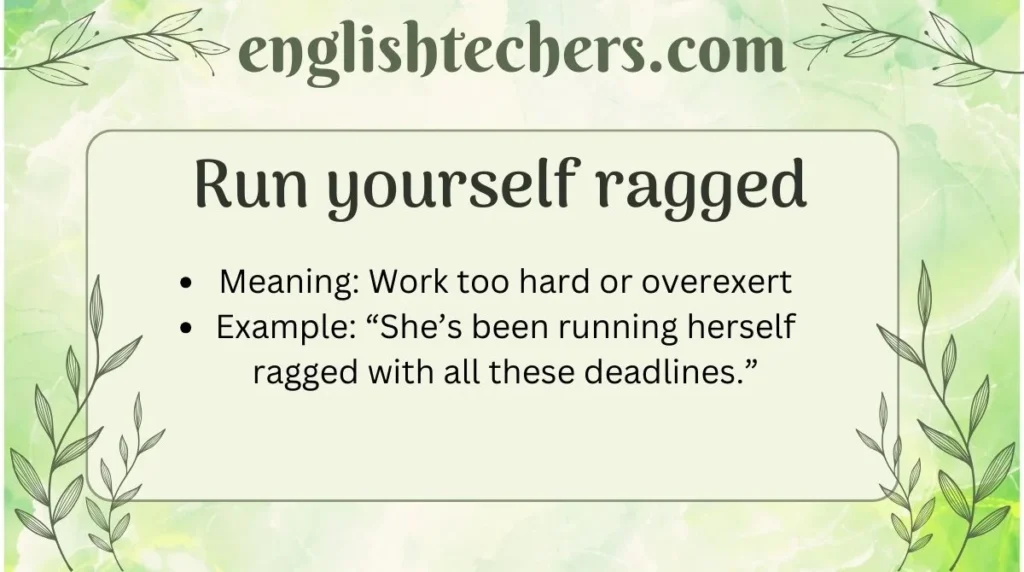
9. Run yourself ragged
Meaning: Work too hard or overexert
Example: “She’s been running herself ragged with all these deadlines.”
10. Run out of patience
Dialogue:
“I’ve explained this ten times!”
“Wow, you must be running out of patience.”
11. Run hot and cold
Meaning: Be inconsistent in behavior
Example: “His moods run hot and cold, which makes teamwork tricky.”
📚 Idioms in Literature
- Run the gamut – Cover a full range
“Her emotions ran the gamut from joy to despair in just a few minutes.” - Run a muck – Behave uncontrollably
“The kids ran amuck during the holiday party.”
Cultural Tip: Many of these expressions appear in classic novels and modern fiction, giving learners insight into natural English usage.
🏃 Emotional Scale Table
| Intensity | Idiom | Usage |
|---|---|---|
| Mild | Run errands | Daily tasks |
| Mild | Run like the wind | Speed without urgency |
| Moderate | Run out of steam | Loss of energy |
| Moderate | Run hot and cold | Emotional inconsistency |
| Intense | Run for your life | Danger/emergency |
| Intense | Run yourself ragged | Extreme overwork |
✨ Idioms Used by Native Speakers
- “I need to run this by you.” → Ask for approval
- “We’re running late.” → Behind schedule
- “She runs the risk of failing.” → Face potential danger
Tip: Listening to podcasts or shows helps learners hear idioms naturally in context.
🏃 How to Use Idioms in Daily Life
- Speaking: Add color to casual conversations.
Example: “Don’t worry, she’ll run circles around the problem.” - Writing: Enhance stories, emails, or social posts.
- Professional: Use workplace idioms judiciously to sound confident but natural.
⚠️ Common Mistakes Learners Make
- Translating idioms literally → “I ran out of steam” ≠ “I lost steam physically”
- Overusing idioms → Makes speech unnatural
- Using informal idioms in formal writing → Avoid phrases like “run like confused” in essays
- Confusing similar idioms → “Run into trouble” vs “run across trouble”
- Ignoring tense → Idioms may need past, present, or continuous form
✏️ Practice Exercise
Fill in the blanks with the correct running idiom:
- He was exhausted after working all day. He had _________.
- Don’t just sit there—if it rains, we must _________.
- Our new intern really ________ everyone else in efficiency.
- The kids love to ________ every weekend.
- I tried to fix the printer but immediately _________.
(Answers: 1. run yourself ragged, 2. run for it, 3. run circles around, 4. run amuck, 5. ran into trouble)
FAQ
1. Can idioms about running be used in formal writing?
Yes, but choose idioms like run the risk or run on schedule rather than casual phrases.
2. Are running idioms the same in British and American English?
Most are similar, but some phrases like run errands are more common in American English.
3. How can I remember idioms better?
Use them in mini-stories, dialogues, or daily journaling.
4. Do idioms always refer to literal running?
No. Many describe emotions, situations, or work contexts rather than physical running.
5. Can idioms help in IELTS or language exams?
Absolutely! Using idioms naturally can improve speaking and writing scores, but don’t overuse them.
Conclusion
Idioms about running aren’t just phrases—they’re tiny bursts of culture, humor, and emotion. From “run like the wind” to “run yourself ragged”, each idiom helps you express ideas vividly and naturally.
By practicing these in conversation, writing, and even workplace settings, your English will feel more alive and authentic. So lace up your linguistic sneakers and start running through conversations with style!

Thomas Reed is an experienced English teacher helping students learn with simple, clear lessons.
He focuses on improving speaking, grammar, and confidence through easy daily practice.