Idioms are colorful expressions that don’t mean exactly what the words say. Native speakers use them every day to sound natural, emotional, and human.
When you learn idioms, you don’t just learn English—you learn how people feel in English.
Idioms for slow are especially useful because life often moves at different speeds. Sometimes things are calm and relaxed. Sometimes they drag on forever. Sometimes they move so slowly that you want to scream.
Imagine this:
You’re waiting for an important email. One hour passes. Then two. Then a whole day. Your friend asks, “Any update?” You sigh and say, “Nope. It’s moving at a snail’s pace.”
That one idiom says more than a long explanation ever could.
In this article, you’ll learn 18+ common idioms for slow, grouped by feeling and situation. You’ll see short stories, dialogues, tables, cultural tips, and practice exercises—written in clear, friendly English for learners.
Fun Fact / Trivia 🧠
The English language has hundreds of idioms about speed, and many slow idioms use animals—snails, turtles, sloths. This comes from old farming cultures where people watched animals closely and used them to describe life.
🟢 Everyday Life: Calm or Mildly Slow
These idioms are neutral or gentle. They don’t sound angry.
1. At a snail’s pace
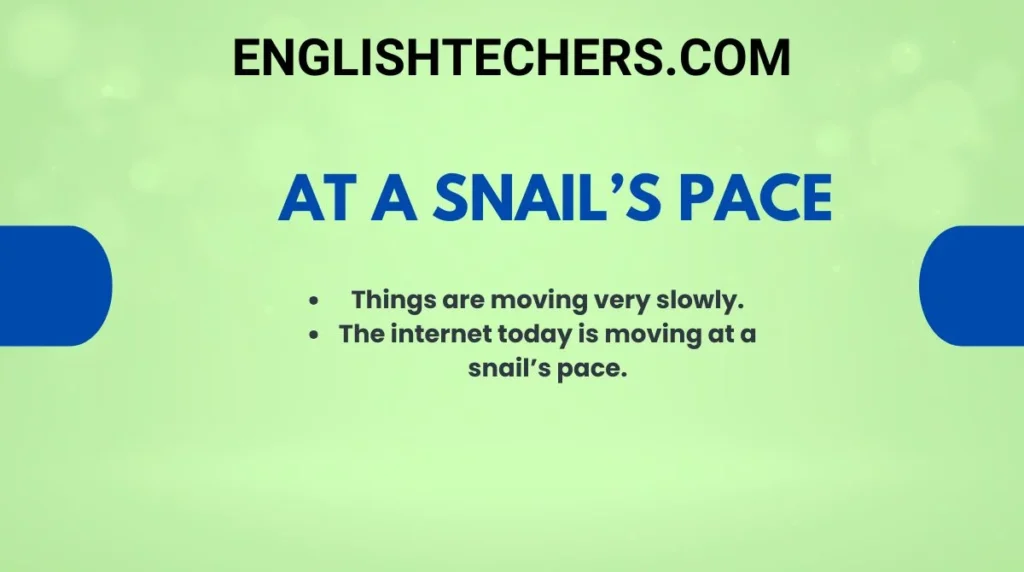
Things are moving very slowly.
The internet today is moving at a snail’s pace.
Cultural note: One of the most common slow idioms in spoken English.
2. Slow and steady
Slow but careful—and successful in the end.
She studies a little every day. Slow and steady wins the race.
Used often to encourage patience.
3. Take it easy
Don’t rush. Relax.
Dialogue:
A: “You’re working too hard.”
B: “Yeah, I need to take it easy.”
4. Drag one’s feet
To do something slowly because you don’t want to do it.
He’s dragging his feet about cleaning the garage.
Usage warning ⚠️: This implies unwillingness, not just slowness.
🟡 Work & Professional Settings
Polite but honest ways to describe slow progress.
5. Move at a glacial pace
Extremely slow, like a glacier.
The approval process is moving at a glacial pace.
Sounds formal but expressive—great for emails.
6. On the back burner
Delayed, not a priority right now.
That project is on the back burner until next month.
Common in offices and meetings.
7. Crawl along
Progressing very slowly.
Traffic was crawling along during rush hour.
Often used for traffic, queues, or systems.
8. In slow motion
So slow it feels unreal.
The meeting felt like it was happening in slow motion.
Adds dramatic emotion.
🔵 Emotional Slowness: Tired, Stuck, or Drained
When slow feels heavy or exhausting.
9. Dead in the water
No progress at all.
Without funding, the plan is dead in the water.
Strong idiom—use carefully.
10. Going nowhere fast
Busy, but no real progress.
We talk every day, but the project is going nowhere fast.
Very common in spoken English.
11. Stuck in a rut
Repeating the same slow routine.
Mini story:
Every morning, same bus, same desk, same coffee. Tom felt stuck in a rut and needed change.
🔴 Frustration & Impatience
These idioms show irritation.
12. Like watching paint dry
So boring and slow it’s painful.
That lecture was like watching paint dry.
Funny and dramatic 😄
13. Drag on
Continue longer than expected.
The meeting dragged on for hours.
Great for complaints.
14. Take forever
Very slow in a casual tone.
This app takes forever to load.
Simple, natural, and widely used.
🟣 Creative, Funny, or Informal Idioms
Perfect for humor and casual talk.
15. Slow as molasses
Extremely slow and sticky.
My old laptop is slow as molasses.
American English favorite 🇺🇸
16. Turtle speed
Very slow movement.
He types at turtle speed.
Modern and playful.
17. At leisure
Unhurried, relaxed pace.
Read the book at your leisure.
More formal and polite.
18. Not exactly fast
A polite understatement.
The service was… not exactly fast.
Used to avoid sounding rude.
📊 Emotional Scale: From Calm to Extreme
| Intensity | Idioms |
|---|---|
| Calm | take it easy, slow and steady |
| Mild slow | at a snail’s pace, crawl along |
| Frustrated | drag on, take forever |
| Extreme | dead in the water, glacial pace |
📚 Idioms for Slow in Literature
Writers love slow idioms to build mood.
- “Time crawled as he waited.”
- “The days dragged on without hope.”
These idioms help show emotion without explanation.
🗣️ Idioms Native Speakers Use Most Often
If you remember only five, choose these:
- at a snail’s pace
- take forever
- drag on
- stuck in a rut
- slow and steady
These sound natural and modern.
✍️ How to Use Idioms in Daily Life
Speaking
- Use 1 idiom per sentence
- Match emotion (don’t joke in serious moments)
Writing
- Avoid too many idioms in formal essays
- Perfect for blogs, emails, stories
Professional Settings
- Choose polite idioms: glacial pace, on the back burner
❌ Common Mistakes Learners Make
- ❌ He is slow as snail
✅ He is slow as a snail - ❌ Using funny idioms in serious emails
- ❌ Mixing idioms from different emotions
- ❌ Overusing idioms in one paragraph
📝 Practice Exercises
Fill in the blanks:
- The update is moving at a __________ pace.
- This meeting is starting to __________ on.
- Let’s put that idea on the __________ burner.
(Answers: snail’s, drag, back)
FAQ
Are idioms for slow formal?
Some are. At leisure is formal. Slow as molasses is casual.
Can I use these idioms in IELTS?
Yes, but don’t overuse them. One or two is enough.
Do all cultures understand these idioms?
Not always. Use simple ones with international audiences.
Are idioms necessary to sound fluent?
They’re not required—but they make you sound natural.
How many idioms should I learn at once?
5–7 at a time is ideal.
Conclusion
Life doesn’t always move fast—and English has many beautiful ways to talk about slow moments. Whether something is calm, frustrating, boring, or gently relaxed, there’s an idiom that fits perfectly.
Start small. Pick three idioms from this article and use them this week—in a message, a conversation, or even a thought. With time, your English will grow slow and steady… and that’s the best way to win.
👉 Save this guide, practice often, and let your English flow—no rush needed.

Thomas Reed is an experienced English teacher helping students learn with simple, clear lessons.
He focuses on improving speaking, grammar, and confidence through easy daily practice.