Idioms are short expressions that do not mean exactly what the words say, but native speakers use them every day to sound natural, emotional, and human.
When learners understand idioms, their English suddenly feels alive, not textbook-flat.
Idioms for “small” are especially useful because life is full of small things: small problems, small changes, small chances, small mistakes, and small joys. Native speakers rarely say “a very small problem.” Instead, they say “a drop in the ocean” or “no big deal.”
Imagine this short moment:
You spill coffee on your notes before a meeting. You panic. Your colleague smiles and says, “Relax. It’s just a drop in the bucket.”
Suddenly, the stress feels smaller.
That’s the power of idioms. They shrink big emotions into manageable words. In this guide, you’ll learn 18+ natural idioms for “small”, how real people use them, and how you can start using them with confidence.
🎯 Fun Fact / Trivia
English has hundreds of idioms related to size, but interestingly, “small” idioms are used more often than “big” ones in daily speech. Why? Because people love to minimize problems, soften bad news, and stay polite.
Understanding “Small” in Idioms
In idioms, small doesn’t always mean physical size. It can mean:
- Small importance
- Small amount
- Small effort
- Small problem
- Small emotional impact
To make learning easier, we’ll group idioms by context and emotional intensity.
🟢 Idioms for Small & Minor Things (Daily Life)
1. No big deal
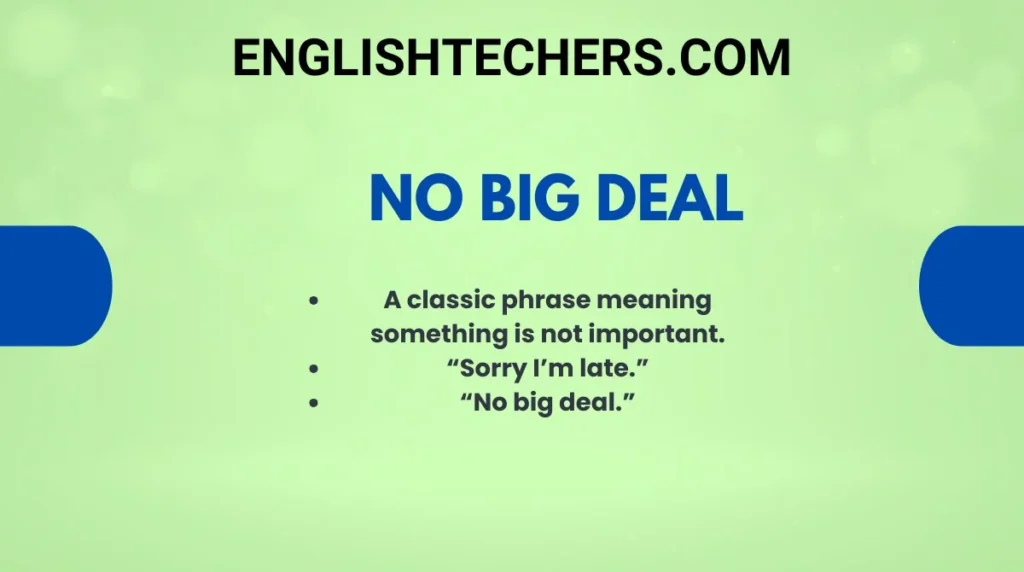
A classic phrase meaning something is not important.
“Sorry I’m late.”
“No big deal.”
Native speakers use this daily to sound relaxed.
2. A small fry
Used for a person or thing that is not important.
He thinks he’s powerful, but he’s a small fry in this industry.
⚠️ Usage note: Slightly informal, sometimes playful.
3. A drop in the bucket
A very small amount compared to what is needed.
Donating $5 is kind, but it’s a drop in the bucket for this project.
4. Peanuts
Means something is very small or insignificant, especially money.
They offered me peanuts for that much work.
💼 Common in workplace conversations.
🟡 Idioms for Small Problems or Worries (Mild Stress)
5. Nothing to write home about
Something ordinary or unimpressive.
The movie was okay—nothing to write home about.
6. A storm in a teacup
A big reaction to a small problem.
🇬🇧 Very common in British English.
The argument was just a storm in a teacup.
7. Make a mountain out of a molehill
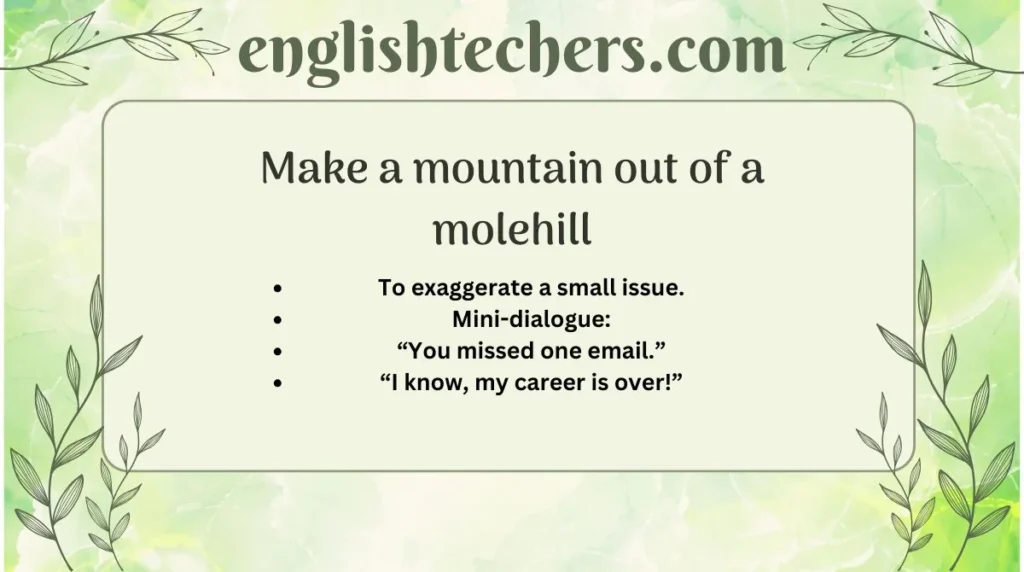
To exaggerate a small issue.
Mini-dialogue:
“You missed one email.”
“I know, my career is over!”
“Stop making a mountain out of a molehill.”
8. Not worth the trouble
Something too small to worry about.
It’s not worth the trouble to complain.
🟠 Idioms for Small Effort or Impact
9. By a hair
Winning or losing by a very small margin.
She won the race by a hair.
10. Cut corners
Doing something cheaply or with minimal effort.
⚠️ Warning: Often negative.
They cut corners, and the quality suffered.
11. A dime a dozen
Very common, not special.
Cheap phone cases are a dime a dozen.
🔵 Idioms for Small Chances or Possibilities
12. Slim chance
Almost no chance.
There’s a slim chance of rain today.
13. Long shot
Something unlikely to happen.
It’s a long shot, but I’ll apply anyway.
📚 Common in motivational stories.
🟣 Idioms About Small Details
14. Nitpick
To focus on very small, unimportant details.
He nitpicks every little mistake.
⚠️ Can sound critical.
15. Split hairs
Arguing over tiny differences.
Let’s not split hairs over wording.
16. In a nutshell
Something explained briefly and simply.
In a nutshell, the plan worked.
😂 Funny & Creative Idioms for Small Things
17. Teeny-tiny
Playful way to say very small.
Just a teeny-tiny favor!
18. Itsy-bitsy
Childlike and humorous.
An itsy-bitsy problem.
19. Small potatoes
Something unimportant.
Compared to last year, this loss is small potatoes.
📊 Emotional Scale: Small → Serious
| Intensity | Idioms |
|---|---|
| Very small | peanuts, teeny-tiny |
| Mild | no big deal, small potatoes |
| Medium | storm in a teacup |
| Strong | mountain out of a molehill |
🗣️ Idioms Native Speakers Use in Real Life
Native speakers often soften conversations using small-idioms:
- To be polite: “It’s no big deal.”
- To calm stress: “Just a small hiccup.”
- To avoid conflict: “Let’s not split hairs.”
These idioms make English sound natural and friendly.
📖 Idioms for “Small” in Literature & Media
- “In a nutshell” – common in essays and journalism
- “A drop in the ocean” – seen in novels and speeches
- “Long shot” – movies, sports, and storytelling
Writers use small-idioms to compress meaning into fewer words.
💼 Idioms for Professional & Workplace English
Use carefully and politely:
- “This delay is a minor issue—nothing to write home about.”
- “The budget increase is peanuts.”
- “Let’s not nitpick the formatting.”
⚠️ Avoid slang like itsy-bitsy in formal emails.
✍️ How to Use Idioms in Daily Life
Speaking
- Use one idiom per sentence.
- Pause before and after for clarity.
Writing
- Avoid overusing idioms in formal essays.
- Perfect for blogs, emails, stories.
Professional Settings
- Choose neutral idioms.
- Avoid humor unless the tone is friendly.
❌ Common Mistakes Learners Make
- Using idioms too often (sounds unnatural)
- Mixing literal and idiomatic meaning
- Using informal idioms in serious emails
- Forcing idioms where simple words work
🧠 Practice Exercises (Try Now!)
Fill in the blanks:
- The mistake was just _________ potatoes.
- Don’t make a _________ out of a molehill.
- Winning by one point is winning by a _________.
(Answers: small / mountain / hair)
FAQ
Are “small” idioms formal or informal?
Most are informal, but some like “in a nutshell” are neutral.
Can I use these in IELTS or exams?
Yes—sparingly and correctly.
Do British and American English differ?
Slightly. Storm in a teacup is more British.
How many idioms should I learn at once?
5–7 at a time is ideal.
How do I remember idioms?
Connect them to stories and emotions, not translations.
Conclusion
Learning idioms for “small” helps you think like a native speaker. You stop sounding robotic and start sounding human. These expressions help you minimize stress, explain ideas quickly, and connect emotionally with listeners.
Start small. Pick three idioms today. Use them in a sentence. Say them out loud. English grows one tiny step at a time—and that’s no small thing.
👉 Save this guide, practice daily, and watch your English confidence grow.

Thomas Reed is an experienced English teacher helping students learn with simple, clear lessons.
He focuses on improving speaking, grammar, and confidence through easy daily practice.