

Success isn’t just about hard work—it’s also about how we talk about it. Idioms, those colorful expressions that don’t always make literal sense, add flair and authenticity to your English.
Imagine telling your friend, “I finally landed that job!” versus saying, “I hit the jackpot!” Both convey achievement, but the second adds excitement, personality, and cultural flavor.
Let me tell you a quick story: A young professional, Sara, had been applying to companies for months. One day, after a long interview, she texted her best friend: “I think I’ve hit the ground running!” That tiny phrase packed enthusiasm, confidence, and momentum into four words.
That’s the power of idioms—they communicate emotion and meaning beyond simple words.
Using idioms for success isn’t just fun—it’s practical. They make your English more natural, memorable, and culturally accurate, whether you’re in casual conversation, writing an email, or preparing for IELTS or job interviews.
🎉 Fun Fact: Idioms About Success
Did you know? Many idioms about success originated from sports, farming, or business centuries ago. For example, “strike while the iron is hot” comes from blacksmithing: timing was everything to shape molten metal perfectly. Today, we use it for seizing opportunities in life!
🏆 Idioms for Daily Success: Motivation & Achievement
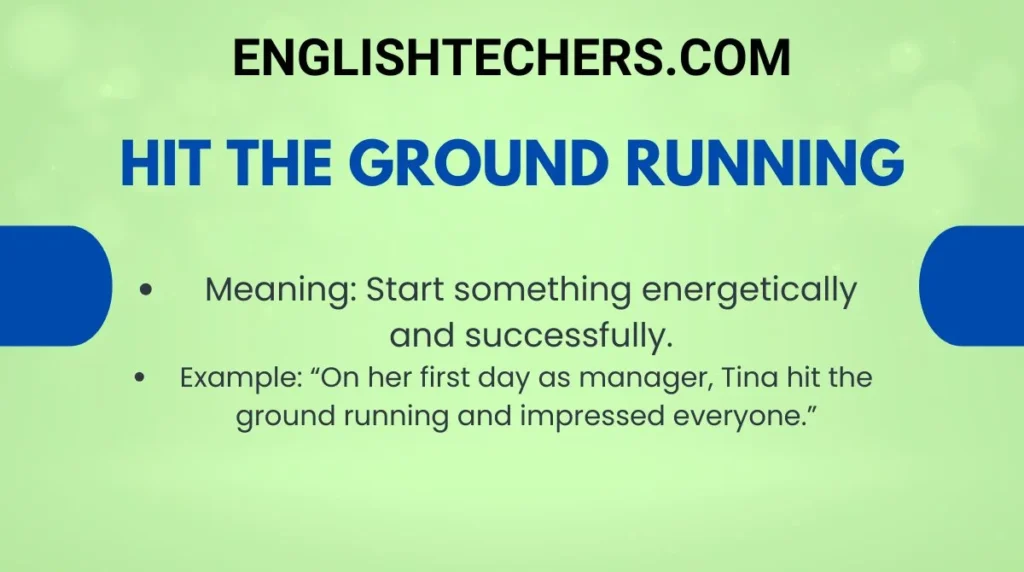
1. Hit the ground running
Meaning: Start something energetically and successfully.
Example: “On her first day as manager, Tina hit the ground running and impressed everyone.”
2. On cloud nine
Mini Story: James got the promotion he dreamed of. “I’m literally on cloud nine,” he said, jumping with joy.
Tip: Use this to express happiness after success.
3. Break the mold
Meaning: Do something in a completely new way.
Dialogue:
- A: “How did your project win the award?”
- B: “We broke the mold and tried a new approach.”
4. Make a name for oneself
Usage: Often used for long-term achievements in career or reputation.
Example: “She’s really making a name for herself in digital marketing.”
💼 Idioms for the Workplace & Professional Life
| Idiom | Meaning | Example |
|---|---|---|
| Strike while the iron is hot | Take advantage of an opportunity quickly | “He struck while the iron was hot and signed the client immediately.” |
| Climb the corporate ladder | Advance in one’s career | “He’s ambitious and wants to climb the corporate ladder fast.” |
| Go the extra mile | Put in extra effort | “To impress his boss, he always goes the extra mile.” |
| In the driver’s seat | Be in control | “After the merger, Maria was in the driver’s seat of the new division.” |
| Ahead of the curve | Be more advanced than others | “Her innovative ideas keep her ahead of the curve.” |
Cultural Tip: Workplace idioms like these are common in English-speaking business environments. Using them shows professionalism and familiarity with cultural norms.
😄 Funny & Creative Idioms About Success
5. The ball is in your court
Meaning: It’s your turn to take action.
Example: “I’ve done my part; now the ball is in your court.”
6. Burning the midnight oil
Story: Alex studied all night for a big presentation. His roommate joked, “Are you burning the midnight oil again?”
Lesson: Perfect for describing hard work leading to success.
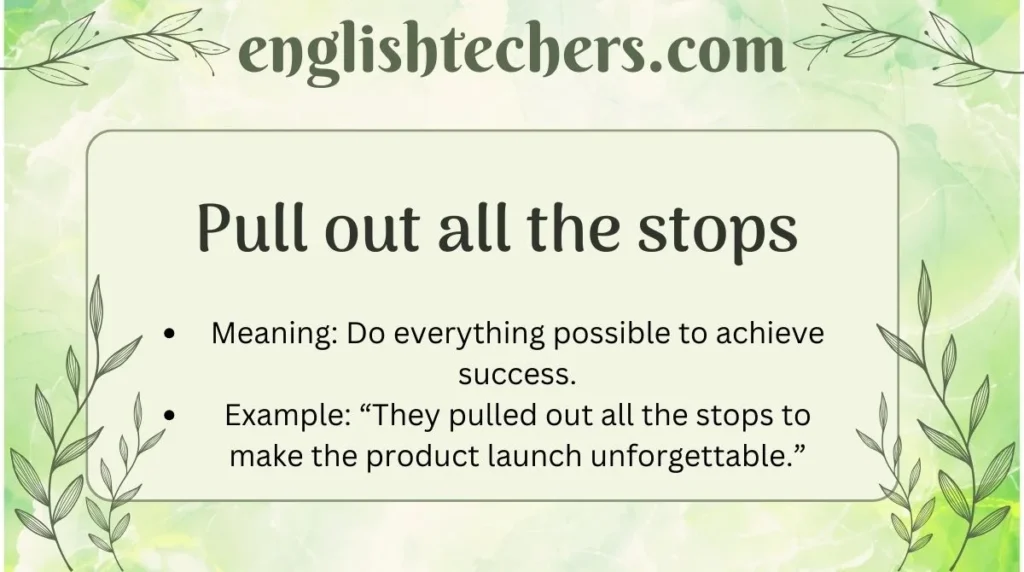
7. Pull out all the stops
Meaning: Do everything possible to achieve success.
Example: “They pulled out all the stops to make the product launch unforgettable.”
📚 Idioms in Literature & Famous Quotes
- “Every cloud has a silver lining” – Even difficult situations can lead to success.
- “Rome wasn’t built in a day” – Achievements take time and patience.
- “Fortune favors the bold” – Taking risks can lead to success.
Mini Exercise: Try rewriting your own short paragraph using one of these literary idioms. It strengthens vocabulary and creative writing!
⚡ Emotional Scale Table: Mild → Intense Success
| Emotion | Idioms | Example |
|---|---|---|
| Mild | Make a name for oneself, ahead of the curve | “She’s ahead of the curve in her field.” |
| Medium | Hit the ground running, go the extra mile | “He hit the ground running with the new team.” |
| Strong | On cloud nine, strike while the iron is hot | “Winning the award put him on cloud nine!” |
| Intense | Break the mold, pull out all the stops | “They really broke the mold with that design.” |
💬 Idioms in Real Life: Native Speaker Insights
Native speakers mix idioms naturally into conversation. Examples:
- Casual chat: “I’ve been working hard, and finally, I’m seeing the light at the end of the tunnel.”
- Professional email: “We must strike while the iron is hot to secure the deal.”
- Storytelling: “He hit the jackpot when he found his dream apartment.”
Tip: Pair idioms with stories, results, or emotions for authenticity.
📝 Exercises for Learners
- Fill in the blank: “After months of effort, she finally _______ and won the award.”
- Match idioms with meanings:
- Pull out all the stops → a) Take a risk
- Break the mold → b) Do everything possible
- Strike while the iron is hot → c) Do something in a new way
Answers: 1) made a name for herself, 2) Pull out all the stops → b, Break the mold → c, Strike while the iron is hot → a
⚠️ Common Mistakes Learners Make
- Using idioms literally: “I literally hit the ground running.” ❌
- Mixing contexts: “I burned the midnight oil” in a casual, fun setting without meaning to work. ✅ Context matters.
- Overusing idioms: Too many idioms in one sentence can confuse listeners.
- Ignoring formality: Some idioms are informal; avoid in professional reports.
- Mispronunciation: Practice common idioms aloud; some sounds are subtle but important.
🏫 How to Use Idioms in Daily Life
- Speaking: Add flavor to conversations with friends or colleagues.
- Writing: Emails, essays, or blogs become more engaging.
- Professional: Use workplace idioms to demonstrate cultural fluency.
- Learning tip: Start small—pick 2–3 idioms weekly and practice.
FAQ
1: Can idioms be used in formal writing?
Some can, like “Rome wasn’t built in a day,” but avoid overly casual idioms in professional reports.
2: Do idioms translate well into other languages?
Not always! Idioms often have cultural nuances, so literal translation may confuse learners.
3: Are all idioms American English?
No, idioms exist in British, Australian, and global English. Some phrases differ slightly.
4: How to remember idioms?
Use flashcards, create dialogues, or write mini-stories including idioms.
5: Can idioms help in IELTS or exams?
Absolutely! Natural use of idioms in writing/speaking impresses examiners, but only when used correctly.
Conclusion
Idioms aren’t just fancy words—they’re tools that make your English expressive, authentic, and memorable. From workplace success to daily life, using idioms like hit the ground running, pull out all the stops, or on cloud nine can help you communicate more naturally.
Start small, practice in real conversations, and watch your English grow. Remember: success in language, like life, comes one step at a time—so strike while the iron is hot!

Thomas Reed is an experienced English teacher helping students learn with simple, clear lessons.
He focuses on improving speaking, grammar, and confidence through easy daily practice.