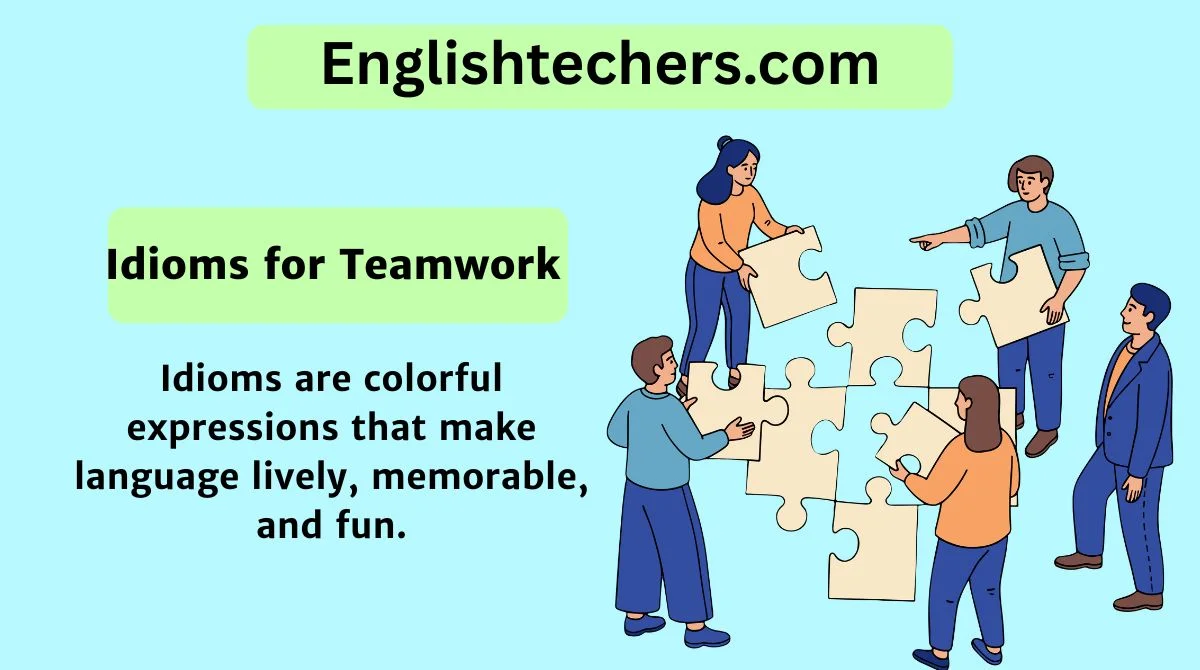
Idioms are colorful expressions that make language lively, memorable, and fun. Imagine your colleague saying, “We need to get all hands on deck!”—without knowing idioms, you might picture sailors literally running around! Idioms for teamwork are particularly powerful because they capture the essence of collaboration, unity, and problem-solving in just a few words.
Let’s say your team is struggling to meet a tight deadline. Instead of a dry statement like “Everyone must help”, you could say, “We need to pull together”. Instantly, it feels motivating, warm, and natural—exactly what native speakers do! These idioms aren’t just words; they’re emotional connectors, teaching you how to communicate teamwork, cooperation, and shared effort in a way that sounds authentic.
By the end of this article, you’ll not only know 21+ idioms for teamwork, but also understand how to use them in everyday life, workplace conversations, literature, and even humorously among friends.
🎉 Fun Fact / Trivia About Teamwork Idioms
Did you know that many teamwork idioms have nautical or military origins? For example, “all hands on deck” comes from ships, where literally every sailor’s help was needed during emergencies.
Similarly, “many hands make light work” dates back to 16th-century England!
🏗️ Idioms Grouped by Context
1. Daily Life & Friendly Contexts
Pull together
Short story:
During the school bake sale, everyone was tired. Mia said, “Come on, team, let’s pull together!” By the end of the day, they had sold out all the cupcakes.
Many hands make light work
- Meaning: Tasks become easier when more people help.
- Dialogue:
Tom: “This garden is huge!”
Sara: “Don’t worry, many hands make light work. Let’s all start planting.”
Team player
Mini cultural note: In sports and workplaces, calling someone a “team player” is a compliment meaning they cooperate and value group success over personal gain.
2. Workplace & Professional Settings
| Idiom | Meaning | Example |
|---|---|---|
| All hands on deck | Everyone must help | “We’re behind schedule, so it’s all hands on deck today.” |
| In the same boat | Facing the same challenge | “Don’t worry, we’re in the same boat with this project.” |
| On the same page | Having the same understanding | “Before we start, let’s make sure we’re on the same page.” |
| Hit the ground running | Start quickly and effectively | “New hires must hit the ground running to meet deadlines.” |
Usage Warning: Avoid overusing “all hands on deck” in casual chats; it sounds more formal or urgent.
3. Stress & Pressure Situations
Bite the bullet
- Meaning: Accept a difficult task.
- Example: “We have a huge client presentation tomorrow. Time to bite the bullet and finish the slides.”
Step up to the plate
- Dialogue:
Manager: “Who can handle the client call?”
Emma: “I’ll step up to the plate.”
Carry the weight of the team
Mini exercise: Write a sentence about a friend or coworker who carries the weight of the team. For example, “Liam always carries the weight of the team during stressful projects.”
4. Funny or Creative Idioms
Pass the baton
- Often used in relay races, it can humorously describe handing over responsibility.
- Example: “I’ve finished my part of the report, now I’ll pass the baton to you.”
Too many cooks spoil the broth
- Warning about too many people trying to lead.
- Micro-story: The committee had 10 members all giving directions, and nothing got done.
On cloud nine together
- Meaning: Feeling extremely happy as a team.
- Example: “After winning the hackathon, we were on cloud nine together.”

5. Idioms in Literature & Culture
It takes two to tango
- Often in novels or plays, this idiom highlights that cooperation or conflict involves more than one person.
- Example from literature: In Shakespearean-inspired modern stories, partnerships or duos often face challenges together, reinforcing it takes two to tango.
Shoulder to shoulder
- Origin: Military and historical texts often describe soldiers standing shoulder to shoulder.
- Modern use: “We stood shoulder to shoulder during the protest, united in our cause.”
6. Emotional Scale Table
| Intensity | Idiom | Use Case |
|---|---|---|
| Mild | On the same page | Simple agreement |
| Moderate | Pull together | Cooperative effort |
| Strong | Carry the weight of the team | Heavy responsibility |
| Intense | All hands on deck | Urgent, full team involvement |
📝 Exercises for Learners
- Fill in the blanks with the right idiom:
- “We’re all ________ on deck to finish the annual report.”
- “Don’t worry, ________ make light work when cleaning the park.”
- “She always ________ to the plate when deadlines are tight.”
- Write a 3-sentence story about a time your team had to step up to the plate.
- Dialogue practice: Use at least 2 idioms in a conversation with a friend about group work.
💡 How to Use Idioms in Daily Life
- Speaking: Sprinkle idioms in conversations to sound natural.
- Writing: Use idioms in emails, presentations, or stories to convey emotion.
- Professional setting: Idioms like “on the same page” or “hit the ground running” make communication concise and engaging.
Common Mistakes Learners Make:
- Translating literally from their native language.
- Overusing idioms in formal writing.
- Using idioms in the wrong context (e.g., saying “pull together” alone without a team).
- Confusing similar idioms (“in the same boat” vs “shoulder to shoulder”).
- Mispronouncing phrases, making them hard to understand.
FAQ
1: Can I use teamwork idioms in formal writing?
A1: Some are fine (on the same page), but avoid overly casual ones (too many cooks spoil the broth).
2: Are these idioms universal in English-speaking countries?
A2: Mostly yes, but minor variations exist between UK, US, and Australia.
3: Can idioms be used in IELTS speaking/writing?
A3: Absolutely! Using idioms correctly can boost your score, but clarity matters more than quantity.
4: How do I remember idioms effectively?
A4: Group them by theme, practice dialogues, and use mini-stories to recall meaning.
5: Can idioms be humorous in teamwork?
A5: Yes! Idioms like too many cooks spoil the broth or pass the baton can lighten the mood.
Conclusion
Idioms for teamwork are more than fun expressions—they are tools to connect, motivate, and communicate effectively.
From daily conversations to professional emails, literature, or presentations, these phrases make your language natural and expressive.
Start using pull together, all hands on deck, or hit the ground running in your next team project. Your English will sound more confident, lively, and native-like! Ready to turn your team conversations into idiom-rich chats? Start today, one idiom at a time.

Thomas Reed is an experienced English teacher helping students learn with simple, clear lessons.
He focuses on improving speaking, grammar, and confidence through easy daily practice.