
Learning English idioms is like unlocking a secret code of the language. Idioms are expressions whose meanings cannot always be understood from the literal words.
For teenagers, who often juggle school, friends, and emotions, idioms offer a colorful way to express feelings, make conversations lively, and even sound like a native speaker.
Imagine this: Sarah, a 16-year-old, just failed her math test. Instead of saying “I’m really upset,” she tells her friend, “I’m down in the dumps.” Suddenly, the feeling is clearer, more relatable, and a little less heavy.
Idioms don’t just make speech fun—they help teenagers navigate social situations, express emotions, and even write more creatively.
From describing stress during exams to celebrating small victories with friends, idioms add personality to words. In this guide, we’ll explore 21+ idioms for teenagers, grouped by emotions and contexts, with examples, mini-stories, cultural notes, and exercises.
Whether you want to chat with friends, write essays, or understand movies and songs, these idioms will level up your English.
Fun Fact / Trivia
Did you know that idioms often have historical or cultural roots? For example, “hit the books” comes from a time when students literally “hit” or pressed the pages of books while studying hard.
Teenagers today still use it casually to mean “study diligently.”
Idioms for Teenagers by Emotion & Context
1. Mild Upset or Disappointment
| Idiom | Meaning | Example |
|---|---|---|
| Down in the dumps | Feeling sad | “I was down in the dumps after losing my favorite hoodie.” |
| Cry over spilled milk | Worry about something that can’t be changed | “Don’t cry over spilled milk; your phone is broken, but you can get a new one.” |
| Feeling blue | Feeling a bit sad | “He’s feeling blue because his team lost the match.” |
Micro-dialogue:
- Emma: “You didn’t get the lead in the play?”
- Liam: “Yeah… I’m feeling a bit blue.”
- Emma: “Cheer up! There’s always next time.”
2. Stressed or Overwhelmed
| Idiom | Meaning | Example |
|---|---|---|
| Burn the midnight oil | Stay up late working/studying | “I had to burn the midnight oil to finish my science project.” |
| Up to my ears | Overwhelmed with work | “I’m up to my ears in homework this week!” |
| Under the pump | Facing pressure or stress | “She felt under the pump before her final exams.” |
Usage tip: These idioms are common in casual conversation but avoid using “under the pump” in very formal writing; it’s more colloquial.
3. Frustration / Anger
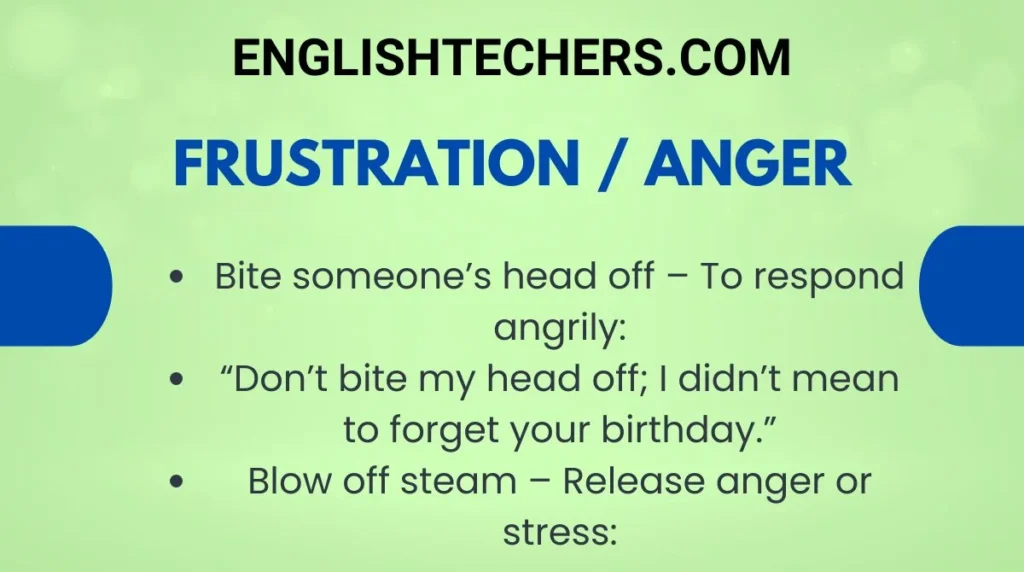
- Bite someone’s head off – To respond angrily:
“Don’t bite my head off; I didn’t mean to forget your birthday.” - Blow off steam – Release anger or stress:
After losing the match, Tom went for a run to blow off steam. - Go control– Become very angry or excited:
“She went control when she saw her broken phone.”
Cultural note: “Go control” is playful and often used among friends. Using it in professional contexts may seem too casual.
4. Heartbreak / Sadness
- Break someone’s heart – Cause emotional pain:
“It really broke my heart when my best friend moved away.” - Cry one’s eyes out – Cry heavily:
“After watching that movie, I cried my eyes out.” - Wear your heart on your sleeve – Show emotions openly:
“She always wears her heart on her sleeve, especially around friends.”
5. Humor / Funny Situations
- Goof around – Act silly or playful:
“Teenagers love to goof around on weekends.” - Kick the bucket (humorous exaggeration) – Die (used jokingly among teens):
“If I don’t get my phone charged, I’ll kick the bucket!” - Hit the nail on the head – Describe something perfectly:
“You hit the nail on the head when you said I need more sleep.”
6. Daily Life / School
| Idiom | Meaning | Example |
|---|---|---|
| Hit the books | Study hard | “Midterms are coming, so I need to hit the books.” |
| Pull an all-nighter | Stay awake all night studying | “She had to pull an all-nighter for her history essay.” |
| Ace a test | Get a perfect score | “I aced my math test today!” |
| Learn the ropes | Understand basics | “It’s my first week at the club; I’m just learning the ropes.” |
Mini cultural note: Many school idioms come from traditional classroom or study habits. Teenagers hear these in school, movies, and YouTube videos.
7. Idioms Used by Native Teenagers in Real Life
- Crash – Go to sleep: “I’m so tired, I’m going to crash.”
- Hang out – Spend time with friends: “Want to hang out after school?”
- Bail – Leave abruptly: “I have to bail; my parents are calling.”
Tip: These idioms are casual and best used with friends or peers, not formal writing.
8. Idioms in Literature / Movies
Teenagers often encounter idioms in novels, films, or songs:
- Read between the lines – Understand the hidden meaning: “She had to read between the lines in the poem.”
- Jump on the bandwagon – Join something popular: “Everyone’s buying the new sneakers, and I don’t want to jump on the bandwagon.”
- Piece of cake – Very easy: “The English test was a piece of cake.”
9. Exercises / Practice Sentences
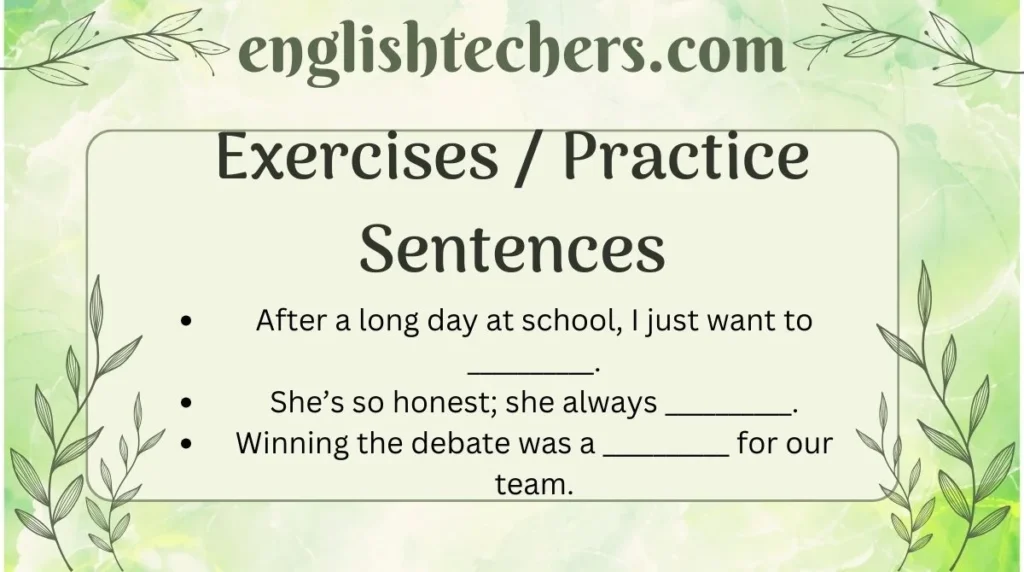
Fill in the blanks with the correct idiom:
- I was really upset about my grade, but my friend said, “Don’t __________ over spilled milk.”
- After a long day at school, I just want to __________.
- She’s so honest; she always __________.
- Winning the debate was a __________ for our team.
- He was so angry that he started to __________.
Answer Key: 1. cry / 2. crash / 3. wears her heart on her sleeve / 4. piece of cake / 5. blow off steam
10. Emotional Scale Table (Mild → Intense)
| Mild | Moderate | Intense |
|---|---|---|
| Feeling blue | Down in the dumps | Cry one’s eyes out |
| Mild frustration | Up to my ears | Bite someone’s head off |
| Small excitement | Go control | Jump out of your skin |
11. How to Use Idioms in Daily Life
- Speaking: Add color to conversations: “I’m burning the midnight oil for my exams.”
- Writing: Use in stories or social media posts to sound natural.
- Professional: Limit to casual emails or presentations; avoid in formal reports.
12. Common Mistakes Learners Make
- Translating idioms literally (e.g., “kick the bucket” → kicking a real bucket).
- Overusing idioms in writing.
- Using informal idioms in formal essays.
- Confusing idioms with similar meanings (e.g., “down in the dumps” vs. “feeling blue”).
- Mispronouncing idiom phrases in speech.
FAQ
1: Can teenagers use all idioms in school writing?
A1: Some idioms are informal, so use them carefully. For essays, prefer neutral expressions.
2: Do idioms have the same meaning in all English-speaking countries?
A2: Not always. Some British idioms may confuse American teens, e.g., “Bob’s your uncle.”
3: How can I remember idioms effectively?
A3: Use them in sentences, dialogues, or short stories. Associating emotions helps retention.
4: Are idioms useful for IELTS or exams?
A4: Yes! Idioms can demonstrate natural language use in speaking and writing.
5: Can I invent my own idioms?
A5: Creative expressions are fine among friends, but in formal contexts, stick to standard idioms.
Conclusion
Idioms are the heartbeat of everyday English, especially for teenagers navigating school, friendships, and emotions.
By using these 21+ idioms, you can express feelings vividly, sound more like a native speaker, and make conversations or writing more engaging.
Remember to start small—pick a few idioms, practice them in daily life, and gradually add more. With time, idioms will feel natural, not forced.
So, next time you’re feeling stressed, excited, or playful, try sprinkling in an idiom or two—you might just impress your friends, teachers, or even your followers on social media! Keep learning, keep practicing, and speak with flair!

Thomas Reed is an experienced English teacher helping students learn with simple, clear lessons.
He focuses on improving speaking, grammar, and confidence through easy daily practice.