
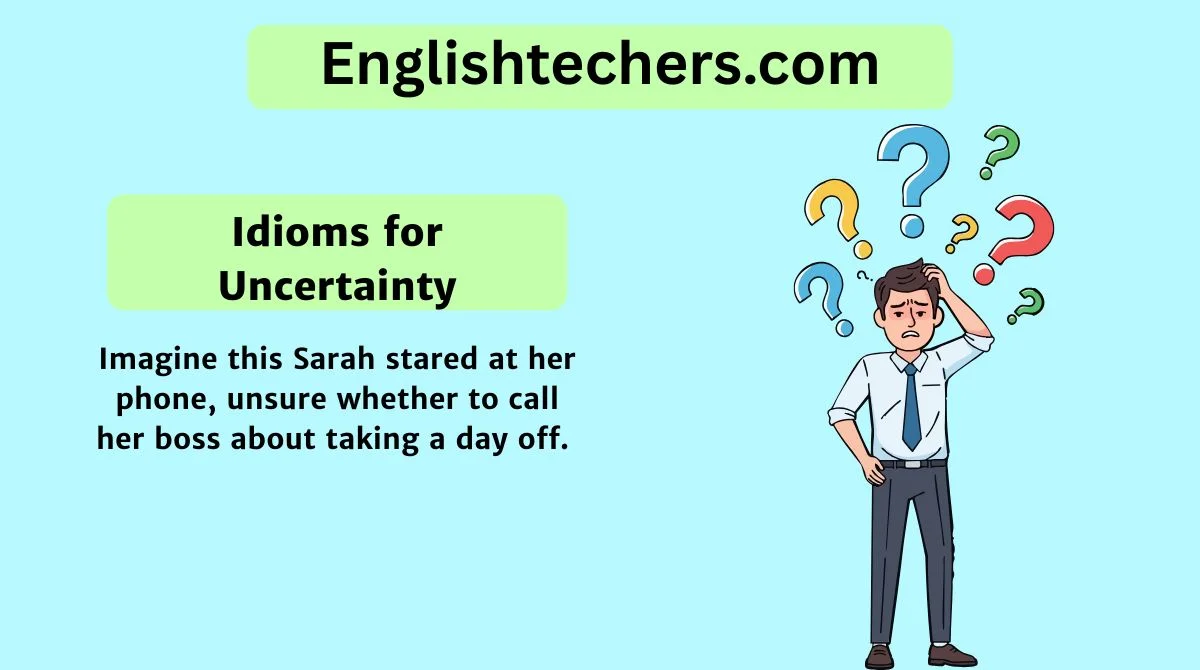
Imagine this Sarah stared at her phone, unsure whether to call her boss about taking a day off.
She muttered to herself, “I guess I’m on thin ice here.” Have you ever felt like Sarah—unsure, hesitant, or even a little nervous? That’s where idioms for uncertainty come in!
Idioms are expressions where the words together create a meaning different from the literal definition. They add color, emotion, and nuance to your English.
Learning idioms for uncertainty helps you express hesitation, doubt, or unpredictability in a natural, native-like way.
Whether in daily conversations, emails at work, or chatting with friends, using idioms makes your language richer and more relatable. Plus, they help you understand movies, books, and even memes without scratching your head.
By the end of this article, you’ll have 17+ idioms at your fingertips—and tips to use them like a pro.
Fun Fact: Did You Know? 🎉
Many idioms for uncertainty come from old English, farming, or nautical terms. For example, “on thin ice” originally referred to literally walking on unsafe frozen water, making it a perfect metaphor for risky situations.
1. On Thin Ice ❄️
Usage in context:
“I know I forgot to finish the report on time. I’m really on thin ice with my manager.”
Mini story:
Tom skipped a meeting again. His colleague whispered, “He’s on thin ice, for sure.” Later, Tom realized he had to apologize to avoid trouble.
Tip: Use this idiom for risky situations, not casual doubts.
2. Up in the Air ✈️
Dialogue example:
- Jane: “Are we moving to Canada next year?”
- Mike: “Honestly, it’s still up in the air.”
Note: Perfect for plans, decisions, or future events that are uncertain.
3. Touch and Go ⏱️
Context: Medical, emergency, or tense situations.
“The patient’s condition was touch and go last night.”
Cultural note: This idiom implies urgency and a critical point where things could go either way.
4. In a Fog 🌫️
Short paragraph:
When you feel confused or unsure, you can say, “I’m in a fog today.” Imagine trying to drive through thick morning fog—you can barely see ahead.
5. Sitting on the Fence 🪑
Usage:
Emily couldn’t decide which university to choose. Her friends joked, “Stop sitting on the fence and pick one!”
Common mistake: Don’t confuse this with being literally between two objects—it’s figurative for indecision.
6. At Sea 🌊
Table: Idioms for Feeling Lost or Confused
| Idiom | Emotion/Intensity | Example |
|---|---|---|
| At sea | Mild confusion | “I’m at sea with these new instructions.” |
| In the dark | Moderate confusion | “I was in the dark about the meeting time.” |
| Bewildered | Intense confusion | “She looked bewildered after the lecture.” |
Tip: Often used in workplaces or when learning new skills.
7. On the Rocks 🪨
Mini story:
Mark and Lucy’s business partnership was on the rocks after a series of disagreements. This idiom works well for relationships, projects, or ventures that are unstable.
8. Touch of Doubt 🤨
Creative twist:
“I accepted the offer, but there’s a touch of doubt in my mind.”
Use this for mild uncertainty without strong emotion.
9. In Two Minds 🧠
Dialogue:
- Alex: “Are you going to the party?”
- Jamie: “I’m in two minds. I want to go, but I’m tired.”
Tip: Very common in British English.
10. On Shaky Ground 🪜
Usage warning:
This idiom can describe a literal unstable place, but figuratively it’s about precarious situations:
“He’s on shaky ground with his team after the failed project.”
11. Run-of-the-Mill Uncertainty 🔄
Short paragraph:
Sometimes uncertainty is ordinary and expected. You can describe it as “run-of-the-mill,” meaning common or typical.
“Job interviews are full of run-of-the-mill uncertainty.”
12. Playing it by Ear 🎵
Cultural note:
Originating from music, this idiom means improvising instead of planning:
“I’m not sure how the meeting will go, so I’ll play it by ear.”
13. A Leap in the Dark 🦘
Mini story:
Samantha quit her job to start a bakery. “It’s a leap in the dark, but I have to try,” she said. Perfect for high-risk, high-uncertainty choices.
14. On Probation ⚖️
Professional setting:
Used in workplaces or legal situations:
“After the warning, he’s now on probation.” Signifies monitored or uncertain status.
15. The Jury is Still Out ⚖️
Short paragraph:
This idiom means a decision hasn’t been made yet.
“The jury is still out on whether the new software will work for us.”
16. In Limbo 🔗
Usage:
“Our vacation plans are in limbo until we confirm flights.”
Use for delayed decisions or suspended states.
17. Up for Grabs 🏆
Dialogue / micro-story:
- Sam: “Who’s getting the promotion?”
- Mia: “It’s up for grabs. Anyone could win.”
Tip: Casual, often used for prizes, opportunities, or positions.
Extra Value Sections
Idioms Used by Native Speakers in Real Life
- Coffee conversations: “I’m on the fence about this movie.”
- Workplace emails: “The proposal is still up in the air.”
Idioms in Literature
Classic novels often use idioms like “on thin ice” to build tension or suspense, showing uncertainty in characters’ decisions.
Funny Idioms / Creative Twists
- “Like a cat on a hot tin roof” = very nervous or uncertain
- “In the soup” = in trouble, unsure how to fix it
Exercises for Learners ✍️
Fill in the blanks:
- I’m __________ about which laptop to buy. (in two minds / on thin ice)
- Their relationship is __________ after the argument. (on the rocks / at sea)
- The outcome of the game is still __________. (up in the air / in a fog)
Answers: 1) in two minds, 2) on the rocks, 3) up in the air
Emotional Scale Table: Mild → Intense
| Intensity | Idioms |
|---|---|
| Mild | in two minds, touch of doubt |
| Moderate | up in the air, on shaky ground |
| Strong | on thin ice, a leap in the dark |
How to Use Idioms in Daily Life ✅
- Speaking: Spice up conversations: “I’m on thin ice with my parents.”
- Writing: Emails, blogs, social media posts: “Plans are up in the air for now.”
- Professional: Use carefully; prefer neutral idioms like “up in the air” over slang.
Common Mistakes Learners Make ❌
- Using idioms literally: “He was really on thin ice” thinking it means walking on ice.
- Overusing idioms: Too many in one sentence can confuse.
- Misplacing context: “On probation” in casual conversation may sound awkward.
FAQ
1. Are these idioms formal or informal?
Mostly informal to semi-formal; some like “up in the air” are safe for professional contexts.
2. Can I use them in IELTS writing?
Yes, use idioms sparingly to show natural language, but avoid slang.
3. Do idioms work cross-culturally?
Some may confuse non-native speakers; always consider your audience.
4. How can I remember idioms?
Practice in dialogues, stories, or flashcards. Connect them with images or emotions.
5. Are there equivalents in other languages?
Yes! For example, French “entre deux eaux” = “in two minds.”
Conclusion
Idioms for uncertainty let you express hesitation, doubt, and risk with style. From “on thin ice” to “up for grabs”, each expression adds color and emotion to your English.
Start small, practice in conversations, and notice how native speakers use them. Before long, these idioms will feel natural, helping you communicate more clearly and confidently.
So next time you’re unsure, don’t just say “I don’t know”—say it like a native! 🌟

Thomas Reed is an experienced English teacher helping students learn with simple, clear lessons.
He focuses on improving speaking, grammar, and confidence through easy daily practice.