
Have you ever been completely caught off guard, like when a friend suddenly drops by unannounced or your boss announces a surprise meeting? Life is full of unexpected moments, and English has a treasure trove of idioms to express them.
Idioms are phrases whose meanings aren’t always literal, but they make your language vibrant, natural, and memorable.
Learning idioms for “unexpected” helps you sound like a native speaker and express surprise, shock, or sudden change with flair.
Imagine this: Jane was enjoying a quiet morning coffee when her phone buzzed. “Guess what? You just won the lottery!” Her jaw dropped. That moment could be described with several idioms for unexpected events. From casual conversations to professional emails, knowing these expressions helps you react naturally and colorfully in English.
Whether you’re a student, professional, or language enthusiast, mastering idioms for surprises and the unexpected can make your English more expressive and fun.
🎲 Fun Fact About Idioms for Unexpected
Did you know that many idioms for surprise or unexpected events have roots in old folklore, literature, or even everyday jobs? For example, “out of the blue” comes from the 19th-century nautical phrase, describing something appearing suddenly from the sky—like a storm!
Idioms for Unexpected: Grouped by Context & Emotion
1. Mild Surprise / Daily Life
Idioms here express light, everyday surprises.
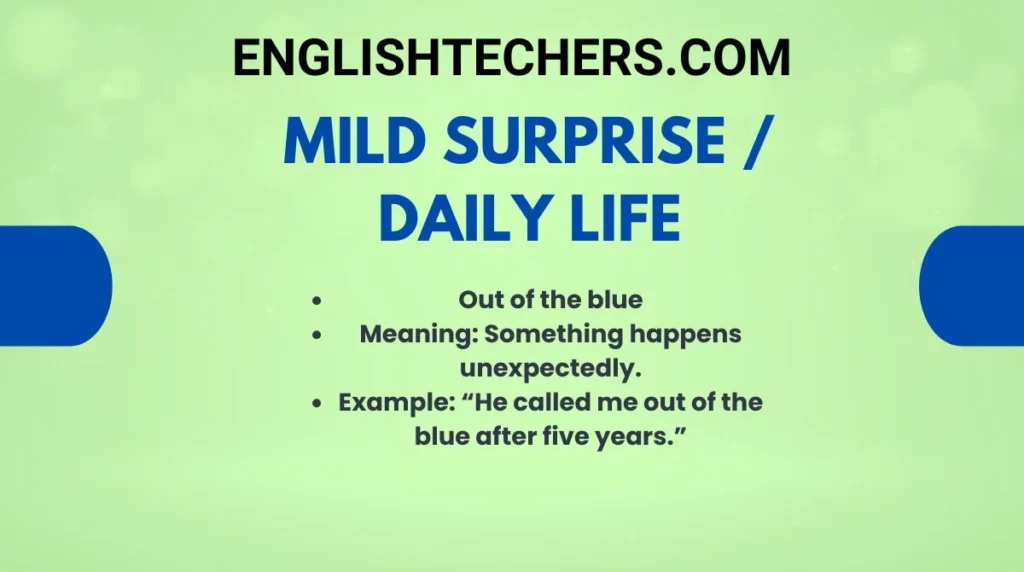
- Out of the blue
Meaning: Something happens unexpectedly.
Example: “He called me out of the blue after five years.” - Catch someone off guard
Dialogue:- Lisa: “Did you see the announcement?”
- Tom: “No! That really caught me off guard.”
- Take by surprise
Example: “The sudden rainstorm took everyone by surprise.” - Come as a shock
Example: “The news of her resignation came as a shock to the team.”
2. Stronger Shock / Emotional Intensity
Use these when the surprise is more intense, emotional, or stressful.
| Idiom | Usage | Emotion Level |
|---|---|---|
| Drop a bombshell | Reveal shocking news suddenly | High |
| Blindsided | Completely unprepared by an event | High |
| Hit like a ton of bricks | Feel sudden shock | Very High |
| Turn the tables | Unexpected reversal of events | Medium-High |
Mini cultural note: In workplace English, “drop a bombshell” is commonly used for big news like mergers, resignations, or promotions.
3. Unexpected Change / Life Events
For sudden twists in life, relationships, or career:
- Throw a curveball
Example: “The sudden policy change really threw us a curveball.”
Tip: Often used in sports metaphorically in business or life. - Come out of nowhere
Dialogue:- Sarah: “I didn’t see that promotion coming at all.”
- Mark: “Yeah, it really came out of nowhere!”
- A bolt from the blue
Example: “Her engagement announcement was a bolt from the blue.” - Turn on a dime (American English)
Meaning: Change suddenly and completely.
Example: “The project’s direction turned on a dime after the new CEO joined.”
4. Funny / Lighthearted Unexpected Events
Sometimes surprises make you laugh!
- Blow someone’s mind
Example: “That magic trick blew my mind!” - Knock your socks off
Example: “The dessert at that restaurant will knock your socks off.” - Throw for a loop
Example: “The unexpected pop quiz threw the students for a loop.”
Usage note: These idioms are informal and best for casual conversations.
5. Idioms in Literature & Storytelling
Idioms help authors express sudden plot twists. For example:
- All of a sudden – classic in stories: “All of a sudden, the door slammed shut.”
- Without warning – adds suspense: “Without warning, the sky turned dark.”
Mini cultural note: Writers often pair these with descriptive verbs to heighten drama.
6. Professional / Workplace Idioms
In office life or business contexts:
- Throw a spanner in the works (British English)
Meaning: Something disrupts a plan unexpectedly.
Example: “The supplier delay threw a spanner in the works.” - Come out of left field (American English)
Meaning: Completely unexpected in a business or strategic context.
Example: “Her proposal came out of left field during the meeting.” - Upset the apple cart
Example: “Changing the schedule at the last minute upset the apple cart.”
7. Exercises / Practice Sentences
Try filling in the blanks with an appropriate idiom for unexpected:
- The CEO’s resignation really __________ everyone in the office.
- I wasn’t ready for that twist; it completely __________ me.
- The news of the award came __________, and I couldn’t believe it.
- That sudden question in class __________ me for a loop!
- The weather today really __________, from sunshine to heavy rain.
8. Emotional Scale Table (Mild → Intense)
| Emotion Level | Idioms |
|---|---|
| Mild Surprise | Out of the blue, Take by surprise, Come as a shock |
| Moderate | Throw a curveball, Turn on a dime, Come out of nowhere |
| Intense | Drop a bombshell, Hit like a ton of bricks, Blindsided |
9. How to Use Idioms in Daily Life
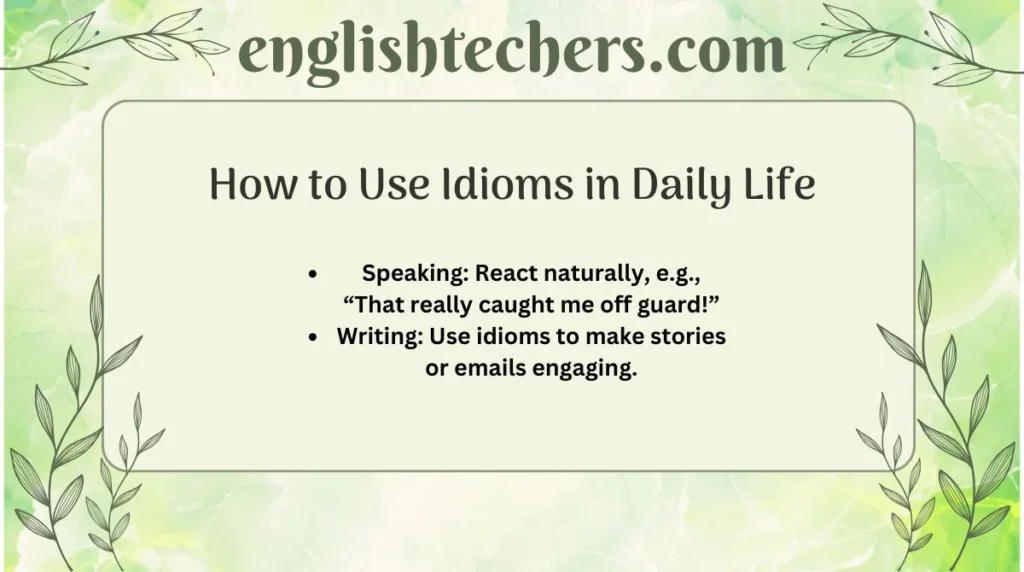
- Speaking: React naturally, e.g., “That really caught me off guard!”
- Writing: Use idioms to make stories or emails engaging.
- Professional: Select context-appropriate phrases, avoid overly casual ones in formal emails.
10. Common Mistakes Learners Make
- Literal translation: “The news hit me like a ton of bricks” doesn’t mean physical injury.
- Wrong intensity: Using a mild idiom for a shocking event can sound underwhelming.
- Formal vs informal: Idioms like “blow your mind” are informal, not suitable for academic writing.
- Overusing idioms: Too many idioms in one sentence can confuse readers.
- Mixing metaphors: Avoid combining unrelated idioms in one sentence.
FAQ
1: Are idioms universal?
A: No. Idioms vary across cultures; “throw a spanner in the works” is mainly UK, while “come out of left field” is US.
2: Can I use idioms in IELTS?
A: Yes, sparingly. Using idioms naturally can boost your score. Avoid forced usage.
3: Are idioms informal?
A: Some are informal (blow your mind), others are neutral (come as a shock). Always check context.
4: Can idioms appear in literature?
A: Absolutely! Writers use idioms for vivid, relatable expression.
5: How to remember idioms?
A: Use mini-stories, dialogues, or connect them to personal experiences.
Conclusion
Idioms for unexpected moments make your English more colorful, natural, and fun. From casual chats with friends to professional discussions, knowing when and how to use them adds personality and impact to your speech.
Start small—pick one idiom, use it in a sentence, and gradually expand your collection. Soon, reacting to life’s surprises in English will feel effortless and expressive.
Go ahead—try these idioms today and make your conversations unforgettable!

Thomas Reed is an experienced English teacher helping students learn with simple, clear lessons.
He focuses on improving speaking, grammar, and confidence through easy daily practice.