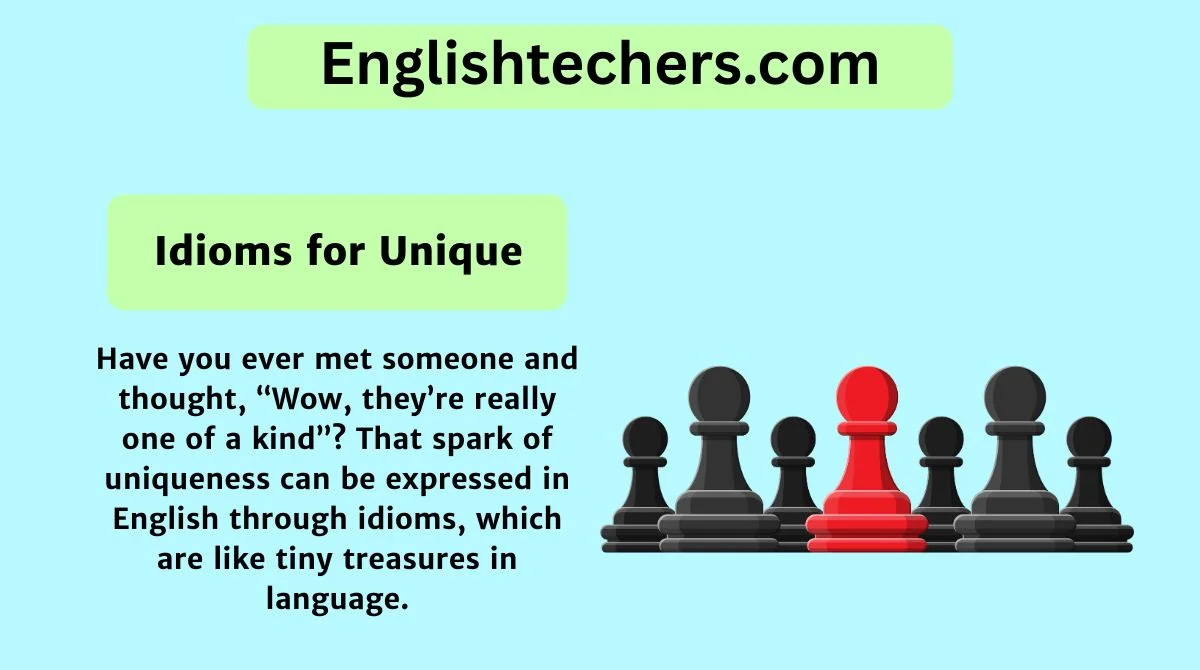
Have you ever met someone and thought, “Wow, they’re really one of a kind”? That spark of uniqueness can be expressed in English through idioms, which are like tiny treasures in language.
Idioms are phrases where the meaning isn’t obvious from the words themselves—they carry emotion, culture, and personality. Learning idioms for unique isn’t just fun; it helps you sound natural, confident, and even charming in conversations.
Imagine this: Sarah walked into her new office and noticed a coworker decorating their desk with vintage typewriters and quirky plants.
She whispered to a friend, “That person is truly a different kettle of fish!” In that single sentence, she captured the coworker’s individuality—without ever saying “unique.” That’s the power of idioms. They let you describe personality, situations, or things in colorful, memorable ways.
Idioms add life to your English, making you sound less like a textbook and more like a native speaker. Today, we’ll explore 19+ idioms for unique, grouped by context, emotion, and usage, with examples, mini-stories, and tips for learners.
Fun Fact / Trivia 🌍
Did you know? The idiom “one of a kind” dates back to the 17th century! People have long used figurative language to describe uniqueness because it captures personality better than plain words ever could.
Idioms in Daily Life 🏠
1. One of a kind
- Meaning: Completely unique.
- Example: “Her sense of style is one of a kind; no one else dresses like her.”
2. A different kettle of fish
- Mini Dialogue:
- Alex: “Is planning a wedding stressful?”
- Ben: “Sure, but organizing a surprise proposal is a whole different kettle of fish!”
3. Stand out from the crowd
- Example Story: Lucy joined a painting class. Her abstract style was bold, vibrant, and original. The teacher said, “Lucy really stands out from the crowd.”
4. March to the beat of one’s own drum
- Cultural Note: Often used in American English to praise individuality and independence.
- Example: “He doesn’t follow trends. He marches to the beat of his own drum.”
Workplace & Professional Idioms 💼
| Idiom | Meaning | Example |
|---|---|---|
| Cut from a different cloth | Has a very different character | “Our new manager is cut from a different cloth—very creative and flexible.” |
| Blaze a trail | Do something original | “She blazed a trail in the marketing world with her innovative campaigns.” |
| Break the mold | Defy tradition | “His presentation broke the mold; it was unlike anything we’d seen before.” |
Usage Tip: These idioms work well in emails or meetings to compliment coworkers or highlight innovative projects.
Fun & Quirky Idioms 😄
7. Oddball / Quirky
- Example: “James is a bit of an oddball, but that’s why everyone likes him.”
8. Out of left field
- Mini Story: During a brainstorming session, Claire suggested a VR approach to marketing. Her colleagues laughed, then realized it was genius. “That idea came out of left field,” said the manager.
9. Cut a unique figure
- Example: “He cuts a unique figure at events with his retro jackets and hats.”
10. March to your own drum
- Already mentioned in daily life but also fun in social or creative settings.
Idioms in Literature 📚
Writers love idioms for uniqueness because they convey personality in just a few words.
- Example: In F. Scott Fitzgerald’s The Great Gatsby, characters who stand out from the crowd are often mysterious or extraordinary.
- Mini Cultural Note: English literature frequently pairs idioms with symbolism to highlight uniqueness, making reading both enjoyable and educational.
Emotional Scale Table: Mild → Intense 💖
| Intensity | Idioms | Example |
|---|---|---|
| Mild | One of a kind, Oddball | “Her taste in music is one of a kind.” |
| Moderate | Blaze a trail, Cut from a different cloth | “He blazed a trail with his startup ideas.” |
| Intense | Out of left field, Break the mold | “Her revolutionary research really breaks the mold.” |
Exercises / Practice Sentences ✍️
- Fill in the blank: “My grandma’s recipes are ____________; no one cooks like her.”
- Rewrite: “He’s very different from other students” using an idiom.
- Dialogue completion:
- A: “Do you think her idea will work?”
- B: “I don’t know, it’s ____________.”
Answers: 1 → one of a kind, 2 → cut from a different cloth, 3 → out of left field
How to Use Idioms in Daily Life ✅
- Speaking: Compliment friends, describe personalities, or spice up conversations.
- Writing: Emails, social media posts, creative writing.
- Professional settings: Praise coworkers, explain innovative ideas, or describe new trends.
Common Mistakes Learners Make ⚠️
- Using idioms literally (“He’s really a different kettle of fish” → wrong interpretation).
- Overusing one idiom repeatedly.
- Mixing up similar idioms (“cut from the same cloth” vs “cut from a different cloth”).
- Using informal idioms in formal writing (e.g., “oddball” in reports).
- Forgetting context: some idioms suit casual speech but not professional emails.
FAQ
1: Are idioms for uniqueness used worldwide?
A: Many idioms are culture-specific, but equivalents exist in most languages. Always check the context.
2: Can I use these idioms in formal writing?
A: Some, like cut from a different cloth or break the mold, are suitable. Avoid overly casual idioms like oddball.
3: Which idioms are best for IELTS or exams?
A: One of a kind, stand out from the crowd, break the mold are safe and versatile.
4: Can idioms have multiple meanings?
A: Yes! Out of left field can mean “unexpected” in general, not just “unique.”
5: How to practice idioms effectively?
A: Use mini-stories, dialogues, or write daily sentences incorporating new idioms.
Conclusion
Idioms for unique aren’t just fun—they make your English colorful, memorable, and natural. Whether in conversations, emails, or exams, these idioms help you express individuality and creativity.
Start using one idiom a day in your writing or speech, and you’ll notice your English sounding more lively and native. Remember, being unique in English expression is as exciting as being unique in life—so stand out from the crowd!

Thomas Reed is an experienced English teacher helping students learn with simple, clear lessons.
He focuses on improving speaking, grammar, and confidence through easy daily practice.