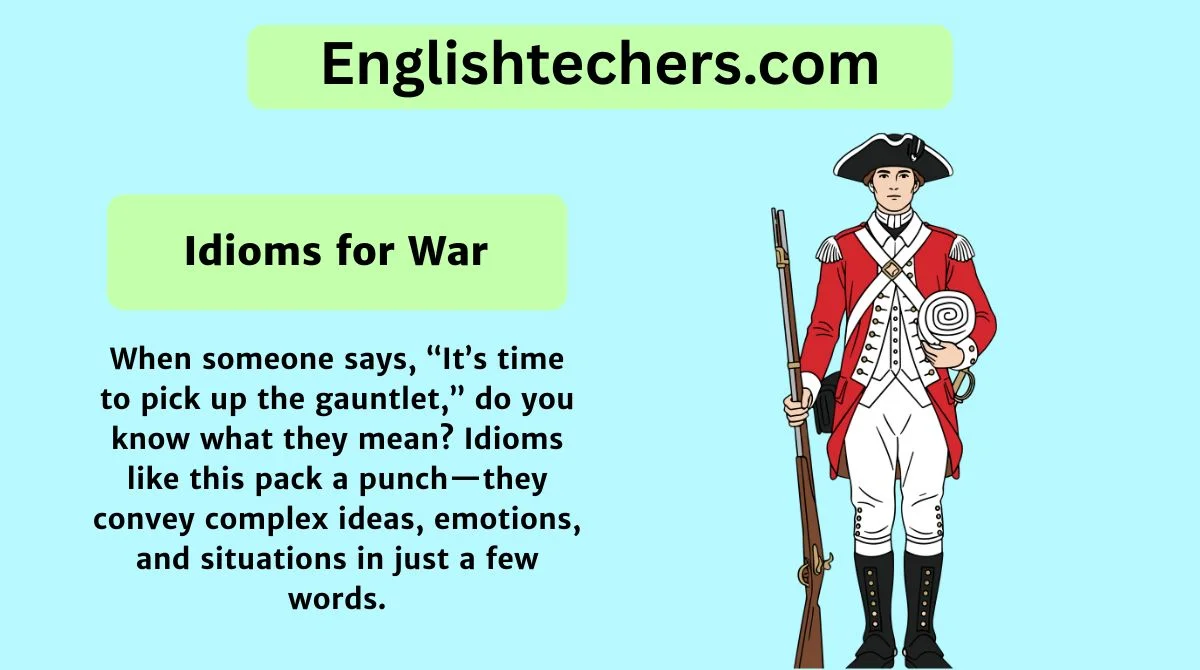
When someone says, “It’s time to pick up the gauntlet,” do you know what they mean? Idioms like this pack a punch—they convey complex ideas, emotions, and situations in just a few words.
Idioms for war are particularly vivid, often borrowed from centuries of battles, strategy, and heroism. They show conflict, struggle, or determination, making your English sound dynamic and natural.
Imagine this: Sarah is nervous about her presentation at work. She tells her friend, “I’ll go into battle with my slides today!” Even though she isn’t literally fighting, the expression immediately communicates stress, courage, and preparation.
That’s the power of idioms—they turn ordinary sentences into memorable, colorful language.
In this article, we’ll explore 19+ idioms for war, grouped by intensity and context, with mini-stories, tables, dialogues, and exercises to help you use them naturally.
By the end, you’ll not only understand these idioms but also confidently sprinkle them into your writing and speech.
🎖 Fun Fact / Trivia About War Idioms
Did you know that many English war idioms date back to the Middle Ages or even Roman times? Phrases like “at daggers drawn” and “bite the bullet” originally described literal battles or injuries.
Over time, they evolved to express emotional, professional, and social conflicts too.
💥 Idioms Grouped by Intensity
Here’s a simple emotional scale for war idioms—from mild tension to full-blown conflict.
| Intensity | Idioms | Example |
|---|---|---|
| Mild stress | Call a truce | “Let’s call a truce before this argument ruins our friendship.” |
| Frustration | Lock horns | “The two managers locked horns over the budget report.” |
| Serious conflict | Pick up the gauntlet | “After hearing the criticism, she picked up the gauntlet and defended her project.” |
| Intense battle | Fight tooth and nail | “They fought tooth and nail to win the championship.” |
| Total war | Go to the mat | “When it comes to patent disputes, this company goes to the mat.” |
⚔️ 19+ War Idioms Explained
1. Bite the bullet
Meaning: To face a difficult situation bravely.
Example story: During the final exam week, Ravi decided to bite the bullet and study all night instead of procrastinating.
2. At daggers drawn
Mini dialogue:
- Emma: “I heard Jane and Lucy are at daggers drawn again.”
- Liam: “Yes, they’ve been rivals since last year’s debate competition.”
3. Call a truce
Used in daily life to suggest stopping an argument or conflict temporarily.
“After hours of bickering, they finally called a truce and agreed to disagree.”
4. Lock horns
Cultural note: Often used in politics and workplace debates.
“The two CEOs locked horns during the merger meeting.”
5. Pick up the gauntlet
Origin: Medieval knights literally threw down a glove (gauntlet) to challenge someone.
“She picked up the gauntlet and submitted her counter-proposal.”
6. Fight tooth and nail
Intense struggle or effort.
“The small startup fought tooth and nail to compete with industry giants.”
7. Go to the mat
Workplace usage: Competing fiercely in business or law.
“The lawyers went to the mat over the trademark case.”
8. Sound the retreat
Used to indicate withdrawing or ending an effort.
“After several failed campaigns, the marketing team sounded the retreat.”
9. Cross swords
Short paragraph style:
When two people argue or compete sharply, we say they cross swords. In literature, you’ll often read about heroes crossing swords with their rivals. Example: “They crossed swords in the boardroom, each defending their strategy.”
10. Run a tight ship
Not exactly literal war, but derived from military discipline.
“As a project manager, she runs a tight ship, leaving no room for mistakes.”
11. Hold the fort
Micro-story:
Tom was worried when his boss left. But he knew how to hold the fort, keeping the office running smoothly until her return.
12. On the warpath
Meaning: Angry and ready to confront.
“The customer was on the warpath after receiving a defective product.”
13. Take no prisoners
Funny twist: Sometimes used in sports humor.
“Our soccer coach takes no prisoners—he even benches the star player if rules are broken!”
14. Fire at will
Mini exercise: Complete this sentence: During the debate, Sarah ________ with sharp questions about the policy. (Answer: fired at will)
15. Maneuver around
Dialogue style:
- Alex: “How do you handle tricky colleagues?”
- Nina: “I try to maneuver around conflicts rather than create new ones.”
16. Draw a line in the sand
Used to set a firm boundary.
“I will tolerate small mistakes, but I draw a line in the sand for unethical behavior.”
17. Bombshell / landmine
Cultural note: Derived from wartime explosives, used metaphorically for surprises or problems.
“The CEO dropped a bombshell about layoffs during the meeting.”
18. Hit below the belt
Common mistake warning: Often confused with literal strikes. Remember, it’s figurative: “That comment about her family hit below the belt.”
19. Take up arms
Literature usage: Often appears in historical novels.
“Villagers took up arms to defend their town from invaders.”
20. Storm the gates
Creative twist / humor: Can be playful too:
“I’m going to storm the gates of the coffee shop before they run out of muffins.”
💡 Idioms in Real Life
- Workplace: “Lock horns” or “hold the fort”
- Sports: “Fight tooth and nail” or “take no prisoners”
- Daily life: “Call a truce” or “bite the bullet”
📚 Idioms in Literature
Many classic novels and poems use war idioms to describe internal struggles or literal battles. For example:
- Shakespeare: “At daggers drawn” in Henry IV
- Hemingway: “Take up arms” in A Farewell to Arms
✨ How to Use Idioms in Daily Life
- Speaking: Add energy to stories, debates, or casual conversations.
- Writing: Use idioms to make essays, emails, and creative writing more colorful.
- Professional: Apply mild war idioms (like call a truce) to maintain diplomacy.
⚠️ Common Mistakes Learners Make
- Using idioms literally (“He literally took up arms in the office”)
- Confusing intensity levels (“fight tooth and nail” for a small issue)
- Overusing idioms (makes speech unnatural)
- Ignoring context (formal vs informal)
- Mixing idioms from different cultures (“call a truce” in casual humor may confuse non-native speakers)
📝 Practice Sentences
Complete with the correct idiom:
- After hours of negotiation, both sides finally decided to ________.
- She was furious and ________ after hearing the unfair comment.
- The team ________ to win the championship last year.
- He always ________ to manage his projects efficiently.
- The politician ________ with his rival during the debate.
FAQ
1: Are war idioms formal or informal?
Mostly informal, but some like hold the fort can be used professionally.
2: Can non-native speakers use these idioms?
Yes! Start with mild idioms, then progress to intense expressions.
3: Do all war idioms imply literal fighting?
No, most are figurative, describing conflict, effort, or stress.
4: Can idioms be used in IELTS writing/speaking?
Yes, appropriately used idioms demonstrate language proficiency.
5: Are these idioms culturally universal?
Not entirely; some are rooted in Western history. Use context carefully.
Conclusion
War idioms are a fun, expressive tool for learners who want to make English dynamic and engaging. From mild disputes to fierce competition, these phrases capture human emotion vividly.
Try sprinkling them into conversations, emails, or essays—you’ll sound more confident, natural, and culturally aware. Start with one or two idioms per week, and soon you’ll be speaking like a native… ready for any battle life throws your way!

Thomas Reed is an experienced English teacher helping students learn with simple, clear lessons.
He focuses on improving speaking, grammar, and confidence through easy daily practice.