

Idioms are the colorful threads that weave the fabric of any language. They’re more than just phrases—they carry culture, humor, and emotion, making language vibrant and alive.
Imagine Sarah, a student from Spain, trying to express frustration at work. She says, “I’m feeling under the weather,” and suddenly her colleagues instantly understand her mood without a long explanation.
That’s the magic of idioms—they convey feelings, stories, and nuances in a snap. For learners of English, exploring idioms from around the world opens doors to authentic communication, improves comprehension, and adds flair to both speaking and writing.
In this article, we’ll explore 23+ idioms, grouped by emotion, context, and culture, giving you practical tools to sound more like a native speaker.
Fun Fact / Trivia
Did you know some English idioms actually originated from other languages? For example, “to carry coals to Newcastle” comes from the UK but mirrors a similar Dutch idiom. Idioms are little time capsules of cultural history!
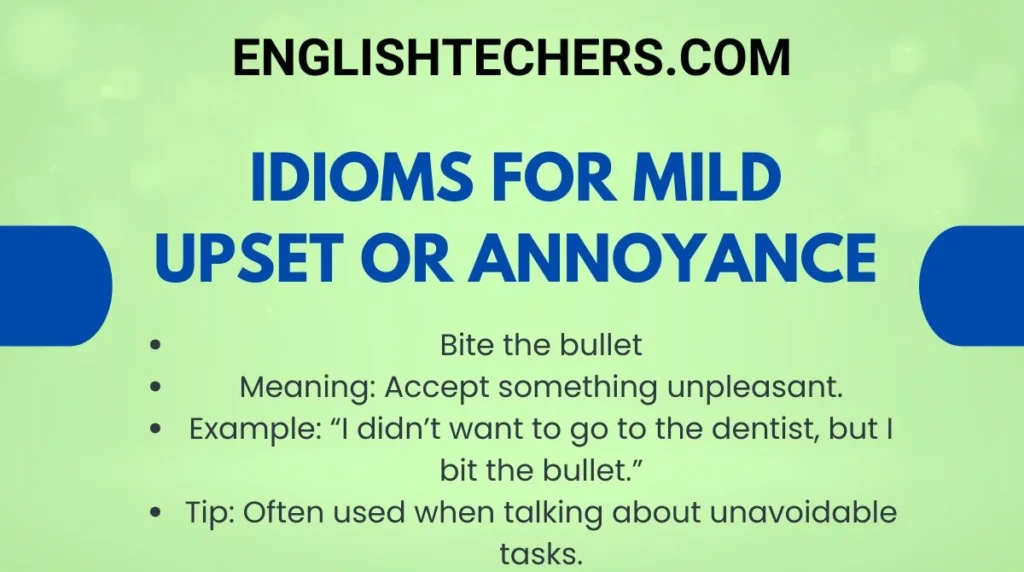
Idioms for Mild Upset or Annoyance
Sometimes, life throws small irritations your way. Here are a few idioms to express mild frustration:
- Bite the bullet
Meaning: Accept something unpleasant.
Example: “I didn’t want to go to the dentist, but I bit the bullet.”
Tip: Often used when talking about unavoidable tasks. - A storm in a teacup
Meaning: Overreacting to something small.
Dialogue:
- Anna: “He spilled coffee on his shirt and now he’s crying!”
- Ben: “It’s a storm in a teacup—he’ll be fine.”
- Hit the nail on the head
Meaning: Describe exactly what’s right.
Mini cultural note: Commonly used in workplaces to praise someone’s observation or suggestion.
Idioms for Stress & Pressure
When life feels heavy, these idioms capture the tension perfectly:
| Idiom | Meaning | Example |
|---|---|---|
| Burn the midnight oil | Work late | “I burned the midnight oil to finish my project.” |
| Carry the weight of the world | Feel responsible | “She’s carrying the weight of the world with her team’s deadlines.” |
| Walking on eggshells | Be very careful | “He’s walking on eggshells around his boss today.” |
Cultural tip: “Burn the midnight oil” comes from times when people literally used oil lamps to work late at night.
Heartbreak & Sadness Idioms
- Break the ice (light, social context)
Example: “I told a funny story to break the ice at the party.” - Cry over spilled milk(regret / sadness)
Dialogue:- Tom: “I failed my exam.”
- Liz: “Don’t cry over spilled milk—study harder next time!”
- Down in the dumps
Meaning: Feeling sad or depressed.
Tip: Commonly used in casual conversations and writing.
Frustration & Anger Idioms
- At the end of one’s rope
Meaning: Completely fed up or frustrated.
Example: “After three hours of fixing the printer, I was at the end of my rope.” - Blow off steam
Meaning: Release pent-up emotions.
Mini exercise: Write a sentence about how you blow off steam after a long day. - Kick the bucket (humorous context)
Meaning: To die. Used more in jokes or literature.
Idioms in the Workplace / Professional Settings
- Touch base (quick check-in)
Example: “Let’s touch base tomorrow about the project updates.” - Think outside the box
Usage tip: Encourages creativity and innovation in meetings. - Get the ball rolling
Example: “We need to get the ball rolling on the new campaign.”
Cultural note: Many workplace idioms are borrowed from sports, especially British football and baseball.
Funny Idioms & Creative Twists
- Let the cat out of the bag – Reveal a secret accidentally.
- Not my cup of tea – Something you don’t enjoy.
- When pigs fly – Impossible events.
Dialogue example:
- Sam: “Will you do my homework?”
- Mia: “When pigs fly, Sam!”
Idioms from Literature
- The pen is mightier than the sword – Words have more power than violence.
- Caught between a rock and a hard place – Tough decisions.
- All’s well that ends well – A Shakespearean reminder that outcomes matter more than struggles.
Tip: Reading novels or classic literature exposes you to idioms in context, making them easier to remember.
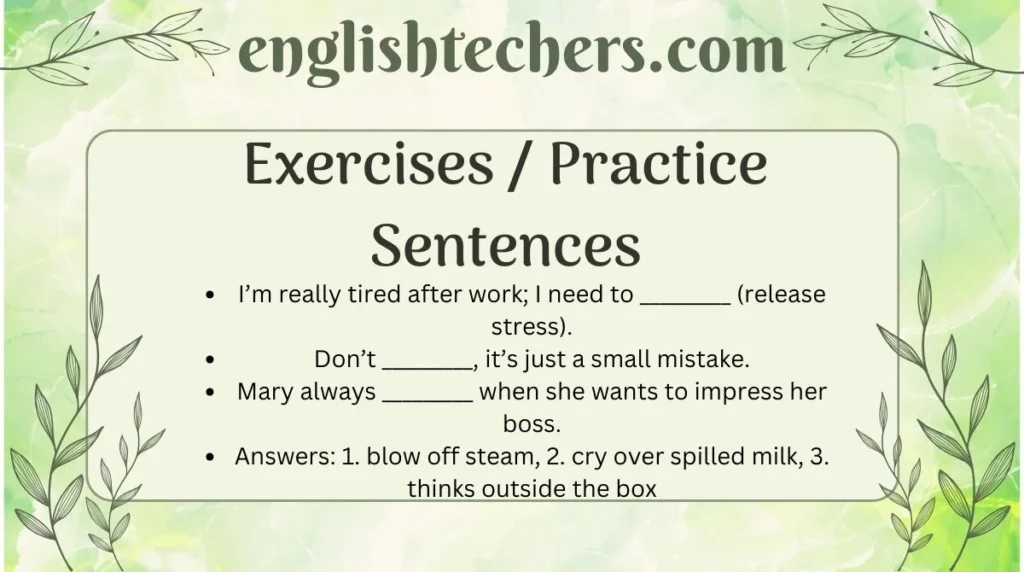
Exercises / Practice Sentences
Fill in the blanks with the correct idiom:
- I’m really tired after work; I need to _________ (release stress).
- Don’t _________, it’s just a small mistake.
- Mary always _________ when she wants to impress her boss.
Answers: 1. blow off steam, 2. cry over spilled milk, 3. thinks outside the box
Emotional Intensity Table (Mild → Intense)
| Emotion | Mild | Medium | Intense |
|---|---|---|---|
| Upset | Storm in a teacup | Bite the bullet | At the end of one’s rope |
| Stress | Burn the midnight oil | Walking on eggshells | Carry the weight of the world |
| Sadness | Down in the dumps | Cry over spilled milk | Heartbroken |
How to Use Idioms in Daily Life
- Speaking: Sprinkle idioms naturally; don’t force them.
- Writing: Use idioms to make your texts or emails more expressive.
- Professional: Stick to familiar, widely accepted idioms like “touch base” or “think outside the box.”
Common Mistakes Learners Make
- Using idioms literally (“It’s raining cats and dogs” → thinking actual animals fall).
- Mixing idioms incorrectly (“Break the milk” instead of “cry over spilled milk”).
- Overusing idioms, making speech sound unnatural.
- Using culture-specific idioms in inappropriate contexts.
- Forgetting the correct preposition or verb in idioms.
FAQ
1: Are idioms universal across English-speaking countries?
A1: Not always. Some idioms are British or American specific. “Bob’s your uncle” is common in the UK but rare in the US.
2: Can idioms be used in formal writing?
A2: Some idioms, especially business ones, are fine. Literary idioms can add flair, but casual idioms may not suit academic papers.
3: How can I remember idioms better?
A3: Use mini-stories, dialogues, or link them to personal experiences.
4: Do idioms help in exams like IELTS?
A4: Yes! Using idioms correctly in speaking or writing can boost your score and show natural language use.
5: Can idioms be translated literally?
A5: Usually not. Direct translation often loses the meaning. Learn the equivalent idiom in your language instead.
Conclusion
Idioms are the heartbeat of a language—they express emotions, add humor, and connect speakers across cultures.
From mild annoyances to heart-wrenching moments, these 23+ idioms from around the world give you a toolkit for every situation.
Start small: try using one idiom a day in conversation or writing. Soon, you’ll notice your English sounding more natural, colorful, and engaging. Keep exploring, practicing, and laughing along the way! 🌟

Thomas Reed is an experienced English teacher helping students learn with simple, clear lessons.
He focuses on improving speaking, grammar, and confidence through easy daily practice.