
Have you ever heard someone say, “I’m feeling under the weather,” even when the sky was perfectly blue? Welcome to the world of idioms—expressions where the meaning is deeper than the words themselves.
Idioms make English colorful, emotional, and human. They help learners move from correct English to natural English.
Weather idioms are especially powerful because everyone understands weather. Rain, sunshine, storms, and clouds are universal experiences.
Native speakers use these idioms every day to talk about moods, problems, success, stress, and hope.
Let me share a quick story. A student once told me, “My boss is raining anger on me.” I smiled—not because it was wrong, but because it showed learning in action. With one small adjustment (“raining criticism”), the sentence became natural and confident.
That’s the goal of this article: to help you understand, feel, and use weather idioms naturally, whether you’re chatting with friends, writing essays, or speaking at work.
☁️ Fun Fact / Trivia
Did you know that over 30% of common English idioms come from nature, especially weather and farming? Before weather apps, people watched the sky closely—so weather became a language of emotion, warning, and wisdom.
🌈 Emotional Scale: Weather Idioms from Light to Intense
| Emotion Level | Feeling | Common Weather Images |
|---|---|---|
| Mild | Slight sadness, small problems | Clouds, drizzle |
| Medium | Stress, confusion | Wind, fog |
| Strong | Anger, pressure | Storms, thunder |
| Intense | Crisis, deep emotion | Hurricanes, lightning |
We’ll explore idioms across this emotional scale.
☀️ Everyday Life Weather Idioms (Most Common)
1. Under the weather
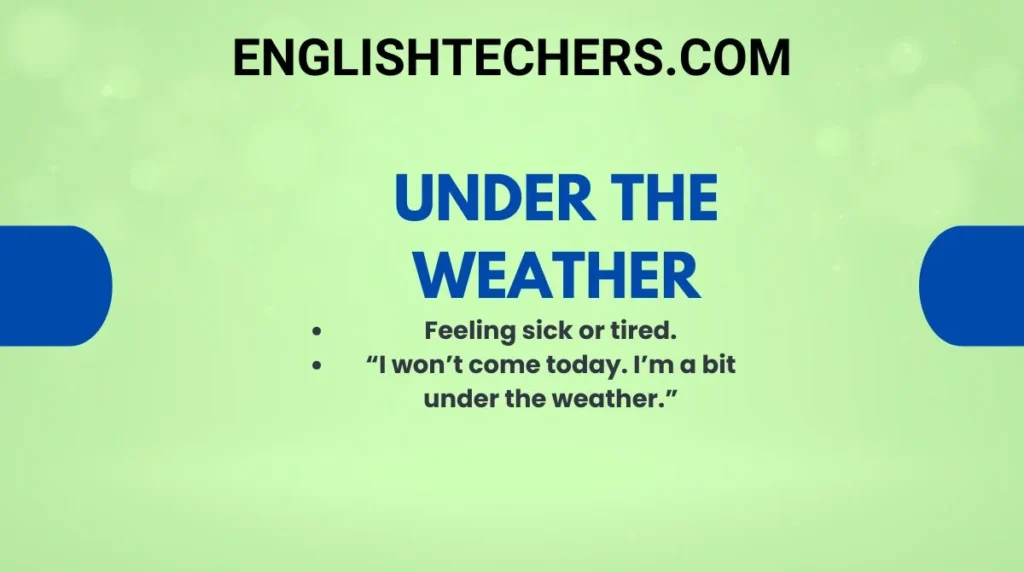
Feeling sick or tired.
“I won’t come today. I’m a bit under the weather.”
💡 Native speakers use this politely instead of saying “I’m ill.”
2. A breath of fresh air
Something new and positive.
Micro-story:
After months of boring meetings, the new manager arrived. She listened, smiled, and made changes. Everyone agreed—she was a breath of fresh air.
3. Rain or shine
No matter what happens.
“I’ll support you, rain or shine.”
Used often in promises and relationships.
4. Save for a rainy day
To prepare for future problems.
Cultural note:
This idiom reflects traditional values of planning and responsibility in English-speaking cultures.
🌬️ Stress, Confusion & Pressure Idioms
5. Stormy relationship
Full of arguments and tension.
“They love each other, but it’s a stormy relationship.”
6. Weather the storm
To survive a difficult time.
Dialogue:
A: “The company is losing money.”
B: “Yes, but we’ll weather the storm.”
Common in business and life advice.
7. In the eye of the storm
In the center of trouble.
⚠️ Usage warning:
Not used for small problems. This idiom suggests serious pressure.
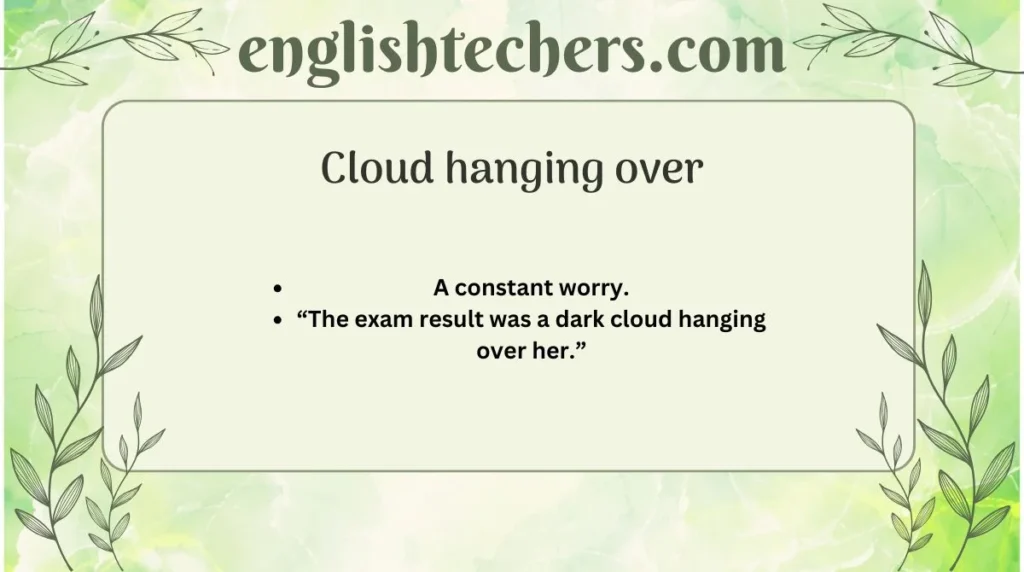
8. Cloud hanging over
A constant worry.
“The exam result was a dark cloud hanging over her.”
🌧️ Sadness, Disappointment & Emotional Weather
9. It never rains but it pours
Problems come all at once.
Mini story:
First, he lost his phone. Then his car broke down. Then he missed his flight. It never rains but it pours.
10. A storm is brewing
Trouble is coming.
Used when tension is quiet but growing.
11. Rain on someone’s parade
To spoil happiness.
“I hate to rain on your parade, but the plan won’t work.”
Often used gently before bad news.
☁️ Confusion & Uncertainty Idioms
12. In a fog
Mentally confused.
“After the long flight, I was in a fog.”
13. Head in the clouds
Dreamy or unrealistic.
💡 Can be positive (creative) or negative (not practical).
14. Foggy idea
Not clear or detailed.
Common in academic and professional feedback.
⚡ Anger, Shock & Strong Reaction Idioms
15. A bolt from the blue
A sudden surprise.
“Her resignation was a bolt from the blue.”
Often used in news and storytelling.
16. Steal someone’s thunder
Take credit from someone else.
Workplace note:
This idiom is common in meetings and office politics.
17. Throw caution to the wind
Act without fear.
“He threw caution to the wind and started his own business.”
Positive risk-taking.
🌤️ Hope, Success & Positive Change
18. Every cloud has a silver lining
Good can come from bad.
Classic motivational idiom used worldwide.
19. On cloud nine
Extremely happy.
💬 Informal, very common in daily speech.
20. Chase rainbows
Pursue unrealistic dreams.
⚠️ Often used as a gentle warning, not an insult.
📚 Weather Idioms in Literature & Media
Writers love weather idioms because they show emotion without explaining it.
- Shakespeare often used storms to show chaos.
- Modern novels use clouds and fog to show confusion.
- News headlines use idioms like “stormy debate” or “economic clouds.”
💼 Weather Idioms in Professional & Workplace English
Appropriate and common idioms:
- Weather the storm – resilience
- A breath of fresh air – innovation
- Cloud hanging over – risk
- Stormy discussion – tense meeting
❗ Avoid very emotional idioms (on cloud nine) in formal emails.
😄 Funny & Creative Weather Idioms
- “He changes opinions faster than the weather.”
- “Her mood forecast: partly sunny, partly sarcastic.”
- “My motivation today is foggy with a chance of snacks.”
Creative twists help you sound playful and confident.
🧠 How to Use Idioms in Daily Life
Speaking
- Use 1 idiom per conversation, not more.
- Pause slightly before the idiom for emphasis.
Writing
- Best in blogs, stories, and personal emails.
- Avoid overuse in academic essays.
Professional Settings
- Choose neutral idioms.
- Match the emotional level to the situation.
❌ Common Mistakes Learners Make
- Using idioms too literally
❌ “It is raining on my parade today.”
✅ “You’re raining on my parade.” - Wrong emotional level
Using strong idioms for small problems. - Overusing idioms
One or two is enough. - Wrong tense or article
❌ “In eye of storm”
✅ “In the eye of the storm”
✍️ Practice Section (Try It!)
Fill in the blanks:
- After hearing the good news, she was on ________ ________.
- We must save money for a ________ day.
- He tried not to ________ on her parade.
Answers:
- cloud nine
- rainy
- rain
FAQ
Are weather idioms formal or informal?
Most are informal to semi-formal. Some are fine at work.
Can I use weather idioms in IELTS?
Yes, but use them naturally and correctly.
Do all cultures use weather idioms?
Yes, but meanings differ. Always learn context.
How many idioms should I learn at once?
5–7 per week is ideal.
Can idioms help me sound fluent?
Absolutely. Idioms signal advanced understanding.
Conclusion
Weather idioms turn simple English into living language. They help you express emotion, describe situations, and connect with native speakers on a human level.
You don’t need to memorize hundreds—just understand a few deeply and use them with confidence.
Start small. Notice how people speak. Try one idiom today, then another tomorrow. Soon, your English won’t just be correct—it will feel natural, expressive, and alive.
☀️ Don’t wait for perfect weather. Start speaking now.

Thomas Reed is an experienced English teacher helping students learn with simple, clear lessons.
He focuses on improving speaking, grammar, and confidence through easy daily practice.