
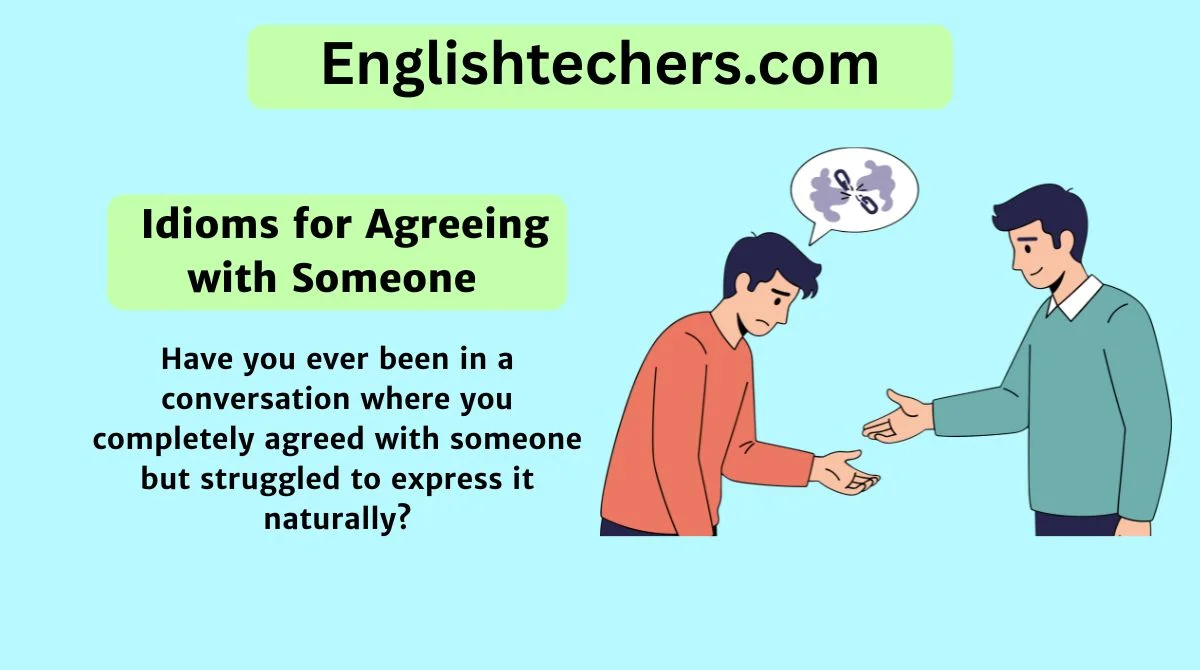
Have you ever been in a conversation where you completely agreed with someone but struggled to express it naturally? Simply saying “I agree” works, but idioms make your English colorful, memorable, and native-like.
Idioms are phrases where the meaning isn’t obvious from the individual words. For example, if someone says, “That movie was a masterpiece,” instead of just replying “I agree,” you could say, “You hit the nail on the head!”—a fun, idiomatic way to show agreement.
Idioms for agreeing are invaluable for learners because they:
- Make your speech more natural and engaging
- Help you understand native conversations
- Improve your writing, especially essays and emails
Imagine this: your friend says, “Teamwork is key to success.” You respond, “Couldn’t agree more!” Suddenly, you’re not just agreeing—you’re showing enthusiasm, friendliness, and understanding, all in one phrase. That’s the power of idioms.
🎉 Fun Fact: Why Idioms Stick
Many idioms for agreeing have cultural origins. For example, “on the same page” comes from printing terminology, where everyone literally had to read the same page to avoid mistakes. Using idioms can connect you to English history and culture, not just words.
✅ Common Idioms for Agreeing (Varied Formats)
1. Hit the Nail on the Head
Example Dialogue:
- Alex: “I think we need to focus on quality, not speed.”
- Jamie: “You hit the nail on the head!”
Tip: Perfect for emphasizing that someone is exactly right.
2. Couldn’t Agree More
Short paragraph:
This is one of the strongest ways to show agreement. It’s enthusiastic and friendly. Use it in casual conversations or professional emails.
- Example: “The new policy will help our team grow.” → “Couldn’t agree more!”
3. On the Same Page
Cultural Note: Often used in workplace or team settings to show alignment.
- Example: “Before we start, I want to make sure we’re on the same page.”
- Meaning: Everyone understands and agrees on the plan.
4. I’m with You on That
Dialogue/Micro-Story:
- Teacher: “Reading regularly improves your vocabulary.”
- Student: “I’m with you on that. I noticed it really helps my writing.”
Usage tip: Casual and versatile for conversations or informal writing.
5. Speak the Same Language
Short paragraph:
This idiom isn’t about actual languages—it shows mutual understanding.
- Example: “We really speak the same language about marketing strategies.”
Mini cultural note: Often used to describe shared ideas or visions in professional or friendship contexts.
6. Right on the Money
Example Dialogue:
- Friend: “I think social media marketing drives more sales than email.”
- You: “Right on the money!”
Tip: Great for precise agreement or acknowledging accuracy.
7. You Took the Words Right Out of My Mouth
Short paragraph:
Use this when someone says exactly what you were thinking.
- Example: “We need a break after this long meeting.” → “You took the words right out of my mouth!”
Fun twist: Can be humorous in casual chats.
8. Agreed
Mini cultural note:
The simplest idiom—short, polite, professional. Works in emails, texts, and meetings.
- Example: “Let’s meet at 10 AM tomorrow.” → “Agreed.”
9. That’s Exactly How I Feel
Emotional scale: Mild → Intense
- Mild: “That movie was nice.” → “Yeah, that’s exactly how I feel.”
- Intense: “I believe honesty is the best policy.” → “That’s exactly how I feel!”
Tip: Good for expressing emotional agreement.
10. Couldn’t Have Said It Better
Short paragraph:
Use this when you want to praise someone’s phrasing while agreeing.
- Example: “Consistency is the key to learning.” → “Couldn’t have said it better.”
11. I’m in Total Agreement
Professional setting:
This idiom is formal and polite—great for workplace emails or meetings.
- Example: “Implementing the new software will increase efficiency.” → “I’m in total agreement.”
12. That Rings True
Usage warning: Often confused with “sounds true,” but “rings true” has a stronger, intuitive sense.
- Example: “Hard work leads to success.” → “That really rings true.”
13. Absolutely
Table – Intensity Levels
| Idiom | Intensity | Example | Context |
|---|---|---|---|
| Absolutely | Strong | “Is teamwork essential?” → “Absolutely.” | Casual, professional |
| Couldn’t agree more | Strong | “We need more training.” → “Couldn’t agree more.” | Casual, professional |
| I’m with you on that | Medium | “Reading helps vocabulary.” → “I’m with you on that.” | Casual |
| True that | Mild | “Coffee helps me focus.” → “True that.” | Very casual |
14. True That
Dialogue/Micro-Story:
- Sam: “Coding late at night always helps me think.”
- Alex: “True that!”
Tip: Very casual, mostly spoken English among friends.
15. You and I Are on the Same Wavelength
Cultural Note:
This idiom shows deep understanding, often used for creative or professional collaboration.
- Example: “I knew you’d understand my idea.” → “You and I are on the same wavelength.”
16. Fair Enough
Mini Exercise: Fill in the blank
- Person A: “Maybe we should wait for feedback before deciding.”
- Person B: “________.” → (Answer: Fair enough)
Tip: Shows agreement without strong enthusiasm, polite in mixed conversations.
🏢 Idioms for Workplace & Professional Settings
- On the same page
- I’m in total agreement
- Absolutely
- Right on the money
Pro tip: Formality matters—avoid “True that” or “You took the words out of my mouth” in official emails.
📖 Idioms in Literature
- Classic novels often use idioms to show character alignment or agreement.
- Example: “Hit the nail on the head” appears in dialogue to emphasize accuracy and wit.
😂 Funny / Creative Twists
- “You took the words out of my mouth”—Imagine someone literally stealing words from a dictionary!
- “True that!”—Could be paired with a wink for extra humor.
✍️ How to Use Idioms in Daily Life
- Speaking: Sprinkle idioms in casual chats to sound friendly.
- Writing: Use idioms in emails or essays, but match tone to context.
- Professional: Stick to formal idioms like on the same page or in total agreement.
⚠️ Common Mistakes Learners Make
- Using idioms too literally: “Hit the nail on the head” does not mean fixing furniture!
- Mixing casual idioms in formal emails: Avoid True that! in professional settings.
- Overusing idioms—1–2 per sentence is enough.
- Forgetting context—some idioms are only for spoken English.
- Translating idioms word-for-word from your native language.
📝 Mini Practice Exercise
Fill in the blanks:
- “I think teamwork is the key to success.” → “________!”
- “Reading books expands your mind.” → “________ I feel!”
- “We should meet at 9 AM.” → “________.”
FAQ
1: Are idioms for agreeing formal?
A: Some are formal (I’m in total agreement), others casual (True that!). Choose based on context.
2: Can I use these idioms in IELTS speaking?
A: Absolutely! Idioms show natural language use, but avoid overstuffing your answers.
3: Do idioms vary in different English cultures?
A: Yes. “True that!” is more American, while “Fair enough” is common in the UK.
4: Can beginners use idioms?
A: Yes, start with simple ones like Agreed or Couldn’t agree more.
5: What’s the easiest idiom for daily conversations?
A: I’m with you on that and Fair enough are versatile and safe.
✨ Conclusion (100 words)
Idioms for agreeing aren’t just fun—they enhance your English, make you sound confident, and connect you to native speakers.
From casual chats with friends to professional meetings, knowing when and how to use idioms adds flair and clarity to your conversations.
Practice them with dialogues, short stories, and writing exercises, and you’ll notice a boost in both understanding and expression.
Start small, pick your favorite idioms, and gradually mix them into daily life. Remember, mastering idioms is a journey, not a race, but each new phrase brings you closer to sounding like a native.

Thomas Reed is an experienced English teacher helping students learn with simple, clear lessons.
He focuses on improving speaking, grammar, and confidence through easy daily practice.