
Life isn’t always sunshine and rainbows. Sometimes, it feels like everything is going wrong at once—your alarm doesn’t go off, your coffee spills, or an important project fails.
These moments are bad situations, and English speakers often use idioms to express them naturally.
Idioms are phrases whose meanings cannot always be understood from the individual words. Instead, they carry cultural flavor and emotion. For example, saying “I’m in hot water” doesn’t mean you’re literally boiling; it expresses trouble.
Learning idioms for bad situations helps learners sound more fluent, expressive, and native-like, while also understanding humor, frustration, and empathy in conversation.
Imagine this: Sarah accidentally sent a personal email to her entire company. She whispered to her friend, “Well, I’m in deep water now.” That short phrase conveys embarrassment, worry, and regret in a way that “I’m in trouble” cannot. Idioms can do that magic.
In this article, you’ll discover 15+ idioms for bad situations, their usage, and tips to apply them naturally.
Fun Fact About Idioms for Bad Situations
Did you know that many idioms for bad situations come from everyday objects or natural disasters? For instance, “between a rock and a hard place” dates back to Greek mythology, while “in hot water” was first recorded in the 1400s, literally describing someone in trouble with boiling water as punishment.
Idioms by Emotion and Context
1. Mild Upset
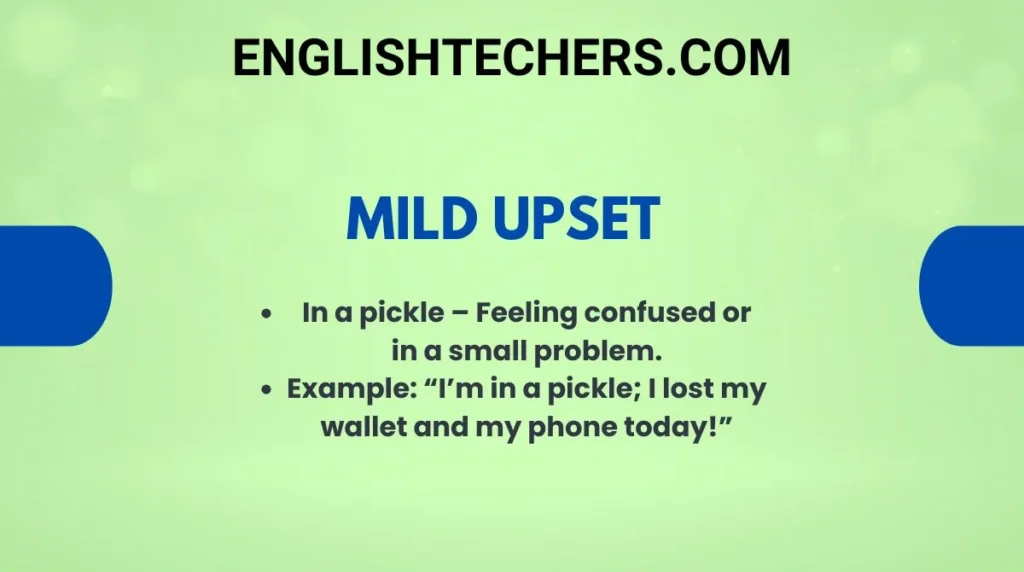
- In a pickle – Feeling confused or in a small problem.
Example: “I’m in a pickle; I lost my wallet and my phone today!” - Up the creek without a paddle – Helpless or stuck.
Micro-story:
Tom forgot his presentation files at home. “Looks like I’m up the creek without a paddle,” he sighed to his colleague.
2. Stressed or Anxious Situations
- Burning the candle at both ends – Overworking yourself.
Example: “She’s burning the candle at both ends with exams and part-time work.” - Between a rock and a hard place – Forced to choose between two bad options.
Dialogue:
Anna: “I can either tell my boss the truth or risk lying and getting caught.”
Ben: “Wow, you’re really between a rock and a hard place.” - In hot water – In trouble with someone.
Mini cultural note: Commonly used in workplaces when someone makes a mistake or breaks a rule.
3. Heartbroken or Disappointed
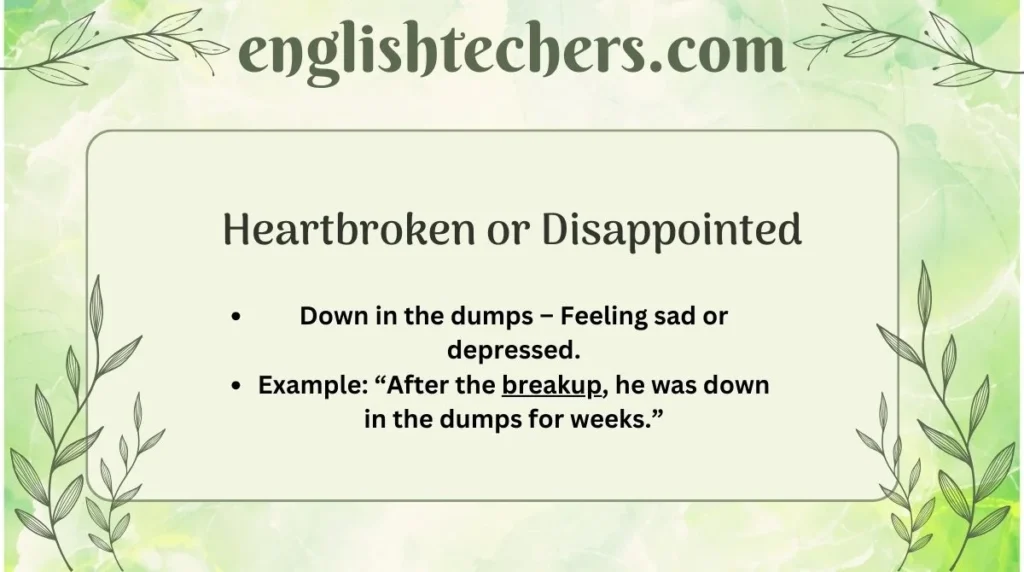
- Down in the dumps – Feeling sad or depressed.
Example: “After the breakup, he was down in the dumps for weeks.” - Bite the dust – Fail or die, often used humorously.
Example: “My phone finally bit the dust after three years.” - Hit rock bottom – Extreme low point emotionally or financially.
Exercise: Make a sentence: “After losing his job, he…”
4. Frustrated or Irritated
- Add fuel to the fire – Make a bad situation worse.
Example: “Telling her about the mistake just added fuel to the fire.” - Go pear-shaped – Things don’t go as planned (common in British English).
Dialogue:
John: “How was the event?”
Lisa: “It went pear-shaped when the speaker didn’t show up!” - Throw in the towel – Give up or admit defeat.
Cultural note: Originally from boxing; widely used in casual and professional contexts.
5. Everyday Life Problems
| Idiom | Meaning | Example |
|---|---|---|
| On the rocks | Facing serious difficulty, often relationships | “Their marriage is on the rocks after constant arguments.” |
| Go down the drain | Wasted effort or opportunity | “All my hard work went down the drain when the computer crashed.” |
| At the end of your rope | Completely stressed or out of patience | “I’m at the end of my rope with these noisy neighbors.” |
Idioms in Professional/Workplace Settings
- Caught between the devil and the deep blue sea – Tough choice at work.
- Drop the ball – Make a mistake or fail to meet expectations.
Example: “I really dropped the ball on that client presentation.” - On thin ice – Doing something risky that could get you in trouble.
Funny or Creative Idioms
- Go control– To become mistaken or frustrated.
Example: “I went control when I realized my suitcase was missing.” - All hell broke loose – Chaos erupted.
Dialogue:
Mark: “How was the party?”
Lucy: “All hell broke loose when the cake fell on the floor!”
Idioms Used by Native Speakers in Real Life
- “I’m up against it” → Facing a difficult challenge.
- “Out of the frying pan, into the fire” → Went from a bad situation to a worse one.
- “In deep water” → Serious trouble; can be used humorously or seriously.
Idioms in Literature
- Shakespeare often used idioms for bad situations. For example:
“The lady doth protest too much, methinks.” → She is in a tricky situation trying to defend herself. - Modern novels use idioms to convey character emotions quickly and vividly.
Exercises / Practice Sentences
Fill in the blanks with suitable idioms:
- After spilling coffee on the boss’s report, I knew I was in ___ ___.
- Losing all his files made him feel like everything went __ ___ ___.
- She had to make a tough choice, truly __ ___ __ ___ ___.
Emotional Scale Table
| Emotion Intensity | Idiom Examples |
|---|---|
| Mild Upset | In a pickle, Up the creek without a paddle |
| Stressed | Burning the candle at both ends, In hot water |
| Frustrated | Go pear-shaped, Add fuel to the fire |
| Heartbroken | Down in the dumps, Hit rock bottom |
How to Use Idioms in Daily Life
- Speaking: Add natural emphasis: “I’m in hot water… big time!”
- Writing: Great for emails, stories, or blogs, but avoid overly casual idioms in formal reports.
- Professional: Idioms like drop the ball or on thin ice are understood in business contexts.
Common Mistakes Learners Make
- Using idioms literally → “I’m in hot water” = Trouble, not literally boiling water.
- Overusing idioms → Makes writing sound unnatural.
- Wrong context → Go control is informal, not suitable for professional emails.
- Mixing idioms → Avoid phrases like “up the creek without a paddle and down in the dumps” in one sentence; it confuses readers.
- Mispronunciation → Some idioms, like pear-shaped, may confuse if mispronounced.
FAQ
Q1: Can idioms for bad situations be used in formal writing?
A1: Generally, informal idioms are best for conversations or storytelling. Use sparingly in formal writing.
Q2: Are idioms the same in American and British English?
A2: Some differ, e.g., go pear-shaped is British; Americans may say went wrong.
Q3: How do idioms help in IELTS speaking?
A3: They demonstrate natural, fluent, and expressive language skills.
Q4: Can I mix idioms in one sentence?
A4: Use one idiom per idea for clarity. Overloading can confuse listeners.
Q5: How to remember idioms?
A5: Group by emotion or context, use them in short stories, and practice in conversations.
Conclusion
Idioms bring color, emotion, and authenticity to English. Whether you’re describing mild frustration, heartbreak, or professional mishaps, these 15+ idioms help you express yourself like a native speaker.
Practice them in daily life, conversations, or even storytelling to make your English sound vibrant and natural. Remember, context matters—choose the right idiom for the right situation.
Start using them today, and notice how people respond to your expressive, fluent speech. Don’t just say you’re in trouble; say you’re in hot water and watch the difference!

Thomas Reed is an experienced English teacher helping students learn with simple, clear lessons.
He focuses on improving speaking, grammar, and confidence through easy daily practice.