
Have you ever felt so thrilled that words like “happy” or “excited” just didn’t cut it? That’s where idioms come in.
Idioms are phrases whose meanings aren’t obvious from the individual words but carry a cultural or emotional punch. They make your English sound natural, expressive, and fun!
Imagine this: Sarah got an email saying she won free tickets to her favorite band’s concert. She could say, “I’m excited,” but a native speaker might say, “I’m over the moon!” Instantly, you feel the intensity of her joy.
Using idioms like this helps you express feelings more vividly, impress listeners, and even score points in exams like IELTS.
In this article, we’ll explore 15+ idioms for being excited, grouped by intensity and context, sprinkled with cultural notes, dialogues, mini-stories, and exercises so learners like you can start using them confidently today.
🎉 Fun Fact About Excitement Idioms
Did you know that the idiom “jump for joy” dates back to the 16th century? People literally imagined jumping as a way to show extreme happiness. Over time, it became figurative but still evokes that pure, uncontrollable excitement we all feel sometimes.
Idioms for Mild Excitement
| Idiom | Example | Notes |
|---|---|---|
| On cloud nine | I was on cloud nine when I passed my driving test. | Used for strong but controlled happiness. |
| Tickled pink | She was tickled pink to receive a handwritten letter from her friend. | Often informal, playful. |
| Over the moon | When he got promoted, he was over the moon. | Very common in UK English. |
| Walking on air | After hearing the good news, she felt like walking on air. | Evokes a light, floating sensation of happiness. |
Mini Story:
Tom waited weeks for his art gallery invite. When it arrived, he felt like he was walking on air. “I can’t believe it!” he said, his smile stretching from ear to ear.
Idioms for Intense Excitement

- Jump for joy – When the team won the championship, the fans jumped for joy.
- Like a kid in a candy store – She was like a kid in a candy store when she entered the bookstore.
- On top of the world – After completing the marathon, he felt on top of the world.
Dialogue Example:
“I just got accepted into Harvard!”
“No way! You must be on top of the world!”
“I am! Like a kid in a candy store, honestly!”
Cultural Tip: Many of these idioms appear in everyday conversation in informal settings, like talking with friends or family.
Idioms in Professional or Workplace Context
Excitement isn’t only personal—it happens at work too.
- Chomping at the bit – The interns were chomping at the bit to start the new project.
- Raring to go – The team was raring to go for the product launch.
- Fired up – Everyone was fired up after the motivational speech.
Usage Warning: Avoid overly casual idioms like tickled pink in formal business emails; stick to fired up or raring to go.
Idioms in Literature
Writers often use idioms to make characters relatable. For example:
- “She was on cloud nine as she danced through the garden, her heart bursting with joy.” – Romantic novels often use on cloud nine.
- “He jumped for joy when he found the lost letter tucked in the library book.” – Classic children’s stories love jump for joy.
Mini Exercise: Identify the idioms in your favorite book or movie. How are they used? Does the intensity match the character’s emotion?
Funny or Creative Idioms
English has some quirky idioms that make excitement fun:
- Bouncing off the walls – Used for hyperactive excitement. “The kids were bouncing off the walls after eating ice cream.”
- Like a dog with two tails – Humorous British idiom. “He was like a dog with two tails when he saw his exam results.”
Dialogue Example:
“Why is Jason running around the office like a maniac?”
“He’s like a dog with two tails! Just got a promotion!”
Emotional Scale Table
| Intensity | Idioms | Example |
|---|---|---|
| Mild | Tickled pink, On cloud nine | She was tickled pink by the surprise gift. |
| Moderate | Over the moon, Walking on air | He was over the moon about his new job. |
| Strong | Jump for joy, On top of the world | They jumped for joy after hearing the good news. |
| Extreme | Like a kid in a candy store, Bouncing off the walls | She was like a kid in a candy store at the toy expo. |
How to Use Idioms in Daily Life
- Speaking: Replace plain words with idioms to show emotion: “I’m excited” → “I’m over the moon!”
- Writing: Add idioms to essays or stories to make descriptions vivid.
- Professional Emails: Use mild excitement idioms like raring to go or fired up to motivate colleagues.
Common Mistakes Learners Make
- Using idioms in the wrong intensity: Saying bouncing off the walls for calm excitement.
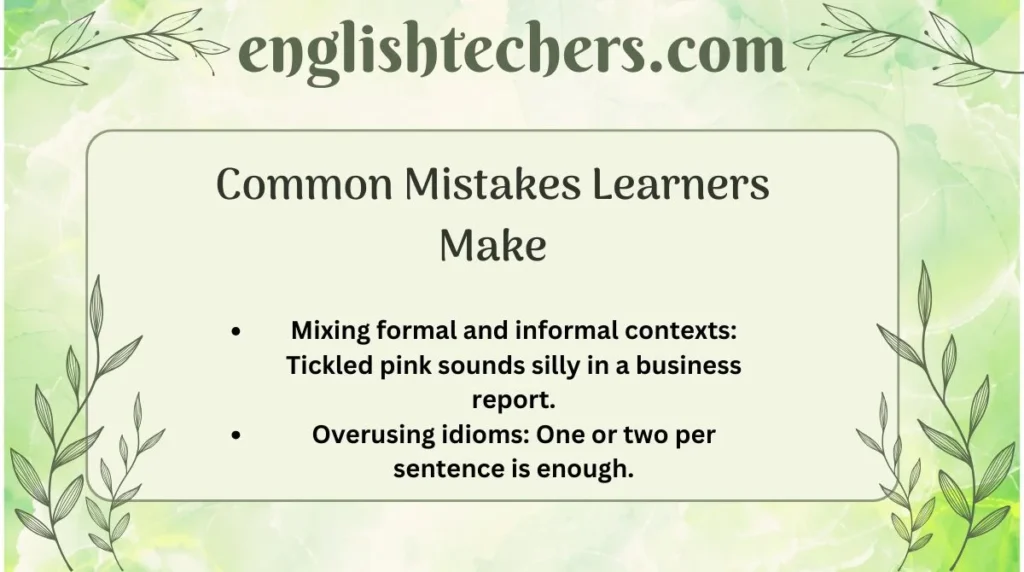
- Mixing formal and informal contexts: Tickled pink sounds silly in a business report.
- Overusing idioms: One or two per sentence is enough.
- Literal interpretation: Jump for joy doesn’t require actual jumping.
Exercises / Practice Sentences
Fill in the blanks with an idiom from the article:
- When she saw the puppy, she was ____________.
- The team was ____________ for the big game.
- He felt ____________ after his first solo performance.
- I was ____________ when my best friend called unexpectedly.
- The children were ____________ after finding the candy stash.
Answer Key: 1. tickled pink, 2. raring to go, 3. on top of the world, 4. over the moon, 5. bouncing off the walls
FAQ
1. Are these idioms used worldwide?
Mostly in English-speaking countries, but many are recognized globally thanks to movies and books.
2. Can I use them in formal writing?
Some, like fired up or raring to go, are acceptable. Avoid overly playful ones like tickled pink.
3. Do idioms always match the literal meaning?
No. Idioms are figurative, so context is key.
4. How can idioms help in IELTS?
They show natural, fluent language and can earn lexical resource points in speaking and writing.
5. Can idioms replace adjectives entirely?
Yes, but use them sparingly for impact. For example, instead of “happy,” you can say on cloud nine.
Conclusion
Idioms bring emotion, color, and life to your English. Whether you’re chatting with friends, writing a story, or giving a presentation, knowing idioms for excitement helps you express feelings naturally and vividly.
Start small—pick a few favorites like over the moon or jump for joy—and sprinkle them into your daily conversations.
Soon, your English will sound more native, playful, and expressive, and you might even notice how people react positively when you do! 🌟

Thomas Reed is an experienced English teacher helping students learn with simple, clear lessons.
He focuses on improving speaking, grammar, and confidence through easy daily practice.