Pregnancy is a special time filled with excitement, change, hope, and sometimes a little worry.
English has many idioms and everyday expressions for pregnancy, and learning them can help you understand conversations, movies, books, social media, and friendly chats more easily.
Some expressions are warm and polite, while others are funny, old-fashioned, informal, or even rude in certain situations.
For example, imagine a friend smiling and saying, “We have a little one on the way!” You immediately understand that a baby is coming, even though the word pregnant was never used.
Another friend might say, “She has a bun in the oven,” which sounds strange if you hear it literally.
Of course, there is no bun in an oven! It is a playful way to say that someone is pregnant.
In this guide, you will discover 40+ pregnancy idioms and expressions, their meanings, examples, cultural notes, usage warnings, and practical exercises.
By the end, you will be able to recognize these expressions and use the most natural ones with confidence.
Fun Fact: Why Is There a “Bun” in the Oven?
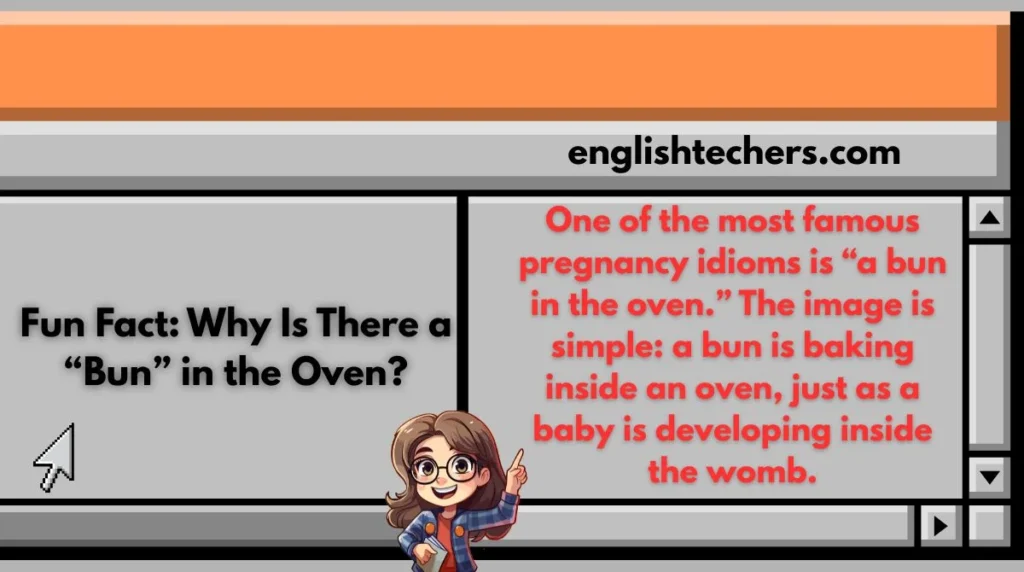
One of the most famous pregnancy idioms is “a bun in the oven.” The image is simple: a bun is baking inside an oven, just as a baby is developing inside the womb.
The expression became popular in informal English because it creates a funny mental picture without directly saying that someone is pregnant.
Example:
“Did you hear the news? Sarah has a bun in the oven!”
It is usually playful and friendly, but it is better used with people you know well.
Everyday Idioms and Expressions for Pregnancy
1. Have a bun in the oven
This is one of the most common playful idioms for pregnancy.
Meaning: To be pregnant.
Example:
“Lisa has a bun in the oven, so she is taking things a little easier these days.”
It is informal and often used in friendly conversations.
2. Have a baby on the way
This expression means that someone is expecting a baby soon.
Example:
“Congratulations! I heard you have a baby on the way.”
It sounds warm and natural, making it a good choice for casual conversation.
3. Be expecting
“Expecting” is one of the most common polite ways to talk about pregnancy.
Example:
“Maria is expecting her first child.”
It is much more appropriate in polite conversation than some slang expressions.
4. Have a little one on the way
This expression focuses on the baby rather than the pregnancy.
Example:
“They are very excited because they have a little one on the way.”
It has a warm, affectionate tone.
5. Be with child
“With child” is an old-fashioned expression meaning pregnant.
You may see it in historical novels, older writing, or stories about past societies.
Example:
“The young woman was with child when she returned to her family.”
It sounds formal or literary in modern English.
6. Be in the family way
This is another traditional expression for being pregnant.
Example:
“Everyone knew she was in the family way.”
Today, it can sound old-fashioned, so it is more common in historical or humorous contexts.
7. Have a little one
This can refer to having a baby, especially when discussing a pregnancy or young child.
Example:
“They’re going to have a little one in December.”
It is gentle and affectionate.
8. Have another mouth to feed
This expression does not directly mean pregnancy. It means that a family will soon have another person who needs food and care.
Example:
“With the baby coming, they joked that they would have another mouth to feed.”
It can be humorous, but it should be used sensitively.
Informal and Humorous Pregnancy Expressions
Some pregnancy expressions are common in casual English but are not suitable for every situation.
9. Knocked up
Meaning: Pregnant.
Example:
“She got knocked up at a young age.”
Usage warning: This expression is very informal and can sound rude, judgmental, or disrespectful. Learners should usually choose pregnant or expecting instead.
10. Up the duff
This is informal British and Australian English.
Meaning: Pregnant.
Example:
“She found out she was up the duff.”
It is slang, so avoid it in professional or formal situations.
11. Up the spout
This is an older British expression that has been used to mean pregnant.
Example:
“The character discovers that she is up the spout.”
It is uncommon today and may sound humorous or old-fashioned.
12. In the pudding club
This is an old British slang expression for being pregnant.
Example:
“The novel jokingly says that she has joined the pudding club.”
It is not a normal modern expression for everyday professional English.
13. In a delicate condition
This older expression was sometimes used as a polite indirect reference to pregnancy.
Example:
“She was said to be in a delicate condition.”
The phrase can also refer to general physical or emotional weakness, so context matters.
14. In a family way
This variation of “in the family way” has been used as a euphemism for pregnancy.
Example:
“The old story hints that she was in a family way.”
It is mainly useful when reading older English.
Expressions About Pregnancy and the Baby
Not every useful phrase directly means “pregnant.” Some describe the arrival of a baby.
| Expression | Meaning | Tone |
|---|---|---|
| Baby on the way | A baby is expected | Warm |
| Little one on the way | A baby is coming | Affectionate |
| Expecting a baby | Pregnant | Neutral |
| Expecting a child | Pregnant | Neutral |
| Starting a family | Beginning family life, often with children | Neutral |
| Growing their family | Having another child | Warm |
| Welcoming a new arrival | A baby is arriving | Warm |
| Awaiting the arrival | Waiting for the baby | Polite |
| Preparing for the new arrival | Getting ready for a baby | Neutral |
| Counting down to the due date | Waiting for the expected birth | Casual |
15. Starting a family
This phrase often refers to having children for the first time.
Example:
“After getting married, they decided it was time to start a family.”
It does not always mean someone is already pregnant.
16. Growing the family
This is a friendly expression for having another child.
Example:
“They are excited about growing their family.”
17. Welcoming a new arrival
A new arrival often means a newborn baby.
Example:
“The whole family is preparing to welcome the new arrival.”
This phrase is especially useful in announcements.
18. The baby is due
This means the baby is expected to be born around a particular time.
Example:
“The baby is due in early November.”
19. The due date is approaching
This refers to the expected date of birth.
Example:
“Her due date is approaching, so the family is getting everything ready.”
20. Counting down to the big day
The big day can refer to the expected birth.
Example:
“They are counting down to the big day.”
It is cheerful and informal.
Pregnancy Expressions You May Hear in Real Life

Native speakers often avoid repeating the word pregnant. They may choose softer expressions depending on the relationship and situation.
Dialogue:
Emma: “Why isn’t Sarah joining us tonight?”
Nina: “She isn’t feeling very energetic.”
Emma: “Oh, is everything okay?”
Nina: “Yes! She’s expecting, actually.”
Emma: “That’s wonderful news!”
Notice how “she’s expecting” sounds natural, polite, and friendly.
Another conversation might be more playful:
Tom: “Why is everyone congratulating Mark?”
James: “His wife has a bun in the oven.”
Tom: “Ah, they’re having a baby!”
The meaning becomes clear from context.
Pregnancy Idioms in Literature and Older English
If you read classic novels, historical fiction, or older English texts, you may encounter expressions that are rare in modern conversation.
21. With child
This expression appears frequently in historical writing.
22. In the family way
A traditional euphemism for pregnancy.
23. In a delicate condition
An indirect and old-fashioned reference to pregnancy.
24. In an interesting condition
This expression has sometimes been used humorously as a euphemism for pregnancy.
Example:
“The older character says that the young woman is in an interesting condition.”
Today, it is more likely to sound humorous than natural.
25. In an interesting way
Older or humorous writing may use indirect language instead of directly saying someone is pregnant.
These expressions are valuable because understanding an idiom does not always mean you should use it yourself. Reading ability and speaking ability require slightly different knowledge.
Professional and Polite Expressions
In the workplace, pregnancy should usually be discussed with clear and respectful language.
The safest choices include:
- She is pregnant.
- She is expecting.
- She is expecting a baby.
- They are expecting their first child.
- She is due in September.
- They are preparing for the arrival of their baby.
Avoid slang such as “knocked up” or “up the duff” in professional communication.
Workplace example:
“Anna is expecting a baby in October, so she will be taking parental leave later this year.”
This is clear, respectful, and appropriate for professional English.
Funny Pregnancy Expressions and Creative Twists
English speakers love humor, so pregnancy often inspires playful expressions.
26. Bun in the oven
A classic playful image for pregnancy.
27. Baby on board
This phrase became especially familiar through car signs and stickers.
Example:
“They put a baby-on-board sign in the car.”
It refers to the baby rather than directly describing pregnancy.
28. Eating for two
This humorous expression suggests that a pregnant person needs to eat more because they are supporting a developing baby.
Example:
“She joked that she was eating for two.”
Cultural note: It is often used jokingly, but it should not be treated as medical advice.
29. Got a baby cooking
A playful variation based on the idea of something developing or “cooking.”
Example:
“They announced that they’ve got a baby cooking.”
This is very informal and creative.
30. The stork is coming
The stork is traditionally associated with bringing babies.
Example:
“Looks like the stork is coming to their house!”
It is playful and often used with children.
31. The stork is on the way
Another humorous variation.
Example:
“Get ready—the stork is on the way!”
32. A little bundle of joy
This affectionate expression usually describes a newborn baby.
Example:
“They can’t wait to meet their little bundle of joy.”
Idioms About the Changes of Pregnancy
Pregnancy involves many physical and emotional changes. Some expressions describe these changes without directly naming pregnancy.
33. Showing
When someone’s pregnancy becomes visibly noticeable, they may be described as showing.
Example:
“She is starting to show now.”
34. Have a baby bump
A baby bump is the visible rounded shape of the abdomen during pregnancy.
Example:
“Her baby bump is starting to show.”
This is common and informal.
35. Growing a baby
This phrase emphasizes the process of pregnancy.
Example:
“She is growing a baby, so she needs plenty of rest.”
It is casual and affectionate.
36. Feel the baby kick
This is not a true idiom, but it is a common pregnancy expression.
Example:
“Her partner was excited to feel the baby kick for the first time.”
37. Have a little miracle on the way
This affectionate phrase describes an expected baby.
Example:
“They have a little miracle on the way.”
It is emotional rather than literal.
38. Expecting a bundle of joy
This combines expecting with the affectionate phrase bundle of joy.
Example:
“They are expecting a bundle of joy in December.”
Emotional Scale: From Simple to Playful
| Expression | Style | Intensity |
|---|---|---|
| Expecting | Neutral | Mild |
| Expecting a baby | Neutral | Mild |
| Baby on the way | Warm | Mild |
| Baby is due | Neutral | Mild |
| Starting a family | Warm | Mild |
| Growing the family | Warm | Mild |
| Little one on the way | Affectionate | Warm |
| Bundle of joy | Affectionate | Warm |
| Bun in the oven | Humorous | Playful |
| Eating for two | Humorous | Playful |
| Stork is coming | Humorous | Playful |
| Up the duff | Slang | Strongly informal |
| Knocked up | Slang | Potentially offensive |
How Native Speakers Choose the Right Expression
The relationship between speakers matters.
With close friends:
“She’s got a bun in the oven!”
In ordinary conversation:
“She’s expecting.”
At work:
“She’s expecting a baby.”
In a formal announcement:
“We are delighted to announce that we are expecting our first child.”
In a historical novel:
“She was with child.”
The key lesson is simple: natural English depends on context, not just vocabulary.
Common Mistakes Learners Make
Mistake 1: Using slang in formal situations
Saying “She’s knocked up” at work can sound disrespectful.
Use:
“She’s expecting.”
Mistake 2: Thinking every expression is a true idiom
Expressions such as “baby on the way” and “baby bump” are common phrases, but they are not necessarily idioms in the strict linguistic sense.
Learning both idioms and common expressions gives you a more natural vocabulary.
Mistake 3: Translating idioms word for word
If someone says:
“She has a bun in the oven.”
Do not imagine an actual bun.
The phrase means:
“She is pregnant.”
Mistake 4: Using old expressions as modern slang
“With child” is understandable but sounds old-fashioned in modern everyday conversation.
Mistake 5: Assuming every expression works everywhere
British, American, and Australian English can have different slang expressions. Always consider the audience and situation.
Practice: Choose the Natural Expression
Complete each sentence with a suitable expression.
- Maria is ________, and the baby is due in December.
- They have a little ________ the way.
- John joked that his wife has a ________ in the oven.
- The old novel says that the woman was ________ child.
- The family is excited to welcome the new ________.
Answers
- expecting
- one on
- bun
- with
- arrival
Mini Practice Dialogue
Try reading this dialogue aloud:
A: “Have you heard the news?”
B: “No. What happened?”
A: “Daniel and Mia are expecting!”
B: “Really? That’s wonderful!”
A: “Yes. They have a little one on the way.”
B: “When is the baby due?”
A: “In January.”
Now replace “expecting” with:
- having a baby on the way
- growing their family
- welcoming a new arrival
Notice how each option changes the feeling slightly.
How to Use Pregnancy Idioms in Daily Life
Speaking
Use “expecting,” “baby on the way,” and “little one on the way” when talking with friends or family.
Writing
For social posts or personal messages, expressions such as “bundle of joy” and “new arrival” can make your writing warmer.
Professional English
Choose direct and respectful language:
“We are expecting our first child.”
Avoid slang unless you are discussing informal language itself.
Creative Writing
Older expressions such as “with child” can help create a historical atmosphere.
Humor
Use expressions such as “bun in the oven” only when the relationship and situation make playful language appropriate.
FAQs
Is “bun in the oven” a polite way to say pregnant?
It is generally a friendly and humorous expression, but it is informal. “Expecting” is a safer choice when you are unsure about the situation.
Is “knocked up” rude?
It can sound rude, judgmental, or overly casual. It is slang and should normally be avoided in formal or professional English.
Is “with child” still used today?
It is understandable but old-fashioned. You are more likely to find it in literature, historical writing, or traditional expressions than in everyday speech.
Can I use pregnancy idioms in IELTS?
Yes, but use them naturally. IELTS rewards clear and appropriate vocabulary, not unusual idioms used only to sound advanced. “Expecting a baby” is often better than forcing a rare expression into an answer.
Are pregnancy expressions the same in every English-speaking country?
No. British, American, Australian, and other varieties of English can use different slang and traditional expressions. “Expecting” and “baby on the way” are widely understandable, while some slang terms are strongly regional.
Conclusion
Pregnancy gives English learners a fascinating collection of idioms, euphemisms, slang, and affectionate expressions.
From “bun in the oven” and “baby on the way” to the old-fashioned “with child,” these phrases show how language can describe the same idea in many creative ways.
The most important lesson is to choose expressions according to context, audience, and tone.
Start with natural phrases such as “expecting” and “baby on the way,” then explore the more humorous and literary expressions as your vocabulary grows. Try using a few of these phrases

Thomas Reed is an experienced English teacher helping students learn with simple, clear lessons.
He focuses on improving speaking, grammar, and confidence through easy daily practice.