Have you ever struggled to express exactly what you feel in English? Or perhaps you wanted to sound more natural in conversations but found your sentences a bit stiff? Idioms are your secret weapon.
These colorful expressions are phrases where the meaning isn’t literal but carries a special nuance. They can instantly make your speech more lively, relatable, and native-like.
Imagine this: Sarah, a language learner, was nervous about giving a presentation at work. She practiced endlessly, trying to make her sentences perfect.
On the big day, instead of speaking word-for-word from her notes, she used idioms like “hit the nail on the head” and “break the ice”. Suddenly, her speech felt smooth and confident.
People connected with her words, and she even got compliments for sounding natural. This is the power of idioms—they convey meaning, emotion, and personality in ways that plain words often cannot.
Whether you’re learning English for travel, exams, or everyday conversations, mastering idioms related to speaking can make a huge difference. Let’s explore 23+ idioms that will transform the way you express yourself.
Fun Fact / Trivia 🧐
Did you know? English idioms often come from historical events, literature, or old professions. For instance, “tongue-tied” originally referred to someone literally unable to speak clearly because of a physical condition, but now it describes anyone struggling to find words.
Idioms for Speaking – Grouped by Context & Emotion
1. Daily Life Conversations
These idioms are perfect for casual chats or social situations.
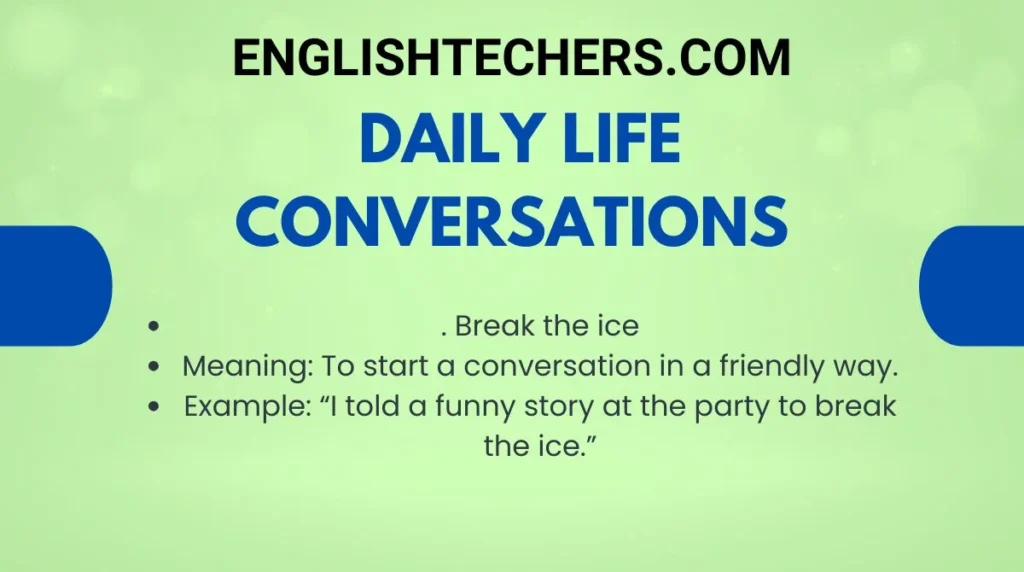
1. Break the ice
Meaning: To start a conversation in a friendly way.
Example: “I told a funny story at the party to break the ice.”
2. Shoot the breeze
Meaning: To chat casually without any serious topic.
Dialogue Example:
- Tom: “Want to grab coffee?”
- Anna: “Sure! Let’s just shoot the breeze for a while.”
3. Small talk
Meaning: Polite conversation about unimportant things.
Mini Tip: Small talk is essential in Western cultures to create comfort before deep conversations.
2. Expressing Confidence or Praise
Idioms for speaking that highlight accuracy or eloquence.
4. Hit the nail on the head
Meaning: Say something exactly right.
Example: “When you said the project needs teamwork, you really hit the nail on the head.”
5. Speak volumes
Meaning: Communicate clearly without words or in a way that shows much.
Cultural Note: Often used to describe silent messages, e.g., body language.
6. Have a way with words
Meaning: Be especially good at speaking.
Dialogue Example:
- Lucy: “I love how Mark explains things.”
- Kate: “Yes, he really has a way with words.”
3. Frustration & Mild Upset
Idioms for when speaking gets tricky or stressful.
7. Tongue-tied
Meaning: Unable to speak clearly due to nerves.
Example: “I was tongue-tied during the interview.”
8. Cat got your tongue?
Meaning: Said to someone who suddenly stops talking.
Dialogue Example:
- Mom: “Cat got your tongue?”
- Kid: “…I’m just thinking.”
9. Beat around the bush
Meaning: Avoid speaking directly.
Mini Exercise: Rewrite this sentence using the idiom: “Stop avoiding the question and tell me the truth!”
4. Stressful or Intense Situations
Idioms for professional or high-pressure settings.
10. Talk someone’s ear off
Meaning: Speak for too long.
Example: “He can talk your ear off about movies for hours.”
11. Call the shots
Meaning: Be in control of a conversation or decision.
Cultural Note: Often used in workplace settings or negotiations.
12. On the tip of your tongue
Meaning: You almost remember something but not quite.
Dialogue Example:
- John: “What’s the name of that actor?”
- Sarah: “It’s on the tip of my tongue!”
5. Humor & Playful Idioms
For light-hearted conversations.
13. Spill the beans
Meaning: Reveal a secret.
Example: “Who spilled the beans about the surprise party?”
14. Talk turkey
Meaning: Discuss serious matters.
Dialogue Example:
- Boss: “Let’s talk turkey about your promotion.”
15. Chew the fat
Meaning: Chat leisurely, often humorously.
Mini Tip: Mostly informal; perfect for friendly conversations.
6. Literature & Writing
Idioms commonly found in books and speeches.
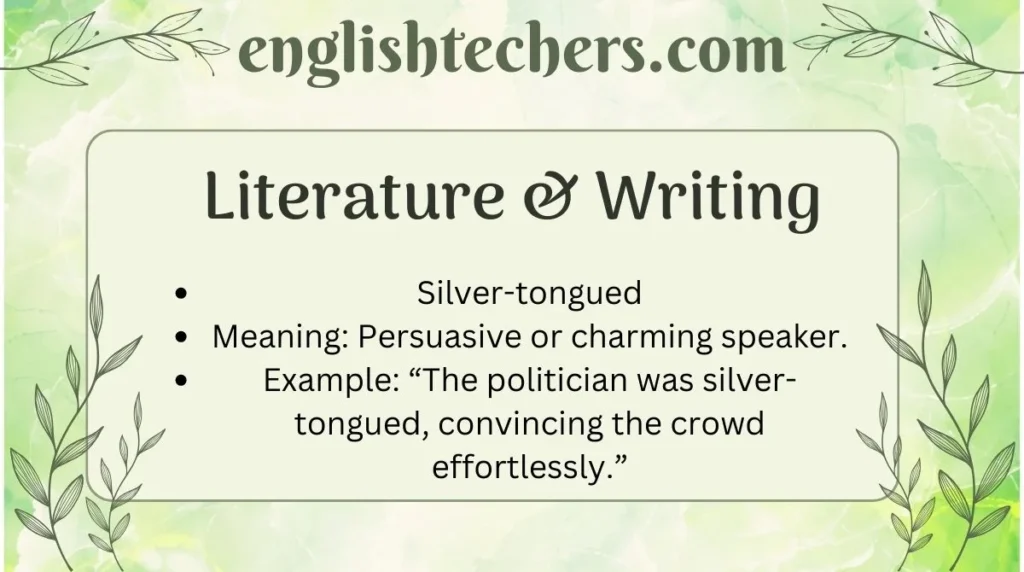
16. Silver-tongued
Meaning: Persuasive or charming speaker.
Example: “The politician was silver-tongued, convincing the crowd effortlessly.”
17. Hold your tongue
Meaning: Stay silent.
Mini Exercise: Try using this in a polite disagreement.
18. Read between the lines
Meaning: Understand the hidden meaning.
Cultural Note: Often used in literature analysis and critical thinking.
7. Workplace & Professional Settings
Idioms for presentations, meetings, and corporate conversations.
19. Get a word in edgewise
Meaning: Manage to speak when others are talking too much.
Dialogue Example:
- Colleague: “I couldn’t get a word in edgewise during the meeting.”
20. In a nutshell
Meaning: Explain something briefly.
Example: “In a nutshell, the project is delayed due to supply issues.”
21. Plain speaking
Meaning: Speak clearly and directly.
Cultural Note: Valued in Western workplaces for honesty and efficiency.
8. Emotional Intensity Table
Here’s a quick visual for learners to grasp intensity of idioms:
| Emotion/Intensity | Mild | Moderate | Intense |
|---|---|---|---|
| Frustration | Tongue-tied | Beat around the bush | Talk someone’s ear off |
| Confidence | Hit the nail on the head | Speak volumes | Silver-tongued |
| Humor / Lighthearted | Spill the beans | Chew the fat | Talk turkey |
Extra Value: Idioms in Real Life
- Native speakers: Often mix idioms naturally, e.g., “I was tongue-tied, but then he helped me break the ice.”
- Movies & Literature: Authors use idioms to show character personality.
- Professional emails: Keep idioms formal, e.g., “To put it in a nutshell, the proposal is approved.”
Practice Exercises for Learners
Fill in the blanks with the correct idiom:
- I wanted to tell her the secret, but I accidentally __________.
- Don’t __________! Say what you really mean.
- During the debate, I could hardly __________.
Answer Key:
- spilled the beans
- beat around the bush
- get a word in edgewise
How to Use Idioms in Daily Life
- Speaking: Add one or two idioms per conversation naturally.
- Writing: Use sparingly in essays or emails for emphasis.
- Professional: Stick to workplace-appropriate idioms like “in a nutshell” or “plain speaking.”
Common Mistakes Learners Make
- Literal translation: “Break the ice” ≠ smashing actual ice.
- Overusing idioms: Can sound unnatural.
- Wrong context: “Spill the beans” in formal emails is too casual.
- Mixing idioms: Don’t say “hit the beans on the head.”
- Pronunciation: Mispronouncing “tongue-tied” changes clarity.
FAQ
1: Can I use idioms in formal writing?
A: Use sparingly. Stick to professional ones like “in a nutshell” or “plain speaking.”
2: Are idioms the same in British and American English?
A: Many are shared, but some differ. For example, Brits say “Bob’s your uncle” instead of “voila.”
3: How do idioms help in IELTS speaking?
A: Using 2–3 relevant idioms can show natural language use and boost fluency scores.
4: Can idioms sound rude?
A: Yes, some idioms are informal or sarcastic. Always consider context.
5: How do I remember idioms easily?
A: Practice with short dialogues, mini-stories, and real-life situations.
Conclusion 🌟
Idioms are more than just words—they’re expressions of culture, emotion, and personality. By learning these 23+ idioms for speaking, you can make your English richer, more confident, and fun.
Start small, use them in daily chats, and watch your conversations come alive. Remember, even native speakers mix idioms casually—so don’t be afraid to experiment! Start speaking like a pro today, and let idioms give your words that extra sparkle. ✨

Thomas Reed is an experienced English teacher helping students learn with simple, clear lessons.
He focuses on improving speaking, grammar, and confidence through easy daily practice.